Stealth startup jobs are exactly what they sound like: roles at a company that’s operating in secret. These startups are deliberately flying under the radar, keeping public attention at bay while they build something completely new. Think of it as being invited to a secret, early screening of a film that’s destined to be a blockbuster.
You know how major movies are sometimes filmed under a code name to keep the plot from leaking? A stealth startup runs on the same principle. It’s a brand-new company, often with visionary founders and serious venture capital backing, that keeps its mission, product—and sometimes its very existence—a closely guarded secret.
This isn't about being mysterious for the sake of it. It’s a calculated business move. The whole point is to build up a massive competitive advantage without alerting bigger, more established companies who could easily copy the idea and muscle them out of the market.
Founders go into stealth mode for a few critical reasons, all aimed at protecting their creation and giving it the best possible shot at success once it launches.
The main drivers usually boil down to this:
A stealth startup is a bet on the power of surprise. It’s the belief that by the time competitors see you, you’ll already be too far ahead for them to catch up.
Joining a stealth startup means you’re on a small, hyper-focused team building something that could genuinely change the game, and almost no one else knows it exists yet. It’s a high-stakes, high-impact environment where your work directly shapes the company’s future, all while preparing for an explosive entry into the market.

Let's be clear: pursuing stealth startup jobs isn't for everyone. It's a high-stakes bet on yourself, an unproven idea, and a small group of people trying to do something no one has done before. Think of it less like taking a new job and more like signing up for an expedition into uncharted territory.
On one hand, the potential upside is career-defining. On the other, the risks are very real and can lead straight to burnout or a dead-end if things go south. Understanding this delicate balance is the first step in figuring out if you're cut out for this world.
The biggest draw of joining a stealth startup is the sheer scale of your impact. When the team is smaller than 20 people, you won't just be maintaining a feature; you'll be building core systems from scratch. As the first product manager, for example, you would define the entire product roadmap, not just a small part of it.
And then there's the equity. While the salary might be competitive, the stock options are the real lottery ticket. If the company takes off and has a successful exit, that equity could be life-changing. This powerful sense of ownership, both in your daily work and in the company’s future, is what gets early-stage employees out of bed in the morning.
But for every potential reward, there's a corresponding risk. The most glaring challenge is the constant uncertainty. You're betting on an idea that hasn't found product-market fit, and you'll feel the pressure of a ticking clock tied to a limited funding runway. It’s a stressful environment where last month's priority might be completely irrelevant today.
The reality of a stealth startup is that you are building the plane while it's taxiing down the runway. Success depends on achieving liftoff before you run out of fuel, and there are no guarantees.
There's another thing to consider: if the startup fails, you won't have a big, recognizable brand name to put on your resume. You'll need to get good at explaining what you did and why it mattered, without being able to point to a well-known product or public success story. For example, you’ll have to articulate, "I built a scalable backend for a consumer application that reached 10,000 beta users before the company was acquired for its technology."
To help you get a clearer picture, here is a practical breakdown of the key trade-offs you'll be making. This isn't an exhaustive list, but it covers the main things you should be thinking about before you take the leap.
Ultimately, the decision comes down to your personal risk tolerance and what you value most at this stage in your career. Are you looking for stability and a clear path, or are you hungry for impact and willing to embrace the chaos for a shot at something big? Only you can answer that.
You won’t stumble across true stealth startup jobs on massive, public job boards. These gigs are part of a hidden job market, open only to people who know where—and how—to look. Landing one requires you to switch from passively applying to actively hunting.
Think of yourself as a detective. Your first clue is almost always the money, which means starting with the people who fund these secret ventures: venture capital (VC) firms. The portfolio pages of top-tier VCs are a treasure map pointing to the next big thing.
Start by making a list of 5-10 VC firms known for backing companies at the earliest stages—think Sequoia Capital, Andreessen Horowitz (a16z), or Lightspeed Venture Partners. Scour their websites for portfolio companies that are listed with a vague description and no public-facing website, often just a logo.
These are your prime suspects. Once you have a name, your next move is to find the people. Use LinkedIn to search for the company and identify the founders or the first few employees. Your goal is to send a targeted connection request with a message like: "Hi [Founder Name], I saw your new venture is backed by [VC Firm] and focuses on [Industry]. My experience in [Your Skill] aligns with this space, and I'd be excited to learn more about the problems you're solving."
The most exclusive opportunities are never advertised. They are filled through trusted networks and direct outreach long before a formal job description is ever written. Being proactive is your only way in.
LinkedIn is your best tool for this kind of search, but you have to get creative. Forget searching for job titles. Instead, search for the coded phrases that founders and early hires use to describe what they’re doing without breaking confidentiality.
Try plugging these specific queries into the main LinkedIn search bar (use quotation marks to make them exact):
Set up alerts for these searches. This will deliver a steady stream of profiles of people actively building unlaunched products. From there, you can figure out the company name and start your outreach. It’s a direct line to the decision-makers who are hiring.
While most recruiters work with established companies, a small handful specialize in the early-stage ecosystem. These folks have the inside track on founders who are quietly assembling their first teams. Sure, some companies openly list their available startup positions on a dedicated page, but for the truly confidential roles, you need a curated network.
Getting involved with platforms focused on discreet job searches can give you a serious edge. Many candidates find their way into unannounced companies through confidential career services that connect them directly with hiring managers. We break down how to approach these types of moves in our guide to confidential career transitions.
The pay for these roles often reflects their exclusive nature. The national average salary for a stealth startup employee is $107,881 per year, though location makes a big difference. For instance, employees in New York pull in a 9% premium, averaging $117,943. And despite the intense pace, employees give their work-life balance a surprisingly strong 4.1 out of 5 stars, suggesting the rewards often justify the risks.
Saying "yes" to a stealth startup is a massive leap of faith. You're not just taking a new job; you're betting on an unproven idea and a brand that doesn't exist yet. That’s why doing your homework isn't just a good idea—it's absolutely critical to protect your career. You have to look past the slick pitch and get into the weeds of the business itself.
Your investigation needs to stand on three pillars: the team, the money, and the market. To really get the full picture, you need to go beyond the surface and start performing fundamental analysis on the company’s core leadership and its chances of survival. This means asking the tough questions that reveal what’s really going on behind the curtain.
The founding team is, without a doubt, the single biggest predictor of an early-stage startup's success. Don't just glance at their LinkedIn profiles. A founder’s impressive tenure at Google or Meta doesn't automatically mean they can handle the scrappy, chaotic reality of building something from nothing.
During your interviews, ask specific, behavioral questions that force them to provide real examples:
Their answers here are gold. You're looking for humility, evidence of learning from mistakes, and a clear process for making hard decisions.
For a startup, especially one in stealth mode, funding is oxygen. You need to know more than just how much money they’ve raised. Who gave it to them? What are the strings attached? If a founder is cagey about their financials, that’s a huge red flag.
A founder who is transparent about their runway, burn rate, and the milestones tied to their next funding round is a founder who respects their team as partners in the venture. Secrecy around financials often signals deeper problems.
Ask direct, practical questions about their financial stability. A great one is, "Based on your current burn rate and headcount plan, what is your projected runway in months? What are the key metrics you need to hit to secure your next round of funding?" This shows you’re thinking like a co-owner, not just an employee. It’s also vital to gauge the company culture from these limited interactions. Combining your financial questions with a sharp cultural assessment will give you a much clearer picture of what you’re walking into. You can learn more about how to do this in our guide on how to vet startup culture in our detailed guide. By putting it all together, you can make a decision based on evidence, not just excitement.
Getting an offer from a stealth startup can feel a little strange. It's one part salary, one part lottery ticket—and that lottery ticket comes in the form of equity. Figuring out how to weigh this blend is everything, because your stock options often hold way more potential value than your base pay ever will.
Evaluating the offer means you have to look past the immediate paycheck. Sure, your base salary needs to be competitive, but the real long-term wealth is hiding in your equity stake. This is your reward for betting on an unproven idea.
Equity can feel intimidating, but it really boils down to a few key ideas. Think of it like this: you’re being given a special coupon to buy company stock at a fixed, super-low price sometime in the future. If the company takes off and its stock value skyrockets, that coupon becomes incredibly valuable.
To make an informed decision, you must get these numbers from the founder:
If you want to go deeper into the mechanics of how this all works, our guide on startup equity basics for job seekers is the perfect next step.
This diagram breaks down the key areas to dig into when you're vetting a startup, including the people behind it, the money backing it, and the market they're going after.
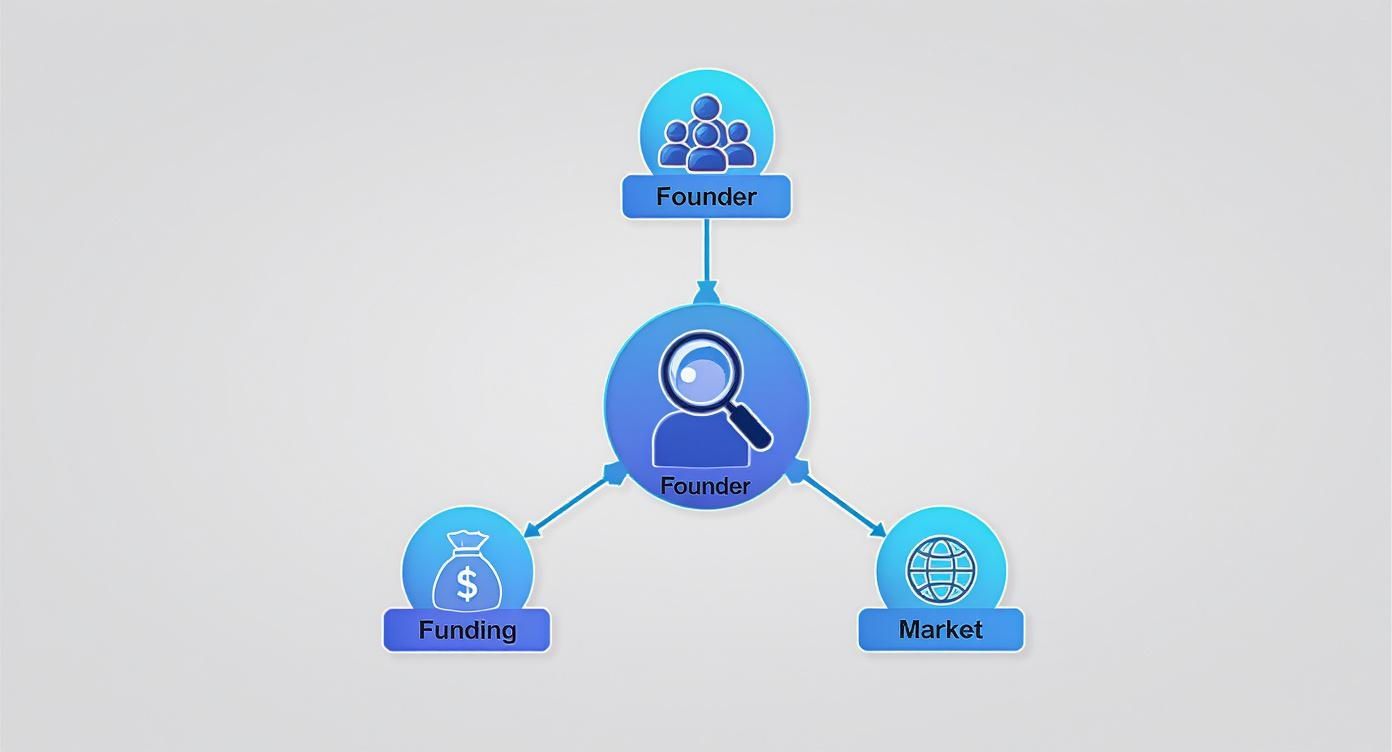
As you can see, a company's potential is directly tied to the strength of its founders, the stability of its funding, and the size of its market opportunity.
While equity holds the promise of future wealth, your salary has to cover your bills right now. The good news? Stealth startups often pay surprisingly well to attract top talent who are willing to take a leap of faith.
An offer from a stealth startup should feel compelling on both fronts. The salary should be strong enough to make you feel valued today, while the equity should be significant enough to represent a life-changing outcome tomorrow.
Recent data shows just how competitive these roles can be. To give you an idea of what to expect, here’s a look at some average salaries for key roles inside stealth startups.
As you can see, these aren't your typical startup salaries. The average software engineer at a stealth startup pulls in $193,000 a year, with the top earners clearing over $279,000. Even new grads are starting with an average annual salary of $167,000—a number that holds its own against offers from the big tech giants.
By getting a handle on both your salary and your equity, you can walk into negotiations ready to secure a package that truly reflects your value.
Working in stealth mode is a whole different ballgame, and it naturally comes with questions you wouldn't ask in a typical job hunt. The secrecy and ambiguity can be tricky to navigate. Let's clear up some of the most common things candidates wonder about.
Getting these answers straight will help you figure out if this path is right for you and get you ready for the unique interview process. It’s all about protecting the company’s secrets while still showing future employers what you’re made of.
You can’t just drop the company name, but you absolutely can—and should—showcase the incredible work you did. The trick is to use a descriptive placeholder that hints at the company's profile without giving anything away.
A practical example would be: "Senior Engineer at Series A FinTech Startup ($20M raised, Stealth Mode)". This signals legitimacy and prestige without violating your NDA.
When describing your role, focus on quantifiable achievements. Instead of saying "built new features," write: "Architected and launched the core transaction processing system, handling over 10,000 transactions in our private beta and reducing data processing times by 40%." This tells a powerful story while keeping the company's mission under wraps.
You should expect to sign a Non-Disclosure Agreement (NDA) very early on, often before you even get to the first technical interview. Don't be alarmed by this; it’s standard practice and actually a great sign. It means the founders are serious about protecting their intellectual property.
This document is a legal promise that you won't share confidential details about the product, team, or strategy. Most are pretty straightforward, but always take a moment to read it.
Pay special attention to any non-compete clauses. Some can be overly broad and might unfairly limit where you can work next. If a clause seems too restrictive, it's reasonable to ask, "Could you clarify the scope of this non-compete? I want to ensure it doesn't unintentionally prevent me from working in broad fields like 'software development' in the future."
While engineers are almost always the first hires—someone has to build the thing, after all—they aren't the only ones. In the very early days, founders often bring on product managers and UX/UI designers to help translate their vision into a tangible product.
As the product starts taking shape and a launch is on the horizon, other key roles start popping up. For instance, once there's a functional beta, you'll see founders looking for their first marketing, sales, or operations hires to start building a waitlist, creating launch materials, or setting up internal systems for growth. That said, during the deep stealth phase, technical roles are by far the most common.
Intense. Fast. All hands on deck. With a tiny team, often under 20 people, job titles are more like guidelines. An engineer might be asked to help with customer support calls to get direct user feedback, or a designer might contribute to writing marketing copy for the initial website.
There’s a massive sense of ownership because every line of code you write or decision you make has a direct and immediate impact. It’s demanding, for sure, but the culture is ultimately a reflection of the founders' personalities. Prepare for some serious crunch time before big milestones, but you'll be part of a tight-knit crew trying to build something from nothing.
Ready to explore the most exciting and confidential opportunities in the tech world? Underdog.io connects top talent with vetted, high-growth startups. With one application, you get access to a curated marketplace where innovative companies apply to you. Find your next big thing on Underdog.io.