An early-stage startup job isn't just a title—it's a ticket to the front lines of building something from scratch. These roles, usually found in pre-seed, seed, and Series A companies, demand a unique mix of skill and scrappiness. You're not just executing tasks; you're directly shaping the company's product and its future.

Imagine being part of a small crew building a ship while it’s already sailing. That’s the closest you’ll get to describing life at an early-stage startup. Your mission isn't just to man a single station; it's to do whatever it takes to keep the entire ship afloat and pointed toward the horizon.
This world is defined by ambiguity, speed, and an incredible amount of ownership. Forget the rigid roles of established corporations. At a startup, your responsibilities will almost certainly spill over the edges of your job description. For example, a software engineer might spend a morning coding a new feature, the afternoon on a customer support call to debug a live issue, and the evening helping the founder draft a technical blog post to attract other engineers.
Of course, not all early-stage jobs are created equal. The experience shifts dramatically based on how much funding the company has raised and how big the team is.
The table below breaks down what you can generally expect at each of the first three funding stages.
As a startup matures from Pre-Seed to Series A, you can see the shift from pure survival and discovery to structured growth and specialization. This evolution completely changes the day-to-day reality of your job.
The biggest draw of an early-stage role is the undeniable link between your work and the company's success. Your code ships to users tomorrow. Your marketing campaign directly drives revenue this week. Your design choices are the user experience. There’s no bureaucracy to hide behind.
However, that high-impact environment comes with real risks. Job security is lower, resources can be tight, and the pressure to deliver is always on. An actionable insight here is to ask during your interview, "What's the current cash runway?" This gives you a tangible sense of the company's stability and your job security.
In an early-stage startup, a job title is more of a suggestion than a strict definition. While a big corporation has highly specialized roles, startups need people who are comfortable coloring outside the lines. Everyone pitches in wherever needed to move the company forward, making adaptability your most valuable asset in an early stage startup job.
This creates a unique culture where roles are fluid and responsibilities overlap. A software engineer isn't just a coder; they're a core part of the product team. You'll often find them sitting in on user interviews, brainstorming features, or even helping with customer support to understand the pain points firsthand. This all-hands-on-deck approach is the standard, not the exception.
To give you a better feel for it, let's break down what it’s actually like to work in some of the most foundational startup positions.
The Full-Stack Engineer is the architectural backbone of the product. Their main job is to build and maintain both the front-end (what users see) and the back-end (the servers and databases making it all work). But their day goes way beyond just writing code.
A Day in the Life Might Involve:
At their core, they are problem-solvers, constantly shifting between high-level architectural decisions and the nitty-gritty details of a single line of code.
The Product Manager (PM) is the voice of the customer inside the company. Their entire mission is to figure out what to build next to solve real user problems and drive business growth. They operate at the intersection of technology, business, and user experience.
A startup PM doesn’t just manage a backlog of tasks. They're often the company's first market researcher, user tester, and data analyst all rolled into one. For example, a PM at an early-stage FinTech startup might spend their week interviewing five small business owners about their payment-processing frustrations, then use those insights to create a simple prototype in Figma to test a new invoicing feature idea.
In a startup, the Product Manager's job isn't to be the "CEO of the product," but rather the chief translator—turning customer needs into a clear, actionable roadmap that the engineering team can build and the marketing team can sell.
They make sure the small, resource-strapped team is always focused on building the features that will deliver the biggest impact.
The Growth Marketer has a simple but incredibly challenging goal: find scalable and repeatable ways to get and keep customers. This role is a mix of creative marketing, data analysis, and relentless experimentation. They’re responsible for everything from content and social media to paid ads and email campaigns.
Common Responsibilities Include:
For those focused on technical positions, an early-stage startup might also be hiring for specific roles like Front End Developer roles in startups, who would concentrate solely on the user-facing side of the app.
But across all these jobs—technical or not—the common thread is a hunger to learn, adapt, and wear multiple hats. Thriving in early stage startup jobs means embracing the reality that your most important skill is the ability to pick up new ones on the fly.
Getting an offer from an early-stage startup can feel like learning a new language. You’re not just looking at a base salary like you would in a corporate role. Instead, you're juggling a mix of cash and potential ownership. The classic trade-off is pretty straightforward: a lower base salary in exchange for equity, which is your own small piece of the company.
This might sound risky, and in some ways, it is. But it’s also the entire point. You’re not just clocking in and out; you’re an owner. Your work has a direct line to the company's growth, and if things take off and the company has a big exit—like an IPO or an acquisition—that equity could be worth far more than the cash salary you passed up.
To really know if an offer is right for you, you have to get comfortable with the lingo. These terms don't just define what you get, but how and when you get it.
Nailing these basics is non-negotiable. If you want to go deeper, our complete guide on startup equity basics for job seekers breaks it all down even further.
Here’s the catch: you don’t get all your equity on day one. Ownership has to be earned over time through a process called vesting. It’s the company's way of making sure you stick around and help create the value you’re getting a piece of.
A vesting schedule is a timeline that dictates when an employee gains full ownership of their granted stock options. It's designed to align the long-term interests of the employee with the success of the startup.
The most common setup you'll see is a 4-year vesting schedule with a 1-year cliff. This means you have to stay with the company for at least one full year before you get your first chunk of equity—usually 25% of your total grant. After you clear that one-year "cliff," the rest of your equity typically vests every month for the next three years.
This timeline is a big deal. It aligns your journey as an early employee with the company’s own growth path, from shipping the first product to figuring out how to sell it.
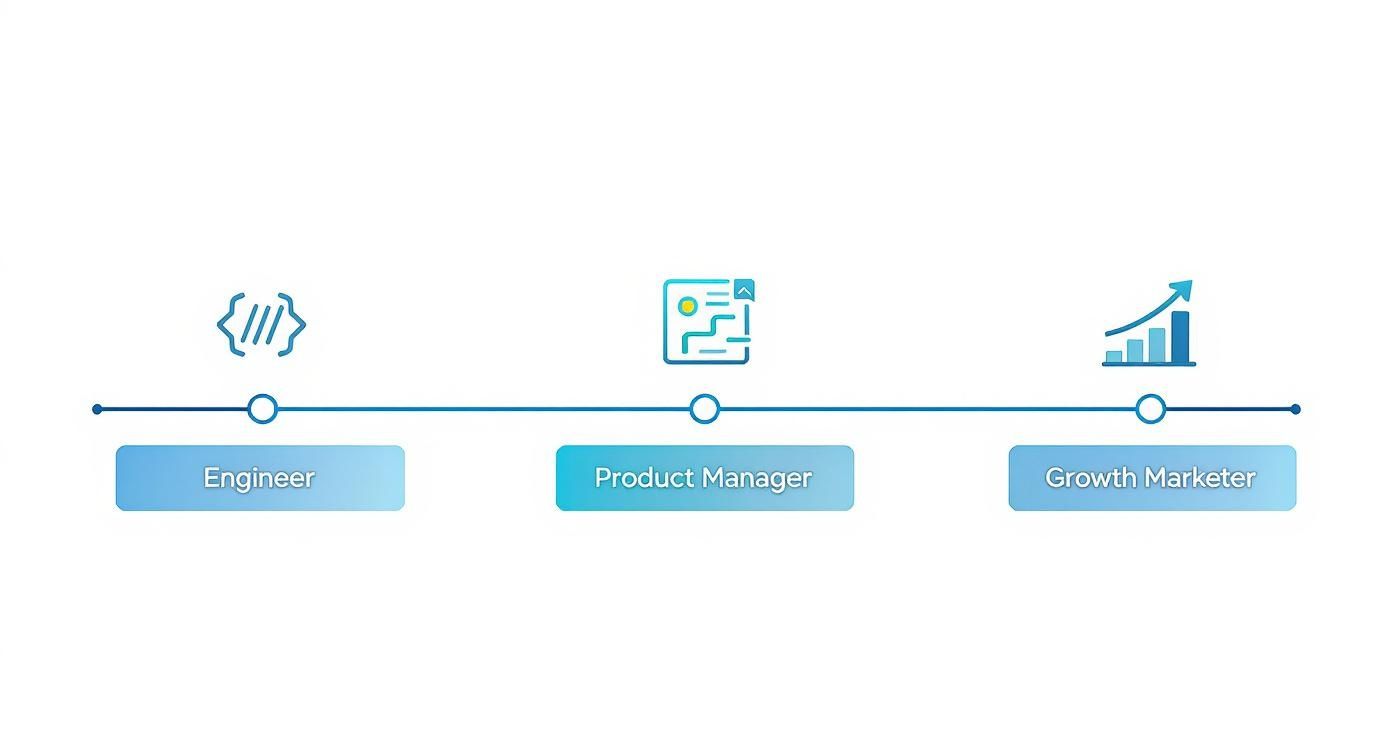
Each role is a natural next step, showing how a company evolves from building a thing to finding people who will pay for that thing.
Let’s make this less abstract. Say hello to Alex, one of the first engineers at a made-up startup called "InnovateCo."
Alex gets an offer that includes 20,000 stock options at a strike price of $0.50 per share. The company has 2 million total shares out there, so her grant is worth 1% of the company. Her options are on a standard four-year plan with a one-year cliff.
Now, let's jump five years into the future. InnovateCo just got acquired for $100 million. By now, Alex is fully vested. Her 20,000 shares are now worth $50 each ($100M valuation / 2M shares).
Here's how the math shakes out for her:
This is the power of equity in action. Sure, her salary might have been less than what a big tech company offered, but her ownership stake led to a life-changing payday. This is the high-reward scenario that makes early-stage startup jobs so magnetic.
Jumping into an early-stage startup is a huge bet. You're betting on the founders, the product, and the market all at once. Let's be real: most startups don't make it. Your ability to look past the slick pitch deck and do your own homework is what separates a smart career move from a cautionary tale.
This isn't about finding some mythical "perfect" company. It's about finding one with a solid foundation, a clear direction, and a level of risk that you're comfortable with. Think of yourself as a scout for a pro sports team. You aren't just looking for the player with the flashiest stats today; you're looking for the one with solid fundamentals, a killer work ethic, and the raw potential to become a superstar. Vetting a startup is the exact same game.
Before you even think about hopping on an interview, you need to put on your detective hat. The goal is to piece together a clear picture of the company’s health and where it’s headed, using only what you can find publicly. A practical first step is to create a simple spreadsheet to track the companies you're researching, with columns for Founder Background, Funding Amount, Key Investors, and a link to their product.
Start by digging into these key areas:
For a deeper dive, check out these proven strategies to find startup jobs. It offers a great framework that goes even further.
Once you've got the basics down, it’s time to dig into the stuff they don't put in the press releases. This is where you investigate the internal dynamics and culture—the glue that holds an early-stage team together when things inevitably get tough.
A great idea is just the starting line. A resilient, mission-driven team is what drags a startup through the mud and across the finish line. Vetting the culture is every bit as important as vetting the business model.
During the interview process, you're not just being interviewed; you're interviewing them. Pay close attention to how the team interacts. Are they open and honest about the challenges they're facing? An actionable tip is to ask, "Can you tell me about a time the team disagreed on a major decision and how you resolved it?" Their answer will reveal more about their culture than any stated company value. Our guide on how to vet startup culture is packed with more tips like this.
Doing your homework can feel overwhelming, so it helps to have a structured approach. This checklist breaks down the key areas to investigate so you can make an informed decision, not just an emotional one.
Using a checklist like this ensures you don't miss any red flags and helps you compare different opportunities on an apples-to-apples basis.
Let's be honest, sifting through thousands of postings on massive job boards is a soul-crushing experience. This is where curated talent marketplaces like Underdog.io and Wellfound change the game. They do the initial heavy lifting for you.
These platforms vet both the companies and the candidates, creating a high-signal, low-noise environment where you’re way more likely to connect with legit, well-funded startups. Instead of firing your resume into a black hole, you build one killer profile and let vetted companies apply to you.
This approach has some serious perks:
By mixing your own diligent research with the power of a curated platform, you build a targeted, effective job search. This methodical approach is your best bet for finding a role where you can make a real impact and join a venture with a genuine shot at success.
If you're used to corporate-style interviews, it's time to hit the reset button. When you’re going for early stage startup jobs, the whole game is different. It’s less about walking through your resume line-by-line and more about showing them how you think, adapt, and attack problems in real-time.
Startups aren’t just filling a role; they're hiring a mindset. They need to know you can thrive in the controlled chaos of building something from the ground up. So, the interview is built to test your resilience, curiosity, and personality just as much as your hard skills.
The AI boom has definitely shaken things up, too. Driven by AI and healthcare tech, job postings jumped a massive 60% year-over-year. On the other side of the table, 55% of companies are using AI to help with initial screening. You can get a deeper look at the current startup job market trends on Chmura.com.
While no two startups are exactly alike, the interview process usually follows a similar path. They're trying to get a full picture of you as a potential teammate, and they tend to move fast.
Winning a startup interview boils down to doing your homework and showing up with an "owner's mindset." They aren't looking for someone to just follow orders; they want a co-builder.
The best candidates interview the company just as much as the company interviews them. Your questions reveal more about your thought process and priorities than your answers do.
If you want to leave a real impression, zero in on these strategies:
For more tips on how to position yourself, check out our guide on how to find a startup job and get your application noticed. Mastering this process is the final step to landing one of the most rewarding early stage startup jobs out there.
Let’s be honest: deciding to join an early-stage startup isn’t something you figure out with a simple pros-and-cons list. It’s more of a gut-check moment. You have to take a hard look at your appetite for risk, how you handle ambiguity, and whether you have that fundamental drive to build something from the ground up.
The upside is incredible—you'll learn faster than you ever thought possible, see your work make a direct impact, and build camaraderie you won't find anywhere else. But those rewards are earned in a pressure-cooker environment.
The reality is that startup life comes with a healthy dose of instability. While some ventures hit it big, many more don't make it. Long hours aren’t just a possibility; they’re often the standard, especially when you’re sprinting toward a product launch or a new funding round. You have to be okay with the pressure of knowing your work directly impacts the company's survival.
To really know if this world is for you, it helps to think about two classic profiles.
Most people who succeed at early-stage companies are hardcore generalists. They’re the ones who are just as comfortable digging through user feedback as they are helping set up the booth at a trade show.
The real question isn’t just, "Can I do this job?" It’s, "Can I thrive when my job changes completely next month?" Your ability to adapt and MacGyver solutions with limited resources is your single most valuable asset.
Before you make the leap, ask yourself a few tough questions. Are you energized by messy, undefined problems, or do you work best with clear instructions and predictable days? How do you react when a project you've poured weeks into gets scrapped because the company has to pivot?
If the thought of building the plane while you're flying it excites you more than it terrifies you, a startup job might just be the most rewarding move you ever make. It's a path forged in intense growth, true ownership, and the absolute thrill of being on a small team chasing a massive vision.
Jumping into the world of early-stage startup jobs can feel like stepping into a different universe, and it’s natural to have a few questions. Let’s clear up some of the most common ones so you can move forward with confidence.
Forget the rigid 9-to-5. Work-life balance at a startup is all about cycles of intensity. You’ll have “sprint” periods—usually leading up to a product launch or a big funding round—that demand long hours and deep focus. But these are almost always followed by calmer stretches where you can catch your breath and recharge.
The trick is finding a company whose rhythm matches your own. Don’t be afraid to ask direct questions in the interview, like, "What does a typical week look like for the team when you're approaching a major deadline versus a normal week?" This will give you a real sense of the day-to-day expectations.
While the "hustle culture" narrative gets a lot of airtime, the smartest startups know that lasting success is built by a healthy, motivated team, not a burnt-out one. They keep people engaged with mission-driven work that feels genuinely impactful, which makes the effort feel rewarding.
Let's be direct: job security at a startup is inherently lower than at a massive, established corporation. The hard truth is that many startups don’t make it. In fact, recent data shows that over 90% of startups ultimately fail, a risk every employee signs up for.
But you’re not powerless here. You can seriously stack the odds in your favor by doing your homework. Look for startups that have solid funding from reputable investors, a believable path to making money, and a founding team that has experience. A practical tip is to ask the founders, "What is your current cash runway, and what are the key milestones you need to hit to secure the next funding round?" A transparent answer is a very good sign.
Absolutely. Working at a startup is like putting your career on fast-forward. In a very short amount of time, you get a crash course in how a whole business runs, not just one tiny piece of it. You learn how to be scrappy, solve problems when you don’t have all the resources, and own major projects from start to finish.
For example, instead of just managing a small piece of a marketing budget, you might be responsible for the entire customer acquisition strategy, from writing blog posts to running paid ads and analyzing the results. This "generalist" skillset is gold to larger companies, as it proves you can adapt on the fly—a trait every employer is looking for.
Ready to find a vetted startup where you can make a real impact? Underdog.io flips the script on the job search. Create one profile and let top startups apply to you, cutting through the noise and connecting you with opportunities that truly fit. Explore your next move at https://underdog.io.