Read Time: 10 min read
Landing a software engineer role at a high-growth startup, whether in NYC, San Francisco, or fully remote, requires more than just LeetCode mastery. The interview process is designed to test not just what you know, but how you think, collaborate, and contribute to a fast-moving, product-focused team. This guide breaks down the 10 core types of software engineer interview questions you'll face, providing practical examples, actionable preparation strategies, and crucial insights into what interviewers are truly looking for.
We move beyond generic advice to give you a specific, actionable framework needed to showcase your full range of skills. You'll learn how to navigate complex system design trade-offs, demonstrate a strong ownership mentality through behavioral examples, and articulate your product thinking clearly. Our goal is to equip you with the tools to deconstruct any question, understand the interviewer's intent, and present your experience in the most compelling way possible.
This curated collection covers everything from deep-dive technical discussions and real-world debugging scenarios to questions about your approach to growth and cross-functional teamwork. Each section provides sample answers and outlines what a "good" response looks like from a startup's perspective, where versatility, speed, and cultural fit are paramount. Whether you're a seasoned engineer targeting a senior position or a recent graduate aiming for your first role, this comprehensive breakdown will prepare you to confidently navigate the unique challenges of the startup interview loop and land your dream job.
Among the most challenging yet crucial software engineer interview questions, the system design question evaluates your ability to architect a complex, scalable application from the ground up. Interviewers aren't looking for a single "correct" answer. Instead, they want to observe your thought process, your understanding of trade-offs, and your ability to handle ambiguity, all critical skills for engineers in a fast-paced startup environment. You'll be asked to design a familiar service like "Twitter," "Uber," or a "URL shortener," forcing you to make high-level architectural decisions.
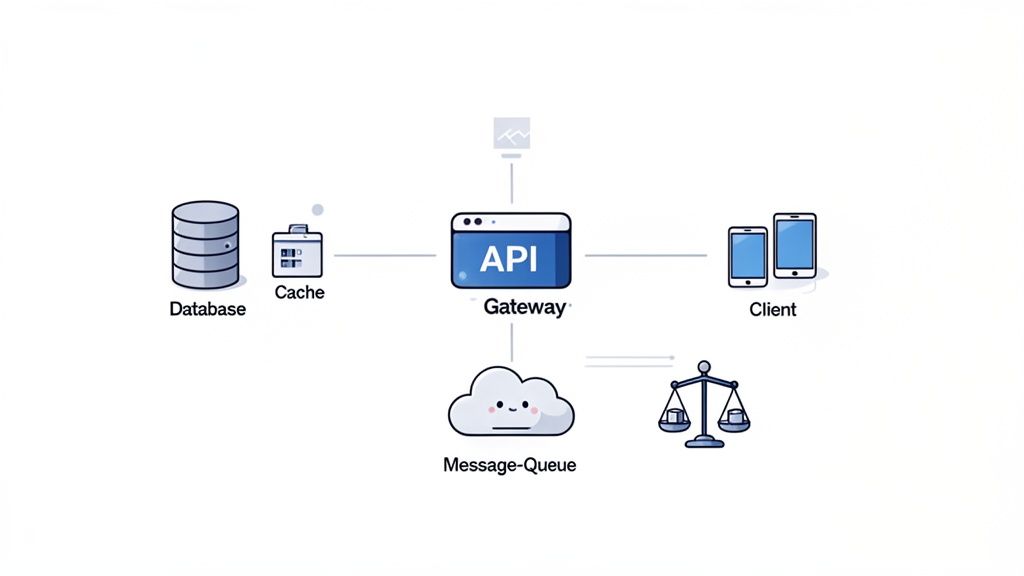
Startups need engineers who can think beyond writing code and consider the business implications of technical choices. Your design for a notification system, for example, directly impacts user engagement and the company's ability to scale its user base without performance degradation. This question reveals if you can build for today while planning for tomorrow.
Interviewer's Intent: Can you navigate from a vague problem to a concrete, scalable technical plan? Do you proactively identify bottlenecks, discuss trade-offs (e.g., consistency vs. availability), and justify your component choices (e.g., SQL vs. NoSQL, REST vs. GraphQL)?
A structured, methodical approach is key. Don't jump straight into designing a database schema.
This is the bread-and-butter of technical interviews, designed to test your core problem-solving abilities and fluency in a programming language. You'll be given a well-defined challenge, often involving data structures and algorithms, and asked to write production-quality code to solve it in a shared editor. Common examples include "Two Sum," "Reverse a Linked List," or "Merge K Sorted Lists." The goal is to assess your foundational programming skills, logical reasoning, and ability to communicate technical ideas clearly.

Startups require engineers who can jump into the codebase and contribute effectively from day one. These algorithm questions act as a universal benchmark for coding competency. They reveal whether you can translate a problem into clean, efficient, and correct code, a non-negotiable skill when building a product under tight deadlines. Success in this round signals you have the fundamental skills to tackle day-to-day engineering tasks.
Interviewer's Intent: Can you write clean, bug-free code? Do you understand fundamental data structures and algorithms? Can you analyze your solution's time and space complexity and articulate why it's optimal?
Your process is just as important as the final code. A methodical approach demonstrates professionalism and strong problem-solving habits.
seen to store the value and its index. As I iterate through the array, I'll check if the required complement already exists in seen."While coding and system design test your technical prowess, behavioral software engineer interview questions assess your character, soft skills, and cultural fit. Questions like, "Tell me about a time you disagreed with your manager," or "Describe a project that failed," are designed to uncover how you handle real-world challenges. For startups, where teams are small and every hire has a significant impact, these answers are often as important as your technical abilities.
In a fast-moving startup environment, resilience, collaboration, and ownership are non-negotiable. An engineer who can't take feedback, learn from failure, or communicate effectively can disrupt a small, agile team. Startups use these questions to gauge your ability to thrive in a high-stakes, resource-constrained setting where you're expected to wear multiple hats and take initiative.
Interviewer's Intent: How do you behave under pressure? Can you collaborate effectively, take ownership of your mistakes, and learn from experience? Do your past actions demonstrate a bias for action and adaptability, key traits for startup success?
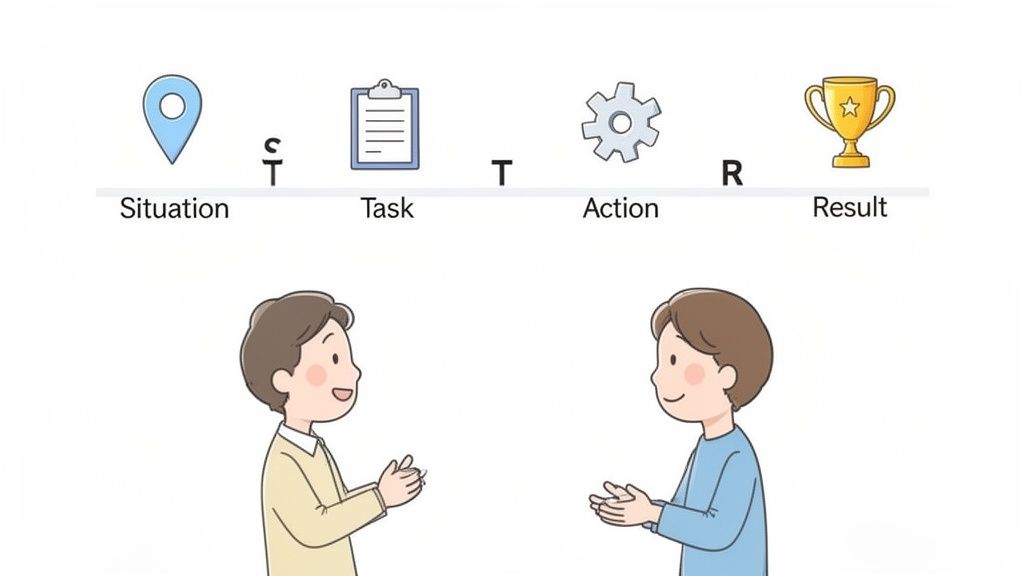
Vague, rambling answers won't work. The key is to be concise, structured, and specific. To effectively answer behavioral interview questions, mastering the STAR method is essential for structuring your responses.
Beyond high-level architecture, the technical deep dive question drills into your specific, hands-on expertise with a technology you claim to know well. This isn't about reciting definitions; it's about proving you've grappled with the nuances of a framework or system in a real-world production environment. The interviewer might ask, "Explain how React's virtual DOM reconciliation works," or "Walk me through the Node.js event loop," to gauge the depth of your mastery.
Startups cannot afford to hire engineers who only have surface-level knowledge. They need specialists who can immediately solve complex problems, optimize performance, and mentor others. If you list "PostgreSQL" on your resume, a startup expects you to be able to debug a slow query, design an indexing strategy, and explain ACID properties. This question validates that your claimed skills are battle-tested and not just tutorial-deep.
Interviewer's Intent: Do you truly understand the tools you use? Can you explain the 'why' behind a technology's design, articulate its trade-offs, and relate it to real-world performance and business impact? Have you moved beyond being a user to becoming a true practitioner?
Demonstrating genuine expertise requires connecting theory to practice. Show, don't just tell.
React.memo and optimizing our useEffect dependency arrays, we prevented unnecessary diffing and reduced component render time by 60%, making the UI feel much more responsive."Distinct from a full system design problem, this type of software engineer interview question zeroes in on a specific architectural decision point. It assesses your strategic thinking and ability to make informed technical choices under constraints. You'll be presented with a scenario like, "Should we use microservices or a monolith for our new product?" or "When should we introduce a caching layer?" and be expected to defend your choice.
Startups operate with limited resources-time, money, and engineers. Every architectural decision has a magnified impact. Choosing microservices too early can cripple a small team with operational overhead, while sticking with a monolith for too long can grind development to a halt. This question reveals if you can align technical strategy with business reality.
Interviewer's Intent: Can you weigh the pros and cons of different technologies in a specific context? Do you understand that the "best" architecture depends on the company's stage, team size, and product goals? Can you justify your decisions with practical, business-aware reasoning?
Your answer must be grounded in the context of constraints and evolution. Avoid making absolute statements; instead, present a nuanced, conditional analysis.
This practical software engineer interview question presents you with a piece of broken code, a failing test case, or a description of a system malfunction. Your task is to diagnose the root cause and propose a fix. The scenario might be a race condition that only appears in CI, a slow database query crippling an API endpoint, or a memory leak causing a server to crash. This question tests your real-world problem-solving skills far more than any abstract algorithm.
Startups operate on live, evolving systems where things inevitably break. Engineers don't just write new features; they spend significant time maintaining and fixing existing code. This question simulates a real production incident, revealing if you can remain calm, think logically under pressure, and methodically resolve an issue rather than just building from scratch. It’s a direct measure of your impact as a day-to-day engineer.
Interviewer's Intent: How do you approach an unknown problem? Can you articulate your thought process clearly? Do you use a systematic methodology to isolate the bug, or do you randomly change code hoping for a fix? Are you familiar with common debugging tools and techniques?
A methodical, communicative approach is more important than finding the fix instantly. Show your work.
user_id and created_at should solve this by avoiding a full table scan. We should also run EXPLAIN ANALYZE to confirm the query plan changes." Discuss any trade-offs your fix introduces.Distinct from a pure system design question, the product thinking question evaluates your ability to connect technical implementation directly to user needs and business goals. Instead of just architecting a system, you're asked to conceptualize a feature or product from the user's perspective. You might be asked, "How would you build a recommendation system for our e-commerce site?" or "Design a notification feature for our app." The focus is less on database schemas and more on the why behind the what.
In a startup, engineers don't just receive perfectly defined tickets; they are partners in shaping the product. Resources are tight, so every feature must solve a real user problem and contribute to business objectives. This question type reveals whether you can think like a product manager, ensuring that engineering effort is spent on what truly matters to drive growth and user satisfaction.
Interviewer's Intent: Can you translate a user need into a technical solution? Do you consider the business impact, user experience, and success metrics, not just the technical elegance? Are you able to prioritize features for a Minimum Viable Product (MVP)?
A user-centric framework is crucial. Show that you think about the user and the business first, then the technology.
This behavioral question is one of the most revealing software engineer interview questions because it moves beyond hypotheticals and into your real-world impact. Interviewers ask you to walk through a significant project from your past to gauge your technical depth, problem-solving skills, and ability to communicate complex ideas. They want to understand not just what you built, but how you built it, the challenges you faced, and the outcomes you delivered. This is your chance to showcase your ownership and passion.
In a startup, every engineer is expected to be an owner. This question directly assesses that capability. Your story about migrating a monolithic service or launching a new feature from scratch demonstrates your ability to navigate ambiguity, make critical decisions with incomplete information, and drive a project to completion. It’s a direct proxy for how you'll perform when tasked with building a core part of the company's product.
Interviewer's Intent: Can you clearly articulate a complex technical project to someone unfamiliar with it? Do you understand the business context and impact of your work? Can you reflect on your decisions, acknowledge failures, and explain what you learned?
Prepare a project you know inside and out. The STAR (Situation, Task, Action, Result) method is an excellent framework for structuring your narrative.
This question assesses your growth mindset and intellectual curiosity, probing how you adapt and learn in an ever-evolving technological landscape. Interviewers will ask questions like, "Tell me about a new technology you've recently learned," or "How do you stay updated with industry trends?" They are looking for proactive, self-directed learners who won't wait for formal training to tackle a new challenge, a common scenario in resource-constrained startups.
In a startup, the tech stack can pivot in a quarter, and you might be the only person available to learn and implement a critical new technology. Companies need engineers who are not just proficient in their current tools but are excited by the prospect of learning new ones. Your ability to quickly ramp up on a new framework or cloud service directly impacts the team's velocity and ability to innovate.
Interviewer's Intent: Are you passionate about technology beyond your day-to-day tasks? Can you demonstrate a concrete process for learning and applying new skills? Do you see learning as an investment in your career and the company's success?
Avoid generic answers like "I read tech blogs." Instead, tell a compelling story about your learning process.
Beyond technical prowess, your ability to communicate complex ideas and collaborate effectively across teams is a massive indicator of your potential impact. This category of software engineer interview questions tests your soft skills through behavioral prompts like, "Explain a complex technical concept to a non-technical stakeholder," or "Describe a time you disagreed with a product manager." These questions are designed to see how you operate within a team, not just how you write code.
In a startup, engineers don't work in a silo. You are a partner to product, design, and even marketing. Your ability to translate technical constraints into business impact, gather clear requirements, and navigate disagreements constructively is essential for a fast-moving team. A brilliant engineer who can't collaborate effectively can create more problems than they solve.
Interviewer's Intent: Can you empathize with non-technical colleagues? Do you handle conflict productively or defensively? Can you articulate trade-offs in a way that helps the business make informed decisions? Are you a team player who elevates others, or an individual contributor who creates friction?
Use a clear, story-based framework like STAR (Situation, Task, Action, Result) to make your answer concrete and impactful.
You've just navigated a comprehensive breakdown of the most critical software engineer interview questions you'll face when targeting high-growth startups. We’ve moved beyond simple definitions, dissecting the "why" behind each query, from the big-picture thinking required in system design to the meticulous detail needed for a live debugging challenge. The journey from a promising candidate to a key contributor at a dynamic startup is paved with these exact challenges, designed not to trick you, but to reveal how you think, collaborate, and build.
Remember, a startup isn't just hiring a coder; they are investing in a problem-solver who can handle ambiguity, own a feature from concept to deployment, and communicate trade-offs effectively. Your ability to articulate the reasoning behind choosing a microservices architecture over a monolith, or explaining how you’d scale a database, is as crucial as writing clean, efficient code. These interviews are a simulation of the daily realities within a fast-paced engineering culture.
The true value of mastering these interview formats lies in what they prepare you for. The skills you sharpen for the interview are the very skills you will use on the job.
The goal isn't just to pass the interview; it's to find a role where you can apply these skills to solve meaningful problems. The preparation you've done equips you to identify the companies that align with your technical interests and career ambitions.
The next step is to translate this preparation into opportunities. The traditional application process can be a numbers game, a frustrating cycle of sending resumes into a digital abyss. For high-demand startup roles, especially in competitive markets like NYC, San Francisco, and top remote-first companies, a more direct path is needed. You need to get your profile in front of the right hiring managers at companies that value the deep, thoughtful approach to engineering we’ve covered.
This is about more than just finding a job; it’s about finding the right team. It’s about joining a company where your ability to debug a complex issue, design a scalable system, and communicate your ideas clearly is not just valued, but essential for the company's success. Your preparation has made you a top-tier candidate; now, it’s time to connect with the companies that are actively searching for talent exactly like you.
Stop shouting into the void of job boards. With a single, private application on Underdog.io, you get direct access to hundreds of curated, high-growth startups in NYC, SF, and remote. Let the best companies apply to you, so you can focus on what matters: acing the interview and building your future. Sign up on Underdog.io and find your next great role.
Interviews typically consist of several distinct rounds, each with its own focus. The main categories are: Coding and Algorithms (solving problems on a whiteboard or in an editor), System Design (architecting a scalable application), Behavioral and Experience-based (assessing soft skills and past projects), and sometimes Domain-specific or Language-specific questions related to the company's tech stack.
Consistent, focused practice is key. Use platforms like LeetCode, HackerRank, or AlgoExpert. Don't just solve problems; focus on understanding patterns (e.g., Two Pointers, Dynamic Programming, Breadth-First Search). Practice explaining your thought process out loud as you code, as communication is often graded as highly as the solution itself. Aim for a balance of speed and optimal solutions.
Be prepared for questions on data structures like arrays, strings, linked lists, trees, graphs, and hash tables. Common problem types include finding duplicates, reversing data structures, traversal algorithms (BFS/DFS), dynamic programming for optimization, and sorting/searching with constraints (e.g., "find the Kth largest element"). Understanding time and space complexity (Big O notation) for your solutions is mandatory.
A system design interview asks you to architect a large-scale system (e.g., "Design a URL shortener" or "Design a video streaming service"). Preparation involves learning fundamental concepts like load balancing, databases (SQL vs. NoSQL), caching (Redis, CDNs), and messaging queues. Practice by breaking down popular systems, focusing on requirements clarification, API design, data modeling, and identifying potential bottlenecks.
Extremely important. Companies hire for culture fit and collaboration. Use the STAR method (Situation, Task, Action, Result) to structure your answers. Prepare stories about past challenges, successes, failures, teamwork, and conflict. Be ready for questions like "Tell me about a time you disagreed with a teammate" or "Describe a technical project you're proud of."
Common pitfalls include: starting to code immediately without asking clarifying questions, not verbalizing their thought process, writing messy or unstructured code without comments, ignoring edge cases, and failing to test their own solution with simple examples. Another big mistake is not having thoughtful questions to ask the interviewer at the end.
For coding: LeetCode, HackerRank, and the book "Cracking the Coding Interview." For system design: the "Grokking the System Design Interview" course, YouTube channels like Tech Dummies, and reading engineering blogs from major tech companies. For behavioral questions, mock interviews with peers are invaluable.