Let’s address the elephant in the server room, shall we?
If you were to create a word cloud based on the collective inner monologue of every software engineer on LinkedIn right now, the biggest words wouldn’t be "Python," "Kubernetes," or "Innovation."
They would be "Unsubscribe," "Spam," and "Please Stop."
On the flip side, if you looked at the inner monologue of a technical recruiter, you’d see "Ghosted," "Unresponsive," and a giant, screaming "WHY?"
We are living through a weird moment in the history of work. We have more ways to communicate than ever before. We have AI tools that can write sonnets about Java stacks. We have automation sequences that can ping a candidate on email, SMS, and carrier pigeon simultaneously.
And yet, the actual connection between the people hiring and the people building has never felt more fragile.
At Underdog.io, we’ve been quietly obsessing over a single, somewhat radical idea: The way we hire isn’t just inefficient; it’s broken because it’s built on a foundation of noise rather than signal.
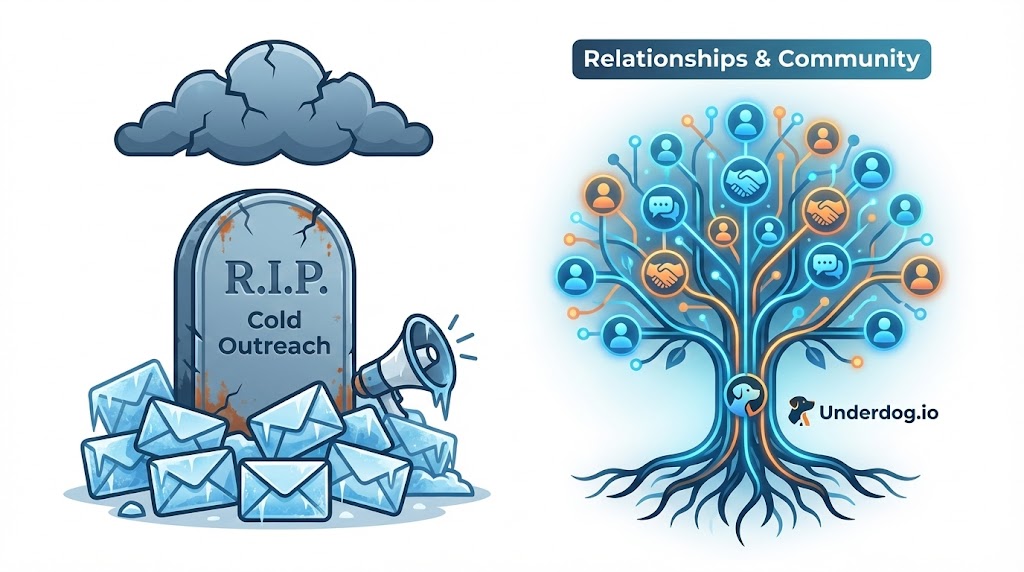
We recently dove deep into a massive set of fresh industry data—surveying thousands of active developers—and the results were a splash of cold water to the face of the recruitment industry. The verdict? Cold outreach is effectively dead.
Here is why the old playbook is failing, and how we can finally declare a ceasefire.
Imagine you’re a Senior Backend Engineer. You’re good at what you do. You’ve got "Rust" and "Distributed Systems" on your profile.
Every morning, you wake up to a digital assault. Your inbox is a crime scene of bold claims and vague promises:
The problem isn't that recruiters are bad people. Most are hardworking folks trying to hit impossible KPIs. The problem is the volume. When tools allow a single recruiter to blast 500 templated messages in an hour, the value of any individual message drops to near zero.
According to the data, the vast majority of developers have tuned out. They aren't just ignoring messages; they are building mental and digital firewalls.
This is the "Noise." And it’s deafening.
When a developer sees a message from a recruiter today, their default reaction isn't curiosity; it's skepticism.
They assume you haven't read their profile. They assume the job description is inaccurate. They assume the salary is a mismatch. And they assume they will be ghosted the moment they ask a hard question.
This isn't paranoia; it's pattern recognition.
Trust is a bank account. Every time a generic, low-effort spam message lands in an inbox, a withdrawal is made. Every time a salary range is hidden until the third interview, a withdrawal is made.
Right now, the industry is overdrawn.
So, if cold outreach is dead, should we all just pack up and go home?
No. Because companies still need to build things. The data shows that while the average recruiter is struggling, the top 1% are thriving. Here is what they do differently:
The elite recruiter doesn't view a candidate as a "lead" to be closed. They view them as a peer. They don't send a message saying, "I have a job, do you want it?" They send a message saying, "I saw you contributed to this open-source library. We’re struggling with a similar architecture challenge. Curious what you think about X."
The days of "competitive salary" are over. The top performers put the numbers on the table immediately. They list the tech stack—warts and all.
If you tell a developer, "Hey, our codebase is perfect," they know you’re lying. If you tell them, "Our codebase is a spaghetti monster, and we need someone with a machete," you might just get their attention. Engineers respect engineering constraints.
Average recruiters focus on "Top of Funnel" (message 1,000 people to get 10 calls). Elite recruiters focus on "Conversion" (message 10 perfect fits to get 8 calls).
This is the reality we built Underdog.io to address. We looked at this landscape—the noise, the spam, the lack of trust—and we asked: "What if we just did the opposite?"
The traditional hiring model is a "Push" model. Recruiters push jobs onto candidates. We built a "Pull" model.
On our platform, the candidates are the prize. They don't apply to jobs. They create one profile—a single source of truth—and they wait. Companies apply to them.
This simple inversion changes the entire power dynamic and, more importantly, the trust dynamic. When a company reaches out to a candidate on Underdog.io, the candidate knows a few things instantly:
The reason developers hate open social networks is that there is no quality control. We act as the bouncer. We pre-vet the talent. We curate the marketplace.
For our hiring partners, this means Signal. You aren't wading through thousands of unqualified resumes. You are looking at a curated list of active, high-quality engineers who are ready to move.
We are never going back to the days of rolodexes and fax machines. But we are also seeing the limits of pure automation. The pendulum is swinging back.
The companies that win the war for talent in the next decade won't be the ones with the best AI sourcing bots. They will be the ones that build the best reputation.
The "State of Trust" in our industry is shaky, but it’s recoverable. It starts with a simple decision to stop viewing hiring as a numbers game and start viewing it as a people game.
So, let’s clear the noise. Let’s stop the spam. Let’s get back to the actual work of building the future, one human connection at a time.
Ready to stop chasing candidates and start meeting them? Apply to join Underdog.io today.
It means that the traditional method of sending generic, high-volume connection requests and InMails to passive candidates is now largely ineffective. Top tech talent is inundated with these messages, leading to low response rates, damaged employer brand, and poor candidate experience. The signal-to-noise ratio is too low for it to be a reliable primary sourcing channel.
Three main factors: candidate saturation (engineers receive too many messages), a rise in quality expectations (candidates expect highly personalized outreach), and the growth of superior alternatives (like curated platforms and employee referrals). Generic outreach now often signals that a company doesn't understand the modern market or respect a candidate's time.
Successful modern strategies focus on warm, high-signal engagement. This includes empowering and incentivizing employee referrals, building an authentic technical employer brand through content and community, using curated hiring platforms that facilitate mutual interest, and investing in highly personalized, research-based outreach when direct contact is necessary.
Highly targeted, warm, and personalized outreach can still be effective. This involves referencing a candidate's specific open-source work, a talk they gave, or a detailed aspect of their career journey. It should feel like a 1:1 conversation starter, not a broadcasted job blast. The key is quality and relevance over quantity.
Curated platforms, like Underdog.io, invert the model. They focus on building a qualified, opt-in talent pool and facilitating introductions based on mutual fit. This removes the "cold" aspect entirely. Candidates have already expressed openness to new opportunities, and companies get pre-vetted profiles, leading to much higher engagement and response rates.
A strong employer brand acts as a talent magnet, making candidates more receptive to outreach or even prompting them to apply directly. When developers follow your engineers on Twitter, read your tech blog, or see your open-source projects, they develop a sense of connection. This makes any subsequent contact feel warmer and more credible.
Move beyond "messages sent" to meaningful metrics. Track source of hire, candidate response rates, interview show-up rates, offer acceptance rates, and quality of hire (e.g., performance and retention). You'll likely find that channels like referrals and curated platforms outperform cold outreach on almost every metric that matters.