You’re probably in one of two spots right now.
Either you’re a hiring manager staring at a blank doc, trying to write a sales engineer job description that doesn’t sound like every recycled template on the internet. Or you’re a developer, solutions consultant, support engineer, or account executive trying to figure out what this role is and whether you’d be good at it.
Both sides get bad information. Companies write job posts that read like a wish list. Candidates read them and assume the role is mostly demos with a little technical charm on top. In practice, a good sales engineer sits in the hardest part of the revenue engine. They help buyers trust the product enough to bet their budget, team time, and reputation on it.
In startups, the role gets even less tidy. The same person who runs technical discovery on Tuesday might help unblock onboarding on Friday. That’s why a useful sales engineer job description has to describe the work accurately, not the fantasy version.
A deal stalls in a familiar way.
The account executive has built interest. The buyer likes the pitch. Then someone from security, engineering, IT, or operations joins the call and asks a question that changes the temperature immediately.
How does this integrate with our stack?
What breaks if we roll this out in phases?
Can your API support this workflow?
Who owns implementation?
That’s the moment a sales engineer earns their keep.
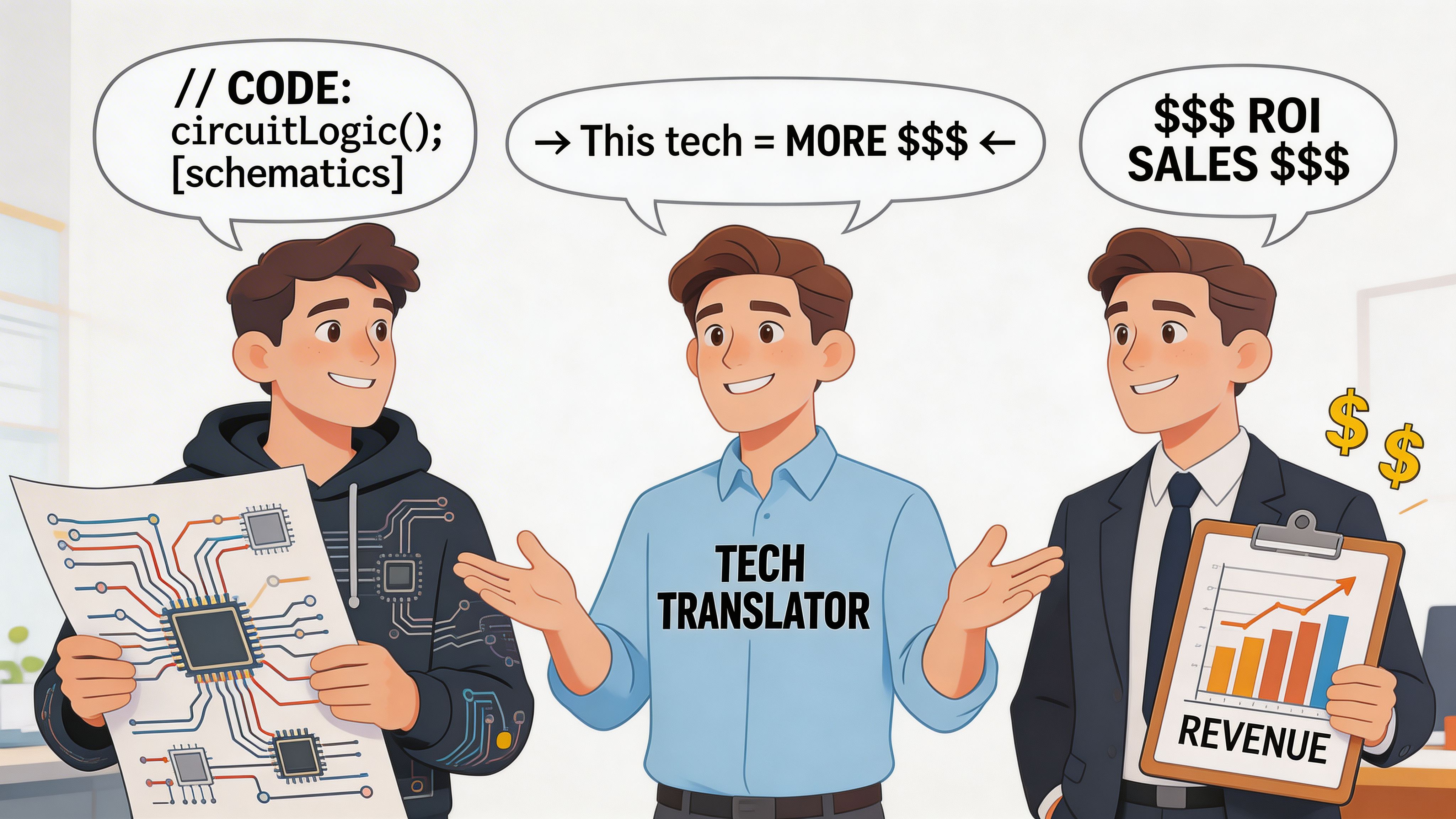
The cleanest way to think about the role is this. A sales engineer is a tech translator. Not a script reader. Not a backup presenter. A translator.
They translate product capability into business value. They also translate customer requirements back into technical terms the product, engineering, and implementation teams can act on.
A good account executive opens doors and manages momentum. A good engineer understands what the product can and can’t do. The sales engineer lives in the gap between those two worlds.
That gap is where many complex deals die.
If the customer hears a polished pitch but not a credible technical answer, trust drops fast. If engineering gives a technically correct answer that ignores business context, the deal can still wobble. Sales engineers bridge both sides.
A strong sales engineer doesn’t just answer technical questions. They answer them in a way that lowers buying risk.
That’s why the role shows up most clearly in B2B software, infrastructure, cloud, manufacturing, telecom, and any environment where a buyer can’t just click “buy now” and figure it out later.
A practical sales engineer job description should say something close to this:
In startups, this can overlap with roles like solutions engineer or even a flavor of forward-deployed engineer, especially when the company needs someone who can shape the product around early customer use cases.
It’s not just “the demo person.”
If that’s all your company wants, you don’t need a strong sales engineer. You need a polished presenter. Those aren’t the same thing. Great SEs qualify hard, push back when a request is a bad fit, and prevent your team from promising custom work your product can’t support.
That’s what makes the role so valuable. They don’t just help close deals. They help close the right ones.
The fastest way to misunderstand this job is to reduce it to presentations.
Demos matter, but they’re only one part of the work. The primary job is moving a buyer from curiosity to technical confidence. That happens across several distinct motions.
A sales engineer should enter discovery with a point of view.
That means reviewing the prospect’s product, public architecture clues, hiring patterns, security posture, existing vendors, and likely stakeholders before the meeting starts. In software, that often means looking at public docs, API references, integration pages, and job postings for tools like Salesforce, Snowflake, AWS, Okta, HubSpot, or NetSuite.
A weak SE asks, “What are your challenges?”
A strong SE asks, “How are you handling identity, data flow, and access controls today, and where does that break under your current process?”
Use discovery to isolate four things:
At this point, the role stops being generic.
A sales engineer maps the product to the customer’s environment. Sometimes that means configuring a demo around the buyer’s workflow. Sometimes it means sketching integration logic. Sometimes it means saying, “We can support the core use case, but not that edge case without product work.”
That honesty matters. Buyers trust technical precision more than optimism.
Practical rule: If your SE can’t explain what implementation would look like, the prospect will assume the hard part starts after signature.
Most bad demos share the same flaw. They’re product tours.
Good demos are narrower. They’re built around a business problem, a user flow, and the exact objections that are likely to surface. The SE should know who’s in the room and what each person cares about.
For example:
This is also where strong SEs separate themselves quantitatively. Top-performing sales engineers exceed quotas by 120-150% through precise technical demonstrations and customized proposals, and strong proof-of-concept work can reduce deployment time by up to 30% while increasing win rates from industry averages of 25% to over 40% in B2B tech sales according to emlyon business school’s sales engineer career guide.
POCs are where discipline matters.
A sloppy POC turns into unpaid implementation. A good one has a timeline, named stakeholders, test criteria, and an agreed definition of success. The sales engineer often coordinates this with product and engineering.
A simple POC checklist looks like this:
Some of the least glamorous work is also the most impactful.
Sales engineers answer technical sections of RFPs, handle security questionnaires, prep account executives for calls, and keep engineering from getting dragged into every prospect conversation. They also absorb pressure from both sides. Sales wants speed. Engineering wants accuracy. The buyer wants confidence.
That daily tension is the job.
| Activity | What it involves |
|---|---|
| Discovery call | Asking technical and workflow questions that shape solution fit |
| Demo prep | Customizing data, environment, storyline, and likely objection handling |
| Internal sync | Aligning with AE, product, or engineering on risks and gaps |
| POC work | Scoping, configuring, testing, and reviewing success criteria |
| Proposal support | Translating technical design into buyer-ready language |
If you’re writing a sales engineer job description, list responsibilities like these. “Deliver demos” is true, but it barely scratches the surface.
A traditional enterprise view of the role says the sales engineer handles pre-sales, then hands the account off after signature.
That’s often wrong in a startup.
Lean teams don’t have the luxury of perfect specialization. The same SE who built trust before the sale may be the best person to help the customer through onboarding, early implementation questions, and the first stretch of value realization.
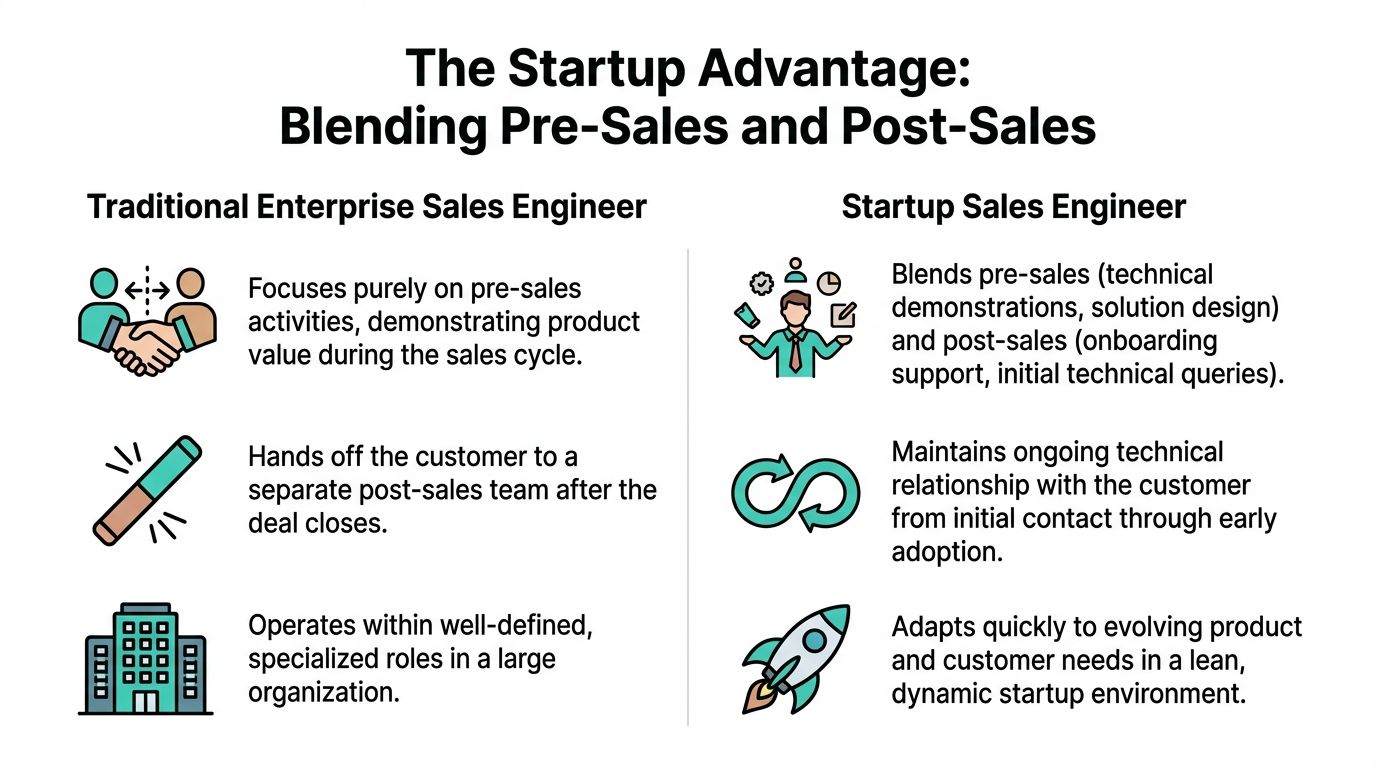
The handoff problem is real. In early-stage companies, customers often buy because they trust a few specific people. If the technical guide disappears right after the deal closes, momentum can drop.
That’s one reason startup SEs often carry a broader charter:
According to the U.S. Department of Energy career map for sales engineers, 93% of Sales Engineers perform demos, and the role is evolving in high-growth firms where SEs often handle both pre-sales and post-sales responsibilities to support retention. That matters because early-stage companies can face 20-30% higher churn risk, which makes technical continuity valuable.
This model has a cost.
When SEs own too much post-sales work, pre-sales capacity can suffer. Pipeline support slows down. Demo quality drops. Strategic deals wait because the SE is helping a recently closed account fix setup issues.
The answer isn’t “never blend the role.” The answer is to blend it intentionally.
Startup sales engineers shouldn’t become unofficial support reps. They should own the technical moments that determine trust, adoption, and expansion.
That means founders and hiring managers need to define boundaries early.
A good startup sales engineer job description includes some post-sales language, but only where it supports revenue and adoption.
Reasonable responsibilities:
Less healthy signs:
If you’re considering a startup role, ask these directly:
The best startup SE roles offer significant influence. You get customer exposure, product influence, and a fast education in how revenue works. The messy ones turn you into a fire extinguisher with a demo deck.
Most hiring teams say they want someone “technical and customer-facing.” That’s too vague to be useful.
A strong sales engineer combines three layers of skill. Think of them as technical chops, sales instinct, and communication glue. If one is missing, the role breaks in predictable ways.
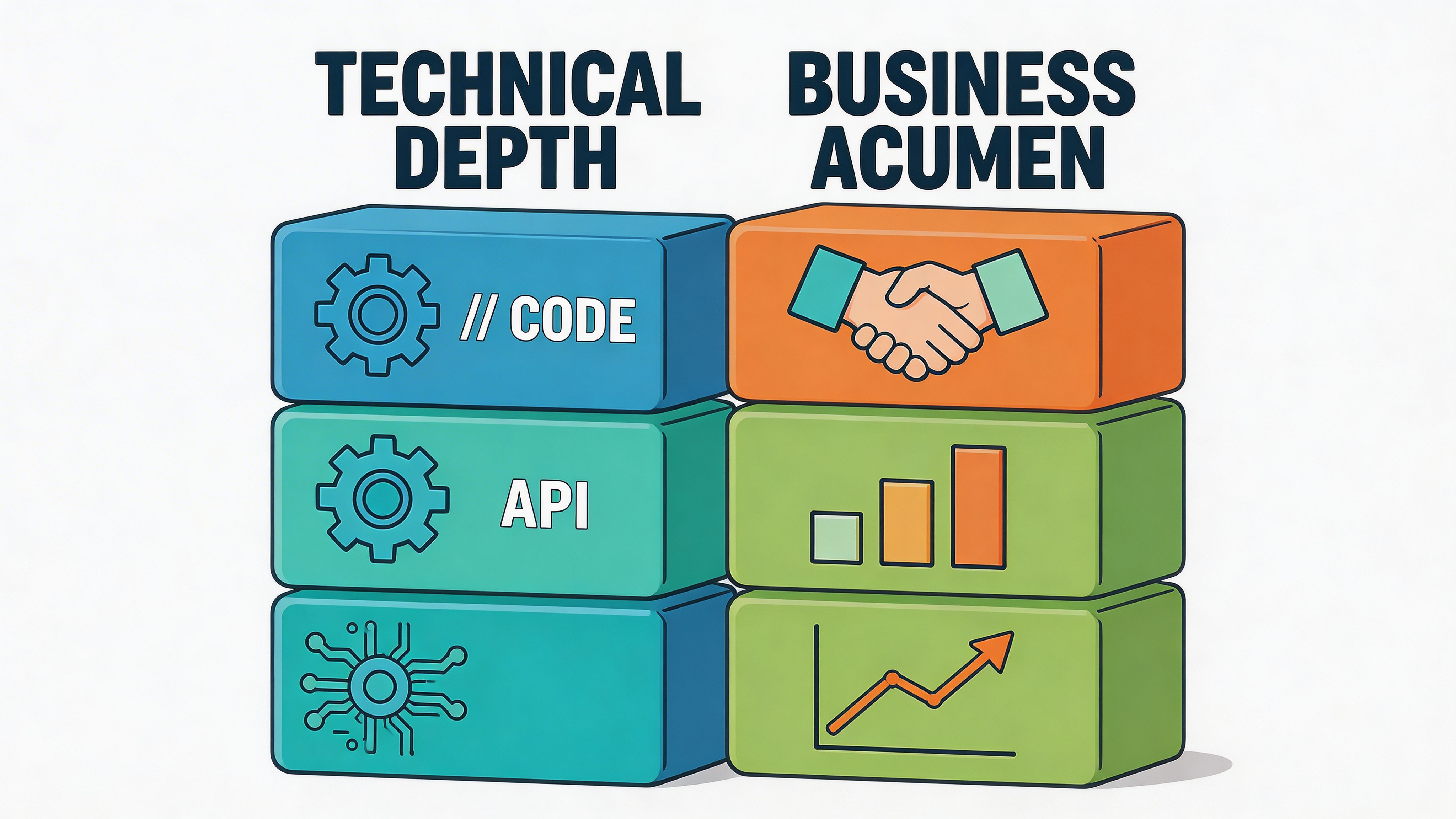
This is the foundation.
In software, the SE needs enough depth to talk through APIs, data flows, authentication, deployment patterns, integrations, and edge cases without bluffing. In manufacturing or hardware, the equivalent may be system specs, installation constraints, or performance requirements.
The exact stack varies, but hiring managers often over-focus on raw coding ability. What matters more is practical fluency. Can this person troubleshoot live? Can they spot implementation risk? Can they turn a vague customer requirement into a credible solution shape?
Useful technical capabilities often include:
This kind of work has operational impact. Sales engineers who conduct weekly performance reports and trend research can help shorten product development cycles by 20-40%. By assessing client sites and collaborating on installations, they can also mitigate integration failures, which affect 35% of B2B tech deals, and achieve 95% customer acceptance rates through customized demos, according to Coursera’s technical sales engineer overview.
Many technically strong candidates stumble at this point.
A sales engineer doesn’t need to be a stereotypical closer, but they do need commercial judgment. They need to know when a prospect is serious, when a request is a distraction, and when a deal is drifting because the customer hasn’t aligned internally.
Sales instinct looks like this in practice:
A useful exercise for aspiring SEs is studying how revenue teams package value, not just how products work. Resources like Mastering AI and Sales Enablement for Peak Performance in 2026 are helpful because they show how technical teams can support deal execution without turning every buyer conversation into a feature lecture.
This is the force multiplier.
The best SEs can explain a difficult concept differently to a CTO, a procurement lead, and a frontline operator without sounding like three different people. They listen for what the stakeholder is trying to protect.
That often means:
If an SE can only impress engineers, they’re incomplete. If they can only impress executives, they’re dangerous.
A candidate who can whiteboard an integration, run a concise demo, ask sharp discovery questions, and admit product limitations clearly.
A candidate who knows the product thoroughly but treats every meeting like training. Or a polished presenter who avoids technical specificity the moment the conversation gets uncomfortable.
For hiring managers, this is the core lesson. Don’t hire for charisma and hope they’ll grow into depth. Don’t hire for depth and assume they’ll magically become customer-facing. Test both.
Compensation for sales engineers is high because the role is hard to replace.
You’re paying for hybrid ability. Technical understanding alone doesn’t close complex deals. Sales polish alone doesn’t survive scrutiny from technical buyers. The market rewards the combination.
As of May 2024, the median annual wage for sales engineers was $121,520, or $58.42 per hour, according to the U.S. Bureau of Labor Statistics as cited in Apollo’s sales engineer compensation overview. The same source notes that 2025 benchmarks showed an average base salary of $123,946 plus $43,336 in commissions, for total annual compensation above $167,000, with the top 10% earning over $202,670.
Most sales engineer comp plans combine:
The details matter more than the headline number.
An offer with a strong base but fuzzy variable can disappoint. A high OTE can also be misleading if the plan is tied to a quota the team rarely hits. Ask how payouts work, who controls outcomes, and whether the SE is measured on individual, overlay, or team performance.
| Experience Level | Years of Experience | Average Base Salary | Average Variable Comp | Total OTE |
|---|---|---|---|---|
| Associate Sales Engineer | 0-2 years | Qualitatively lower than company average | Qualitatively lower than company average | Varies by company |
| Sales Engineer | 2-5 years | $123,946 | $43,336 | Over $167,000 |
| Senior or Leadership Track | 10+ years | Can exceed average materially, especially in leadership paths | Can increase with broader quota scope | Can surpass top market bands |
The exact table gets messy because public benchmark data is strongest at the broad role level, not every title band. That’s why compensation conversations should include scope. A startup SE covering strategic accounts, onboarding support, and product feedback loops isn’t doing the same job as a narrowly scoped enterprise overlay.
Three questions are often underestimated:
What drives variable payout?
If the answer is vague, treat that as risk.
What percentage of comp is at risk?
Apollo notes that in metric-driven cultures, a large share can be tied to quotas and performance. Understand the mechanics before you sign.
How does equity fit into the package?
In startups, equity can justify a lower cash package only if the role has strategic exposure and the company communicates the grant clearly.
If you’re comparing offers, don’t just compare base. Compare package design, role scope, and growth path. This is the same lens I’d use for any technical revenue role, and it’s also why broader guides on compensation and benefits are useful before negotiating.
Most sales engineer job descriptions fail for one reason. They describe a unicorn but not a job.
Candidates can tell when the company hasn’t decided whether it wants a solutions architect, demo specialist, implementation lead, or technical account manager. The best job descriptions make the lane clear, then explain how the role creates impact.
Get these decisions straight internally first:
If you can’t answer those, the posting will sound confused because the org is confused.
Sales Engineer
We’re hiring a Sales Engineer to partner with our account executives on complex customer opportunities. You’ll lead technical discovery, customize product demonstrations, support proof-of-concept engagements, and help prospects evaluate fit with confidence. This role is ideal for someone who can combine product depth with clear customer communication and sound judgment during technical sales cycles.
This template is clean because it filters for the actual overlap. It doesn’t demand every language, every cloud, and every industry. It also names the actual work. “Lead technical discovery” and “support proof-of-concept engagements” are stronger than vague lines about “driving revenue.”
Founding Sales Engineer or Startup Sales Engineer
We’re looking for a Sales Engineer who wants broad ownership in a high-growth environment. You’ll help prospects understand our product during the sales process and stay close enough after close to support early onboarding, technical adoption, and customer feedback loops. You’ll work across sales, product, and engineering, and you’ll help shape how this function scales.
This one attracts people who want ownership, not just task execution. It also warns candidates that the role spans pre-sales and early post-sales. That honesty improves fit.
The best job descriptions don’t try to impress candidates. They help the right candidates self-select.
These lines usually lower response quality:
Use this order:
That structure works because it answers the candidate’s questions. What is the job? What am I walking into? What will I be judged on?
Hiring a sales engineer gets expensive when you confuse charm with competence.
The strongest interview process tests four things. Can the candidate understand technical complexity, communicate clearly, handle commercial ambiguity, and stay credible when something goes sideways?
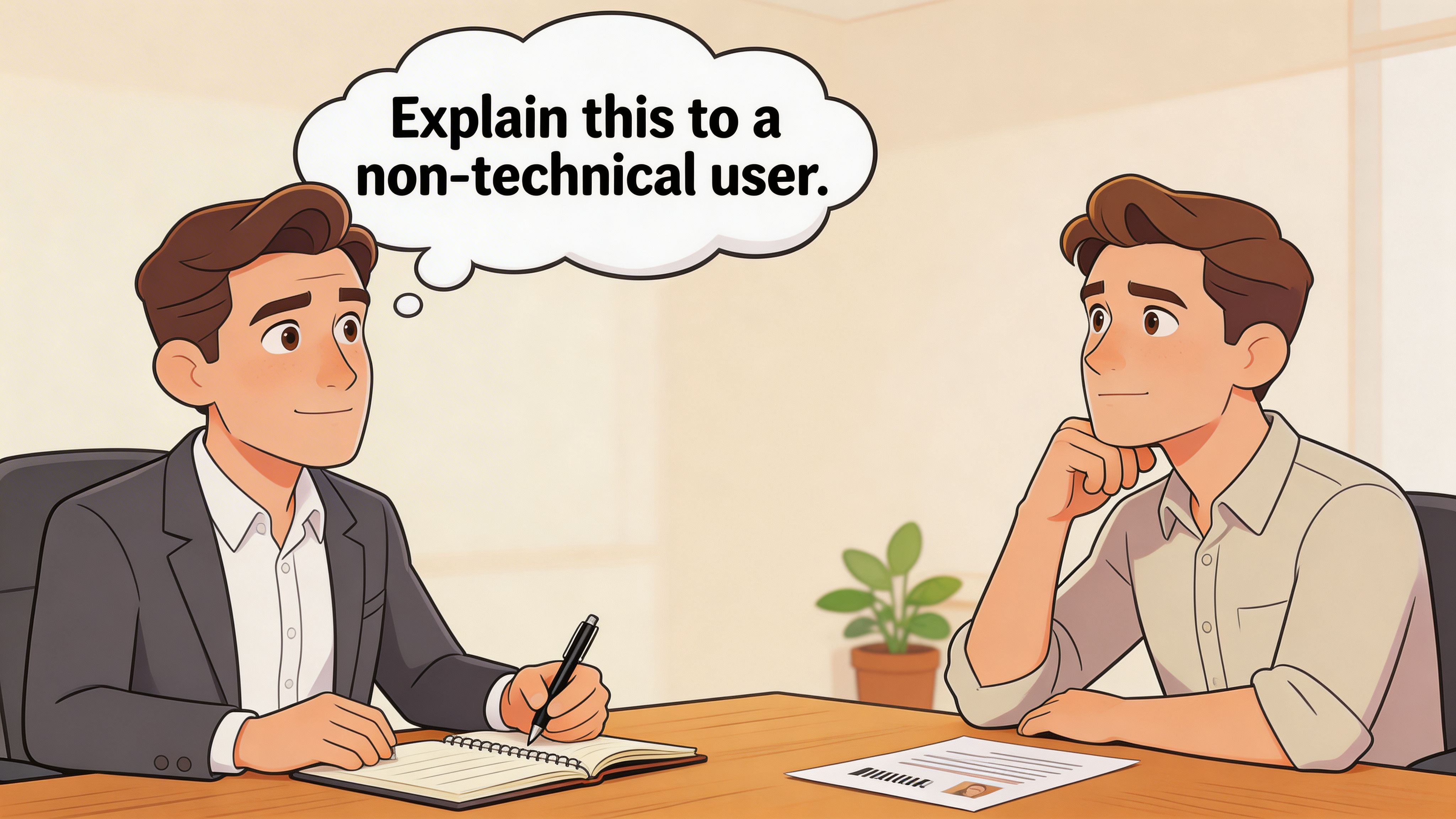
The first conversation shouldn’t be a generic recruiter chat. It should test whether the candidate can move between technical detail and buyer language.
Ask questions like:
What you want to hear is prioritization, clarity, and honesty. Not just enthusiasm.
At this stage, you separate someone who can present from someone who can sell technically.
Use scenarios:
Look for candidates who protect trust, not just momentum.
A live presentation is still one of the best tests, but only if you design it well.
Don’t ask for a generic “demo.” Give them a prompt with a customer profile, one or two objections, and mixed stakeholders. Then see how they adapt.
A solid panel prompt might include:
| Competency | Prompt |
|---|---|
| Technical simplification | Explain a complex integration to a non-technical buyer |
| Objection handling | Respond to a concern about implementation effort |
| Executive communication | Summarize business value in a short closing statement |
| Live recovery | Handle a broken flow or missing data during the presentation |
When a demo breaks, don’t just evaluate composure. Evaluate diagnosis, communication, and recovery. That’s the actual job.
Train interviewers before they meet candidates.
Too many hiring teams evaluate SE candidates from one narrow angle. Engineering probes depth but misses buyer communication. Sales rewards polish but misses technical weakness. A little calibration goes a long way, especially if your team reviews a consistent rubric beforehand. Resources on hiring manager interview training are useful here because they help teams avoid ad hoc evaluation.
If you build the process well, a great sales engineer becomes obvious. They make complex things feel understandable without making them sound easy.
A few questions come up every time this role enters the conversation.
The account executive owns the commercial relationship, deal strategy, and close plan.
The sales engineer owns technical credibility. They handle discovery depth, solution fit, technical objections, demos, and proof. In strong partnerships, the AE and SE move like a two-person team. One leads the buying process. The other makes the buyer confident the product will work.
There is a clear path here, and it’s one reason the role attracts engineers who want customer exposure without leaving technical work behind.
According to the compensation and career data summarized by Apollo, the path often starts with associate sales engineer roles at 0-2 years, moves into more independent demos and ownership in the 2-5 year range, expands into strategic account work around 5-8 years, and can progress to leadership roles such as VP of Sales Engineering after 10+ years. The same overview notes presales manager benchmarks of $157,216 base salary plus $63,245 in commissions in 2025, which shows how leadership compensation can scale. I covered the source in the compensation section above.
The practical version of that path looks like this:
Yes, depending on the product and company.
A bachelor’s degree in engineering or a related field is a common entry point, but it isn’t the only path. Strong SEs also come from implementation, support engineering, solutions consulting, customer success, or even adjacent technical sales roles.
What matters most is whether you can do three things well:
If you’re trying to break in, build proof. That can mean demo samples, implementation stories, open-source contributions, technical writing, or strong customer-facing examples from your current role.
Yes, especially in software.
That said, “remote” can still mean travel for customer meetings, team offsites, or major deals. If you’re exploring options, curated lists of remote jobs can help you see how companies define remote versus field-heavy expectations.
The best way to read any sales engineer job description is to ask a simple question. Does this role want a technical presenter, a solution architect, a full-lifecycle startup operator, or some mix of the three? Once that’s clear, the fit becomes much easier to judge.
If you’re exploring startup sales engineer roles or hiring one for a high-growth team, Underdog.io is worth a look. It’s a curated marketplace built around startup hiring, so candidates can get in front of vetted companies without spraying resumes everywhere, and hiring teams can meet technical talent that already understands how startups work.