A forward deployed engineer went from niche title to strategic role fast. Job postings for FDEs grew by 1,165% year over year from January through October 2025, according to an analysis of over 1,000 postings published by Bloomberry, with New York emerging as the top hub and demand tied directly to deploying complex AI and ML systems with customers in production (Bloomberry’s analysis of 1,000 FDE jobs).
That headline number matters, but the more useful takeaway is what it says about the market. Startups no longer win just by shipping a strong core product. They win when a customer can plug that product into messy systems, regulated workflows, old data models, and impatient operating teams. Someone has to own that gap.
That someone is often the forward deployed engineer.
This role attracts a specific kind of engineer. Not the person who wants to disappear into a backlog for six months. The person who wants to sit close to the customer, solve a problem that is still fuzzy, ship under real constraints, and see whether the thing changes the business.
The FDE role grew because software got harder to deploy where it matters most. A polished demo is easy. A production rollout inside a bank, manufacturer, insurer, or healthcare org is not.

Modern B2B products, especially those built around AI, data infrastructure, and workflow automation, hit the same wall. The core platform may be strong, but every serious customer has different schemas, security requirements, approval chains, latency constraints, and change management problems.
A standard product engineering team usually optimizes for reusable features. That is the right default for most software organizations. But it leaves a gap when a strategic customer needs a working system before the generalized roadmap catches up.
An FDE closes that gap.
They sit in the uncomfortable middle where abstract product capability meets operational reality. They translate broad asks into scoped implementation plans, write production code, integrate systems, and push through deployment friction that would otherwise stall adoption.
For a high-growth startup, one successful enterprise deployment does more than save a deal. It teaches the company what the product needs to become.
That is why the forward deployed engineer is not just a delivery role. It is a learning role. FDEs pull product truth out of customer environments. They discover which requirements are edge cases, which are patterns, and which product gaps are worth turning into core platform features.
A good FDE does not just “make the customer happy.” They convert customer chaos into product insight the company can reuse.
The old split was cleaner. Engineers built. Solutions teams configured. Sales engineers demoed. Professional services handled implementation. That model breaks down when the product itself is highly technical and the deployment surface is part of the product.
In AI-heavy startups, this is even more obvious. Customers are not buying a static feature set. They are buying an outcome. That outcome depends on data quality, orchestration, monitoring, trust, permissions, fallbacks, and operational fit.
The forward deployed engineer became important because companies needed engineers who could own that outcome directly.
A forward deployed engineer is easiest to understand by contrast.
A software engineer usually builds for many customers at once. A sales engineer usually proves the product can work. A forward deployed engineer makes it work inside a specific customer environment, then carries those lessons back into the product.
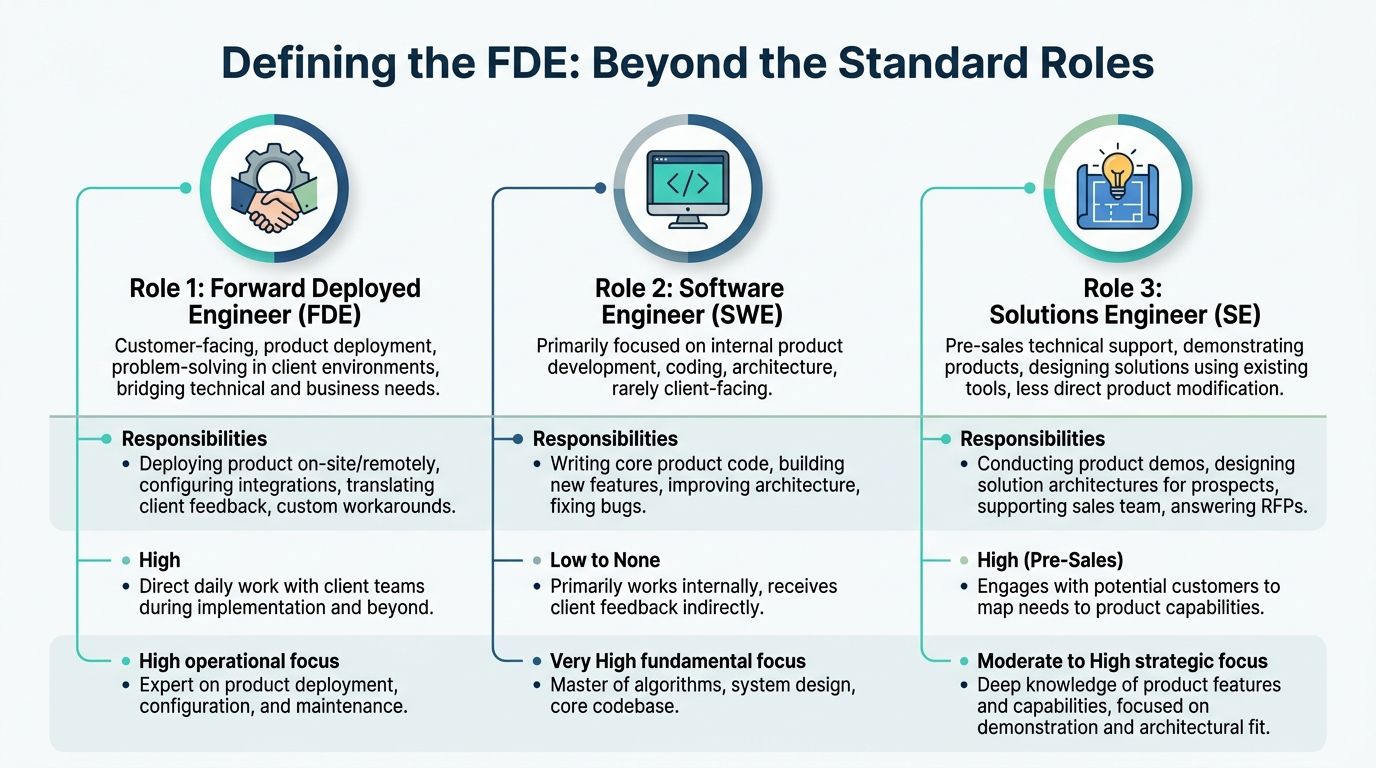
The confusion comes from titles. Some companies call customer-facing technical roles “FDE” when they are really pre-sales or implementation roles with light coding.
The cleaner test is operational.
For leaders building engineering teams, this distinction matters because each role needs a different hiring bar, reporting structure, and success metric.
| Aspect | Forward Deployed Engineer (FDE) | Software Engineer (SWE) | Sales Engineer (SE) |
|---|---|---|---|
| Primary mission | Deliver customer outcomes in production | Build scalable product capabilities | Support technical validation during the sales cycle |
| Core environment | Customer systems, integrations, deployment workflows | Internal codebase, platform, product surfaces | Demos, proofs of concept, buyer conversations |
| Time horizon | Immediate customer value plus reusable product insight | Roadmap-driven feature delivery | Deal progression and buyer confidence |
| Coding expectation | High. Production code, integrations, debugging, deployment | High. Product and platform code | Varies. Often lighter and narrower |
| Customer contact | Constant | Usually limited | Constant during pre-sales |
| Success metric | Deployment success, adoption, reliability, customer impact | Product quality, performance, maintainability | Technical win during the sales cycle |
| Typical mindset | Scope aggressively, adapt fast, own ambiguity | Design for reuse, scale, internal consistency | Reduce buyer risk, answer objections, demonstrate fit |
| Common failure mode | Over-customizing for one account | Building elegant features nobody urgently needs | Proving value without owning implementation reality |
A software engineer builds the road. A sales engineer explains where the road leads. A forward deployed engineer gets a truck through the mud when the road ends halfway to the customer site.
That means the FDE has to make harder trade-offs in real time.
Sometimes the right move is a clean abstraction that can become a core product capability. Sometimes the right move is a narrow integration that solves the customer’s immediate blocker by Friday. The role rewards judgment more than purity.
Strong FDEs know when to generalize and when to ship a one-off with clear boundaries.
Some engineers assume customer-facing work means lower technical depth. In strong FDE organizations, the opposite is true.
The technical challenge is not abstract difficulty. It is applied difficulty under constraints. You are reading unfamiliar systems, dealing with incomplete documentation, integrating brittle APIs, handling security reviews, and debugging issues where the code is only half the problem. The other half is process, data, infrastructure, and politics.
That is why the role tends to suit engineers who already have a solid technical base and want their work to tie more directly to business outcomes.
The most useful way to understand a forward deployed engineer is to follow the work from vague request to stable deployment.
A customer does not usually open with a well-scoped ticket. They say something like, “We need to reduce fraud,” or “We want to use AI in our operations,” or “Our analysts are drowning in manual review.”
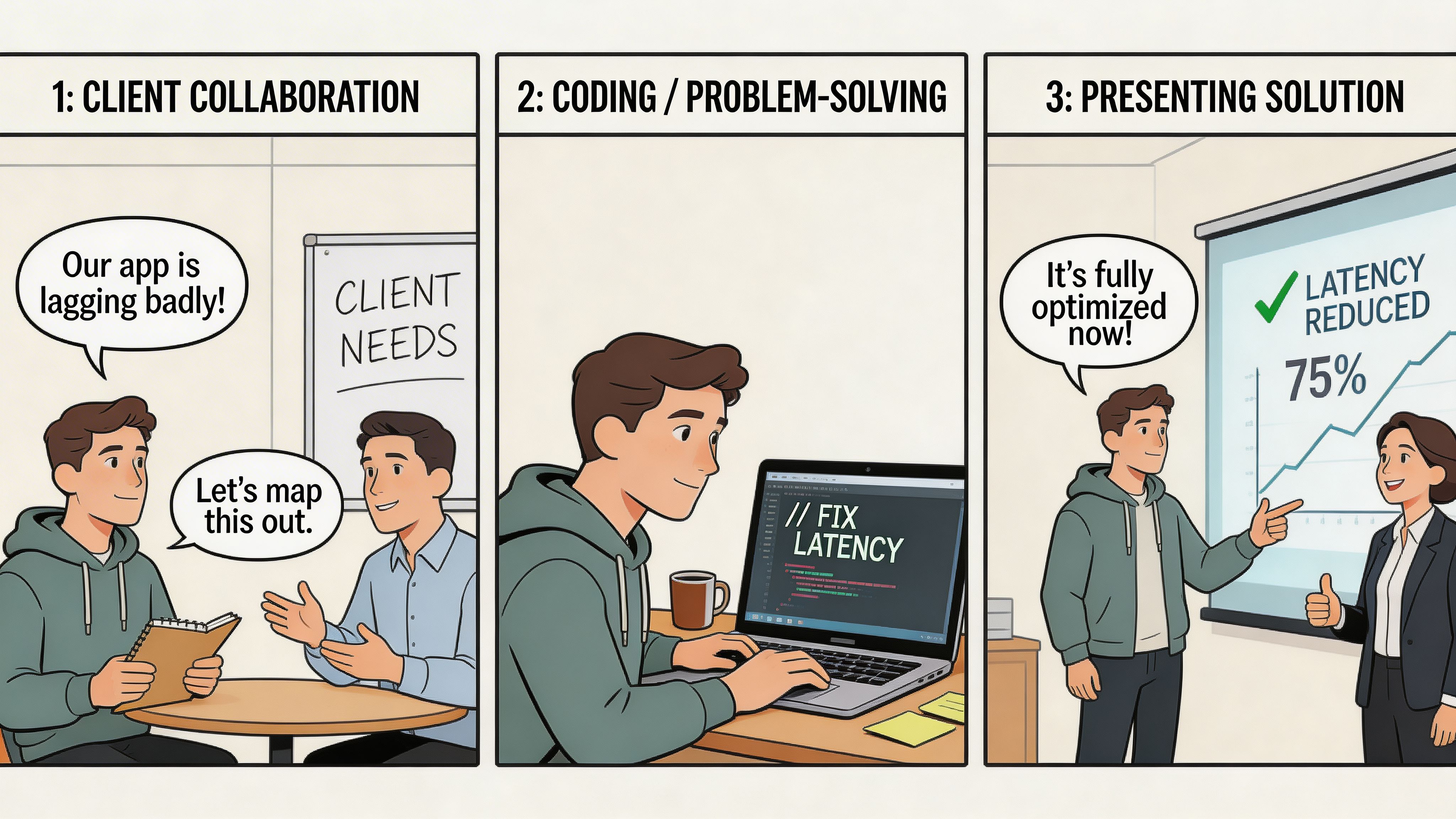
The best FDEs are good at system design, but the earlier skill is sharper. They know how to turn a fuzzy business complaint into a technical sequence that can be built.
That often starts with discovery:
One widely cited guide notes that FDEs excel at this translation layer and often deliver higher deployment success than traditional engineers by being on-site and iterating closely with customers. It describes outcomes such as 2-3x higher deployment success rates, time-to-value dropping from months to weeks, and a 40% fraud reduction in finance deployments (Hashnode’s guide to the forward deployed engineer).
Once the problem is scoped, the day gets very hands-on.
A FDE week can include writing Python for an API integration, shaping SQL to support a reporting flow, building a thin frontend for operators, and standing up service logic that works inside the customer’s auth and network constraints. This is full-stack work in the most literal sense. Whatever blocks the deployment becomes part of the job.
Typical work looks like this:
Prototype the narrow path first
Build the smallest flow that proves the system can connect to the customer’s environment.
Put the workflow in front of users early
Customer teams reveal broken assumptions fast. Their language, approvals, and exception handling usually differ from the original brief.
Instrument before polishing
In customer deployments, observability beats elegance. You need traces, logs, and clear failure states before you need a beautiful abstraction.
If the team needs better release discipline during this phase, reviewing mature CI/CD tools helps identify options for safer iteration without turning every deployment into a manual ceremony.
Prototype work is only half the job. The role gets more valuable when the system enters production and starts behaving like a system instead of a lab exercise.
That is where the forward deployed engineer starts dealing with issues such as:
This is why many FDEs spend their time in the uncomfortable but valuable middle ground between coding, debugging, stakeholder management, and rollout planning.
An FDE does not stop at implementation. They often have to explain trade-offs to non-technical stakeholders who care about outcomes, risk, and timing.
That conversation sounds different from an engineering design review. It sounds like this:
The role rewards engineers who can explain a technical compromise in business language without watering down the truth.
Some days are architecture and discovery. Some are coding marathons. Some are live incident response with a customer team waiting on a fix.
That unpredictability is part of the attraction for many ambitious engineers. The work is messy, but it is close to revenue, adoption, and product truth. You do not have to guess whether your work mattered. The customer environment tells you immediately.
A forward deployed engineer needs breadth, but not random breadth. The job demands a set of capabilities that show up repeatedly in customer deployments.
The easiest way to assess fit is to ask a simple question. Can you take ownership of a messy customer problem from discovery through production, without falling apart when the clean architecture collides with enterprise reality?
A strong FDE usually combines product engineering fundamentals with deployment depth.
One practical benchmark from an FDE roadmap emphasizes production scaling with tools such as Apache Airflow for large data migrations and AWS EKS for handling 1,000+ transactions per second, while noting that this deployment model can improve customer renewal rates by 30-50% when it closes product gaps that derail standard implementations (GeeksforGeeks on the FDE role, skills, salary, and roadmap).
This role filters hard on judgment.
You can teach a capable engineer a new tool. It is harder to teach someone how to walk into a tense customer meeting, identify the core blocker, cut scope intelligently, and preserve trust while doing it.
The most important non-technical abilities are these:
Customers often describe symptoms, not causes. A good FDE hears “the AI is inaccurate” and starts checking data definitions, retrieval quality, workflow placement, and operator feedback loops instead of debating prompts for an hour.
You will work with technical buyers, operators, product managers, security teams, and executives. They do not want the same thing. Someone has to align them around the next sensible step.
A forward deployed engineer has to say no without creating deadlock. That means being able to explain why a narrower first release is safer, faster, or more useful than a broad but fragile rollout.
The job contains shifting requirements by design. People who need crisp boundaries every day usually dislike it. People who can create clarity for others tend to thrive.
If you are building toward this role, focus on skills that compound across many deployments:
Not every company needs a forward deployed engineer. The ones that do usually share a pattern. Their product is valuable, technically real, and hard to operationalize without engineering help.
The role shows up most naturally in a few environments.
These companies sell capability that only becomes valuable after integration, data mapping, monitoring, and workflow adaptation. The product might be impressive on paper, but the buying customer cares about production behavior.
If a startup sells into regulated or operationally complex teams, implementation becomes part of the product experience. That creates a natural home for FDEs.
Some startups are too mature for founders to handle every deployment themselves, but not mature enough to build a large implementation or services organization. That is prime FDE territory.
Read the description carefully. “Forward deployed engineer” can mean different things depending on the company.
A genuine FDE role usually signals:
Be cautious if the description emphasizes pre-sales support, demos, quotas, or handoff after contract signature. That may still be a good role, but it is a different role.
You can find these roles on startup job boards, company career pages, and curated marketplaces that focus on startup engineering talent. For a broader map of search channels, this guide to software engineering job boards is a useful reference: https://underdog.io/blog/best-job-search-sites-for-software-engineers
Location still matters for many FDE roles because customer contact, internal coordination, and enterprise selling often cluster in startup hubs. If you are targeting companies in New York or San Francisco, read descriptions with an eye for how much customer presence they expect and whether the role is embedded in engineering or in go-to-market.
The best FDE roles sit close to product engineering, even when they spend heavy time with customers.
Compensation is one of the clearest signals that this role sits inside engineering, not sales. FDEs are usually paid like engineers because the company expects them to build, ship, and own outcomes in production.
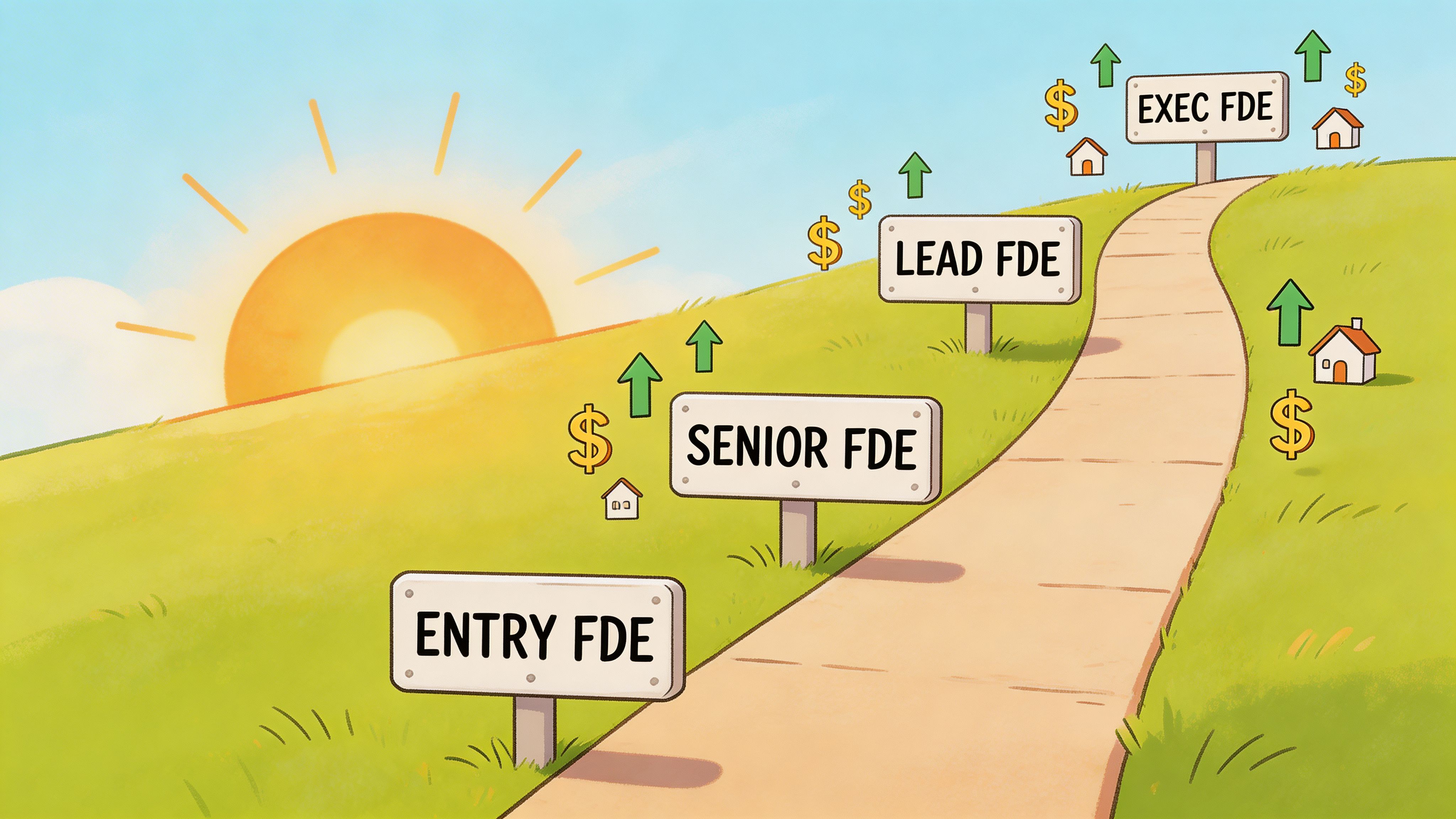
Bloomberry’s analysis of 1,000 FDE jobs reported a median salary of $173,816, with 70% of roles offering equity and 0% mentioning sales quotas. That pattern reinforces the point made earlier. Companies hire FDEs as technical operators who can close the gap between product capability and customer reality.
For candidates weighing startup offers, it helps to understand how salary, equity, and benefits shift across stage and company risk. This guide to startup compensation and benefits trade-offs gives useful context.
The upside is real. So is the cost.
A lot of guides sell the role on proximity to revenue and senior stakeholders. That part is true. The harder truth is that FDE can be one of the most demanding seats in a startup because you carry pressure from both the customer and the internal team at the same time.
A source discussing the gap in FDE coverage points out that long-term progression and burnout remain underexplored, with anecdotes from Palantir and recurring forum questions focused on intense customer embedding and uncertainty about post-FDE career paths (discussion of FDE career progression and burnout).
In practice, the pressure usually shows up in four ways:
This is why ambitious engineers should treat FDE as a deliberate career move, not just an interesting title. The role can accelerate judgment, communication, and business fluency faster than a standard SWE path. It can also trap you in custom work if the company lacks discipline.
The best FDE roles create more options after two or three years, not fewer. Engineers who do well in the role tend to build a rare mix of technical depth, product instinct, and customer credibility.
Common next steps include:
FDEs often see demand earlier than the roadmap does. That can translate well into product roles, especially for engineers who can separate one customer request from a repeatable market need.
Some move into customer engineering, deployments, or enterprise product teams. They usually bring strong execution habits because they have already handled messy cross-functional work under deadline.
This path fits engineers who like reusable integration patterns, deployment systems, and infrastructure that turns custom work into standard capability.
FDE is unusually good preparation for startup leadership. You learn how buyers think, where implementation breaks, what customers will pay for, and how fast product decisions affect revenue.
Treat the role as a high-velocity apprenticeship in business impact. Do not treat it as a permanent box.
Ask direct questions before you sign.
Good answers show that the company sees FDEs as strategic engineers with a path to broader ownership. Weak answers usually mean the role exists to absorb chaos that nobody else owns.
Most strong forward deployed engineers do not start there. They usually arrive from software engineering, data engineering, consulting, or a startup generalist role and then sharpen the customer-facing side.
Your resume should show more than technical competence. It should show that you can solve messy problems with real users and real constraints.
Emphasize work where you:
If you are aiming specifically at startups, this practical guide to startup hiring process and positioning is worth reviewing: https://underdog.io/blog/how-to-get-a-job-at-a-startup
FDE interviews usually blend three things.
First, they test engineering fundamentals. You still need to code and reason clearly.
Second, they test system design under constraints. Not “design a generic global service” in the abstract, but “how would you deploy this for a customer with security restrictions, legacy systems, and a rough deadline?”
Third, they test customer judgment. Expect questions about de-scoping, stakeholder conflict, rollout risk, and how you would respond when the product cannot do exactly what the customer asked for.
If you are a software engineer today, the best preparation is not theoretical. It is experiential.
Look for chances to:
That is the bridge into the role. Companies hire FDEs because they need engineers who can create momentum in ambiguity. Show that you already do that.
No. A sales engineer usually helps validate the product during the sales cycle. A forward deployed engineer is closer to implementation and production ownership. The strongest signal is whether you are expected to write and maintain production-grade code for a customer environment.
Yes. In serious FDE roles, coding is central to the job. That can include integrations, service logic, data workflows, debugging, deployment automation, internal tooling for customer operations, and changes that later inform the core product.
Not in the verified compensation data cited earlier. The Bloomberry analysis reported 0% quota-carrying roles among the FDE jobs reviewed, which is one reason the role should be understood as engineering rather than sales when defined properly.
Not always, but customer presence is common in spirit even when it is not always in person. Some companies want engineers on-site. Others run the role through Slack, Zoom, shared docs, and direct access to customer technical teams. The question is not just travel. It is how embedded the role is in customer work.
It happens, but the role usually favors people with enough technical maturity to operate independently. You need to debug unfamiliar systems, make trade-offs with incomplete information, and represent the company in front of customers. That is easier once you have a strong engineering base.
Software engineering is the most direct path, especially backend and full-stack work. Data engineering, technical consulting, and startup generalist backgrounds also transfer well when paired with strong coding ability and customer comfort.
It can be. The upside is speed of learning, visibility, and proximity to business outcomes. The risk is burnout or becoming too tied to custom work if the company lacks a path into product, platform, or leadership roles. The role is strongest when it expands your options, not when it traps you in permanent exception handling.
Read for substance. A FDE role usually mentions production deployments, direct customer collaboration, coding, integration work, and feedback loops into product. Be skeptical if the description reads mostly like demos, enablement, pre-sales support, or post-sale coordination without real engineering ownership.
If you want to explore startup roles where this kind of customer-facing engineering work exists, Underdog.io is one option to consider. It is a curated hiring marketplace where candidates submit a single application and get matched with startups and high-growth tech companies, including teams hiring for technical roles that sit close to product, customers, and deployment.