You're probably doing some version of the same loop right now. Open LinkedIn. Open Indeed. Save twelve roles that all sound vaguely similar. Wonder whether your portfolio is too broad, too junior, too visual, too product-heavy, or too old. Apply anyway. Hear nothing.
That's a normal way to search for design jobs in NYC. It's also a weak one.
New York still has real density, real money, and real opportunity for designers. It also has a filtering problem. The strongest roles, especially at startups, rarely go to the person who submitted the most applications. They go to the candidate who looks easiest to trust with messy, cross-functional work. That's the standard most generic job-board advice misses.
New York still earns its reputation as a serious design city, but not for romantic reasons. It's compelling because of concentration. In Q1 2024, New York City had 1,107 graphic design offices, and the average annual wage for designers in New York reached $124,278, up 23% year over year, according to the New York Small Business Development Center's graphic design industry research.
That combination matters. There's a dense employer base, and compensation has moved up hard enough to signal that companies are still paying for strong design talent when the fit is right.

NYC design hiring isn't one market. It's several overlapping ones.
You've got agency and brand work. You've got in-house creative teams in media, retail, and fashion. You've got product design roles inside tech companies. And you've got startup jobs where the title says “product designer” but the actual job includes UX, visual polish, prototyping, stakeholder management, and a surprising amount of writing.
That's why broad advice like “just specialize” or “just become a generalist” usually fails. Different slices of the city want different signals.
A startup hiring manager typically cares less about whether your work looks trendy on a portfolio grid and more about whether you can take an unclear problem, shape a direction, get alignment, and ship without constant supervision.
Practical rule: In NYC, competition doesn't just come from other designers. It comes from designers who can also explain trade-offs, run meetings, and keep momentum when scope changes.
Nationally, graphic design is a mature field, not a runaway growth category. If you want a clean career map for product-focused work, this guide for aspiring product designers is useful because it frames progression around skills and ownership instead of titles.
The better way to think about design jobs NYC offers is this:
A lot of candidates get discouraged because they mistake concentration for accessibility. New York has more design energy than most markets, but that doesn't mean every role is easier to land. It means you need to position yourself against the exact hiring context.
Don't read strong pay levels and assume every designer gets them. Don't read office counts and assume every company is hiring. Read both as proof that NYC remains a foundational market for design careers, especially across branding, tech, and media.
Your job is to narrow the field fast. Pick the lane where your current work already looks credible, then tune your portfolio and outreach to that lane. That beats spraying applications across every “designer” listing you can find.
Most portfolios fail for one simple reason. They show artifacts instead of ownership.
A hiring team in New York, especially at a startup, usually isn't asking, “Can this person make attractive work?” They're asking, “Can this person carry a project when nobody has given them a perfect brief?” If your portfolio doesn't answer that, it stays in the maybe pile.
The most useful career advice for designers is still brutally simple. Work backward from the role you want, then review your portfolio on a weekly or biweekly basis so it keeps reflecting project ownership and your ability to work with limited oversight, as discussed in this UX career planning guide.
That sounds basic. In practice, very few candidates do it.
A startup portfolio should make three things obvious within minutes:
If you need help choosing presentation format, this roundup of top platforms for design portfolios is worth reviewing before you rebuild from scratch.
Good startup case studies don't read like school assignments. They read like operator notes.
Use a structure closer to this:
That last part matters. Mature candidates can talk about partial wins, compromises, and mistakes without sounding defensive.
A useful reference point is this collection of product design portfolio examples. Not because you should copy the format, but because it highlights the difference between pretty presentation and evidence of judgment.
A strong portfolio says, “I know how this work got made.” A weak one says, “I know how to arrange screenshots.”
AI has changed the portfolio conversation. It hasn't removed the need for designers. It has made generic execution easier to commoditize.
So don't build a portfolio around “I can generate concepts quickly.” Too many people can now say that.
Instead, show where you use AI-assisted workflows inside a larger process:
The durable signal isn't tool usage. It's taste plus judgment plus systems thinking.
NYC hiring teams move fast. Nobody wants to scroll through twelve projects if only three are relevant.
Trim aggressively:
A portfolio isn't a museum. It's a sales conversation with evidence attached.
Most designers look for roles where listings are abundant. The better strategy is to look where signal is high.
That matters more in New York because startup hiring is hard to read from generic job posts alone. Recent market context shows NYC tech hiring has remained concentrated in growth sectors, with about 30,000 more tech jobs than a decade ago, but generic boards make it difficult to tell which openings are at competitive startups versus larger employers, as reflected in this NYC creative designer job market context.
So the question isn't “Where are there lots of listings?” It's “Where can I tell who is worth my time?”
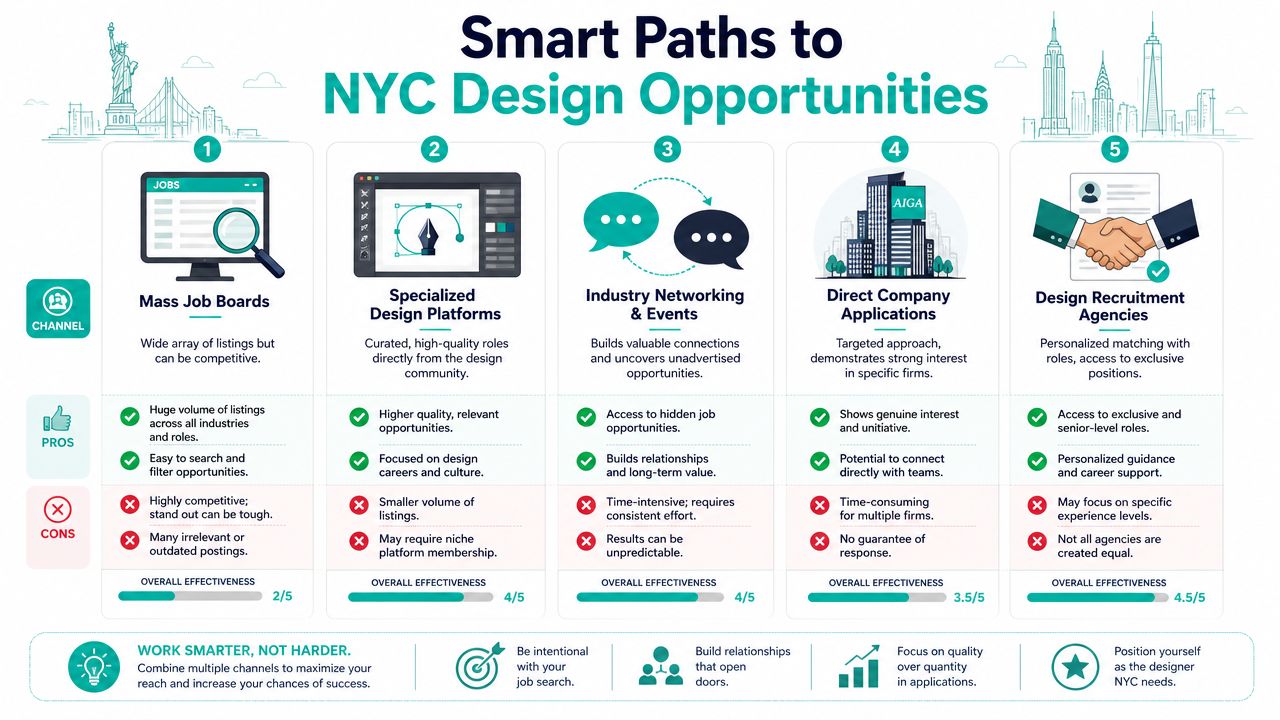
Here's the practical version.
| Channel | Good for | Usually weak on |
|---|---|---|
| Mass job boards | Volume, market scanning, title research | Context, role quality, startup filtering |
| Specialized design platforms | Better-fit creative roles, stronger curation | Narrower inventory |
| Direct company applications | Highly targeted outreach | Time cost if your targets aren't hiring seriously |
| Networking | Warm context, unposted roles, referrals | Slow if you start only when you need a job |
| Recruiters and curated marketplaces | Match quality, signal, hiring-manager access | Fit depends on specialization and review standards |
Mass boards still have a use. They're good for learning language. You can see how companies describe product design, brand design, UX, or technical design work. But they're bad for prioritization because every listing looks equally urgent when you're tired and scrolling.
Startups rarely hire designers just to “add design capacity.” They hire because a product surface is changing, a growth motion needs support, a team needs its first real systems thinker, or founders are tired of design debt.
That's why curated channels matter more than people think. A marketplace like Underdog's guide to NYC tech startup jobs is useful for understanding the startup side of the market, and platforms such as Underdog.io itself work differently from broad job boards because candidates become visible to vetted companies instead of manually chasing every listing one by one.
That model fits startup design hiring better than brute-force applications do. It helps when the role is nuanced and the strongest signal is your overall profile, not your speed at clicking “Easy Apply.”
Hiring filter: If a role could mean five different things from the job post alone, don't apply before you've found a way to clarify the team, stage, and actual design scope.
A smart design jobs NYC search usually mixes channels instead of betting on one.
Try this:
The biggest mistake is treating all openings as equivalent. They're not. Some are broad talent collection posts. Some are backfills with a hidden favorite candidate. Some are real and urgent. Your job is to get better at telling the difference before you invest a week in prep.
The most useful networking I've seen in NYC rarely looks like networking. It looks like good professional citizenship repeated over time.
One designer comments thoughtfully on a product launch teardown in a Slack group. Another shares a sharp observation after a meetup talk instead of asking for a job. A third sends a concise LinkedIn message after seeing someone discuss onboarding flows, then follows up weeks later with a relevant portfolio update. Those people don't feel pushy. They feel familiar.

A weak networking move is asking for fifteen minutes from a stranger when you haven't shown any real point of connection.
A stronger move is narrower. You message a product designer at a New York startup and say you appreciated how they explained a trade-off between speed and usability in a recent post. You mention one specific thing you're working on that overlaps. You ask one answerable question. That opens a conversation.
Offline, the same rule applies. After a meetup, don't try to summarize your life story. Ask what kind of design problems their team struggles with most. The answer usually tells you more than the talk did.
Scenario one. You join a niche design Slack or Discord and consistently contribute useful comments on tooling, critique, prototyping, or handoff. After people recognize your name, your portfolio gets read with more trust because you're no longer random.
Scenario two. You post work and thinking on LinkedIn in a way that demonstrates judgment, not self-branding. If you want more reach for posts that are worth promoting, a tool like this LinkedIn Free Promotion Tool can help amplify visibility. The point isn't vanity. It's giving your work more chances to reach the right peers and hiring managers.
Don't network by asking people to validate your ambition. Network by helping them see how you think.
If networking feels awkward, use a simple cadence:
That rhythm compounds because it creates familiarity before urgency enters the picture. Then when a role opens, you aren't introducing yourself from zero.
The interview stage is where many strong designers accidentally flatten themselves. They show polished screens, talk vaguely about “the user,” and leave the team unsure whether they can handle real production pressure.
That's fixable.
A lot of NYC design interviews, especially for technical or operationally heavy roles, test whether you can manage workflow, not just visuals. A typical New York technical designer posting expects candidates to handle the process from spec sheets and fit sessions to BOMs and TOP sample tracking, which means interviews often probe for end-to-end process ownership, as shown in this NYC technical designer job posting context.
In startup interviews, teams want evidence in four areas:
If you present a case study live, don't narrate every screen in chronological order. That wastes time and hides your judgment.
Use this structure instead:
That's easier for a panel to follow, and it sounds closer to how actual teams operate.
Interview rule: If you can't explain the constraint, your solution won't sound credible.
Whiteboard or live exercises often make designers overperform polish and underperform clarity.
The winning move is not brilliance. It's composure.
Say what assumptions you're making. State what you'd validate first. Identify where you need engineering input. Show how you'd reduce ambiguity before expanding scope. A candidate who does that usually feels safer to hire than one who races into flashy flows with no operating logic.
If you're expecting offer discussions, review practical frameworks for how to counter a job offer before the process reaches the final round. Negotiation gets easier when you've already decided what matters to you.
Candidates often treat negotiation like a confidence test. It's better to treat it like role calibration.
You're not arguing that you “deserve more” in the abstract. You're explaining the level at which you can operate. If your portfolio and interviews showed ownership, cross-functional fluency, and the ability to run projects with limited hand-holding, those are the reasons to ask for stronger compensation.
Keep the language straightforward:
That's more effective than generic market talk. It ties your ask to the work they need done.
The biggest misconception about design jobs NYC candidates hold is that the market has one clear center. It doesn't. It has overlapping standards. Brand teams, product orgs, agencies, fashion, media, and startups all look for different combinations of craft, speed, and ownership.
National labor data helps frame that. The U.S. Bureau of Labor Statistics projects 2% growth for graphic designers from 2024 to 2034 and reports a median annual wage of $61,300 in May 2024, which helps explain why major metros stand apart when they offer denser specialization and stronger pay, as shown in the BLS overview for graphic designers.
Do I need years of experience for an entry-level role?
Not always. But you do need work that looks usable in a real team setting. Entry-level candidates lose out less because of tenure and more because their portfolio still reads like school or self-initiated concept work with no constraints.
Should I specialize or stay broad?
Early on, broad is fine if your story is coherent. “I do everything” is weak. “I'm strongest in product design, with enough brand and motion fluency to support a startup team” is much stronger.
What about AI?
Learn the tools, but don't anchor your value to tool access. Hiring teams still care most about reasoning, prioritization, communication, and your ability to turn ambiguity into decisions.
Is work-life balance bad by default in NYC tech?
It depends more on company stage, leadership quality, and product maturity than on the city itself. Some teams run cleanly. Some create chaos and call it speed.
Use the table below as a directional framework, not a universal rule. The only hard benchmark available in the source set is that New York designers averaged $124,278 annually in Q1 2024 in the state industry research referenced earlier, while national median pay for graphic designers was lower in the BLS data above.
| Role | Junior (1-3 years) | Mid-Level (3-6 years) | Senior (6+ years) |
|---|---|---|---|
| UI/UX Designer | Varies by company, portfolio strength, and scope | Often evaluated on product thinking and collaboration depth | Usually tied to ownership of ambiguous work and cross-functional influence |
| Product Designer | Often requires stronger systems thinking than title suggests | Typically depends on shipping history and autonomy | Usually reflects strategic involvement, not just execution quality |
| Brand Designer | Depends on whether role is campaign, systems, or broader creative | Often rises with range across digital and marketing surfaces | Usually linked to leadership in identity systems and team collaboration |
The right way to use salary benchmarks is to pair them with scope. A title alone won't tell you enough. Ask what you'll own, who you'll work with, how design is measured, and whether the team needs execution, systems, or leadership.
If you want startup-focused design roles without spending weeks sorting weak-fit listings, Underdog.io is one practical option. You submit one application, your profile is reviewed for fit, and vetted tech companies can reach out when your background matches what they need. That setup is useful if you're aiming for startup hiring environments where context and signal matter more than application volume.