You're probably already good at your job.
Maybe you're a backend engineer who's shipped real systems, a product manager who can untangle messy roadmaps, or a designer who knows how to simplify something hard without making it bland. You've decided New York City is the next move, so you open LinkedIn, Indeed, maybe Built In NYC, and start applying.
Then the usual thing happens. You submit solid applications and hear nothing. Recruiters reach out for roles that barely match your background. “Easy Apply” turns into low-quality volume. The process feels busy, but not productive.
That's the first lesson in how to get a job in NYC tech. The city has a huge market, but the startup side doesn't reward generic effort. It rewards signal. If you want serious conversations with strong teams, you need to position yourself like a candidate startups can trust quickly, then use channels that reduce noise instead of adding to it.
New York City isn't a side market anymore. The local tech sector has surged by 160% over the past two business cycles, and tech jobs in the city have outnumbered Wall Street roles since 2020, according to the NYC Comptroller's spotlight on the tech sector. In the same report, Computer Engineering roles showed a 1,150% year-over-year increase.
That kind of growth creates opportunity, but it also changes how hiring works. Startups move fast, teams stay lean, and hiring managers don't have time to decode vague resumes or chase candidates who look polished but unproven. They want evidence. Can you own a messy problem? Can you ship without waiting for perfect specs? Can you communicate clearly with product, design, and founders?
Practical rule: In NYC startup hiring, being qualified isn't enough. You need to be legible.
A lot of experienced candidates miss this. They run a corporate search in a startup market. They optimize for quantity, trust large job boards too much, and hope their background speaks for itself.
It usually doesn't.
The candidates who break through tend to do three things differently:
If you want to know how to get a job in NYC without wasting months in applicant tracking systems, that's the playbook.
A startup resume isn't a biography. It's an argument.
Founders and startup hiring managers scan for signs that you'll increase velocity, reduce risk, or raise the team's ceiling. They don't care that you were “responsible for cross-functional collaboration” unless you show what happened because of that work. They don't care where you studied nearly as much as whether you can make progress in an environment with changing priorities and imperfect information.
That shift matters even more because 60% of NYC startups now prioritize skills-based hiring over degree requirements, according to TestGorilla's write-up on skills-based hiring in underserved communities.
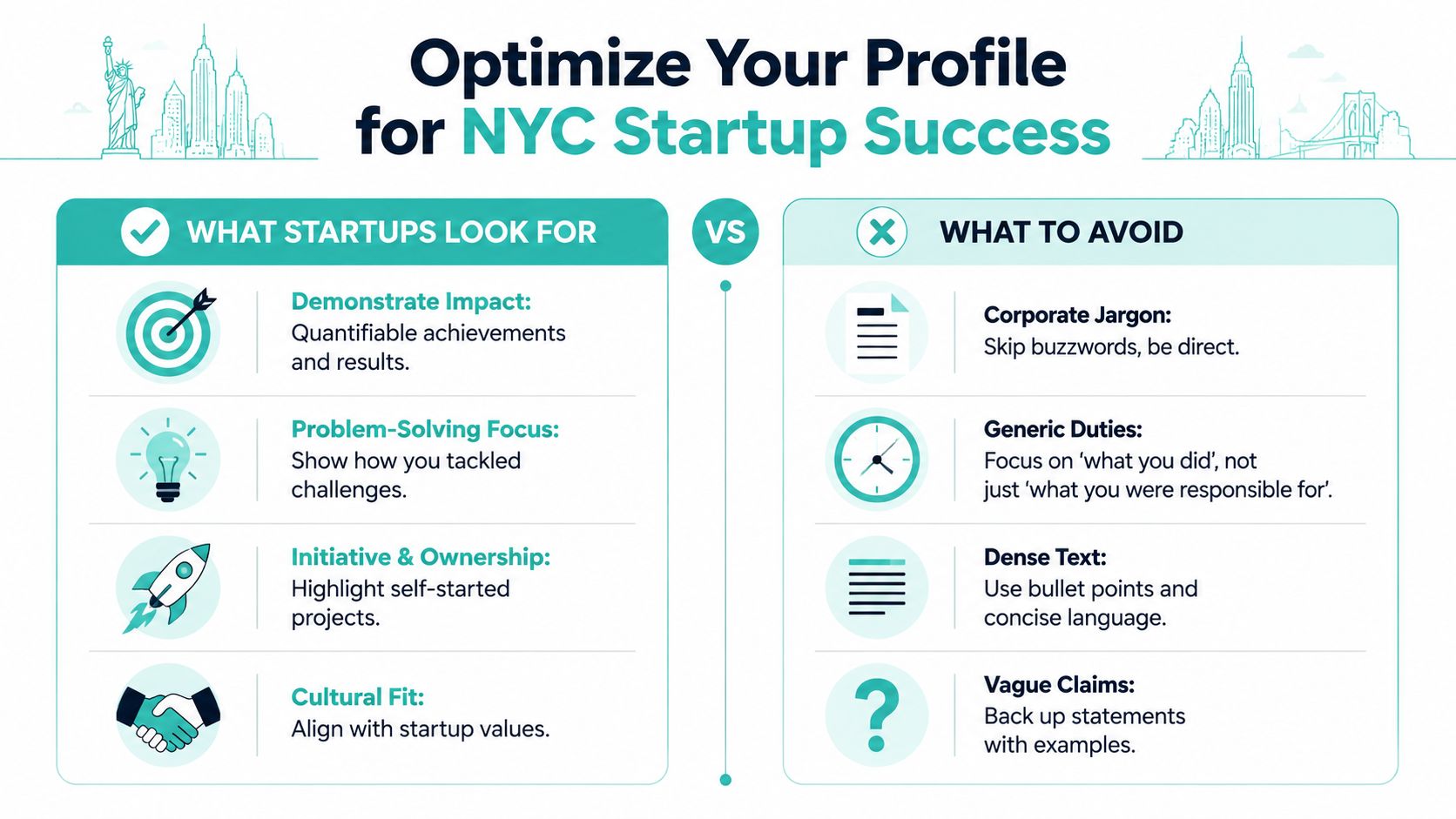
Most summaries are dead space. They're stuffed with adjectives, broad claims, and titles that could belong to anyone.
Compare the difference:
| Weak version | Strong version |
|---|---|
| “Experienced software engineer with a passion for innovation and collaboration.” | “Backend engineer who's built internal platforms, API-heavy systems, and developer tooling. Strong in ambiguous environments where speed matters and ownership is expected.” |
| “Product manager with excellent communication skills and a track record of success.” | “Product manager who's led zero-to-one launches, cleaned up noisy roadmaps, and partnered closely with engineering on execution trade-offs.” |
The second version gives a hiring manager a frame. They can place you in their company.
Most candidates describe duties. Startups hire outcomes and judgment.
Use this checklist when rewriting experience bullets:
A weak bullet says you “worked on internal tooling.” A stronger one says you built internal tooling that reduced manual operational work, improved developer workflows, or gave stakeholders self-serve visibility.
If you're tempted to let AI write the whole thing, slow down. Generic outputs often flatten the exact signals startup teams look for. This breakdown of Why AI resume writers fail startups is useful because it explains where polished language starts to sound interchangeable.
Your LinkedIn profile matters. Your GitHub, portfolio, and personal site often matter more.
For engineers, GitHub should show curiosity and taste. That doesn't mean ten abandoned repos. It means a few projects with clear README files, sensible commit history, and enough explanation that someone can understand the problem you tackled.
For product and design candidates, a portfolio should show decisions, not just screenshots.
Use a structure like this:
That structure reads like startup work because startup work is mostly constrained decision-making.
If your profile makes a stranger trust your judgment before they meet you, it's doing its job.
One more practical move. Read through how to get recruited by startups and compare it against your current materials. If your profile still reads like a corporate archive instead of a startup case for hire, rewrite it before you apply anywhere.
Most candidates use the same search stack. LinkedIn. Indeed. Maybe Built In NYC. That gives them access to volume, but it also puts them in the same pile as everyone else.
There's nothing wrong with broad platforms if you use them deliberately. The problem is treating them as your main engine. In startup hiring, the highest-quality roles often get filled through tighter channels long before mass applicants have a real shot.
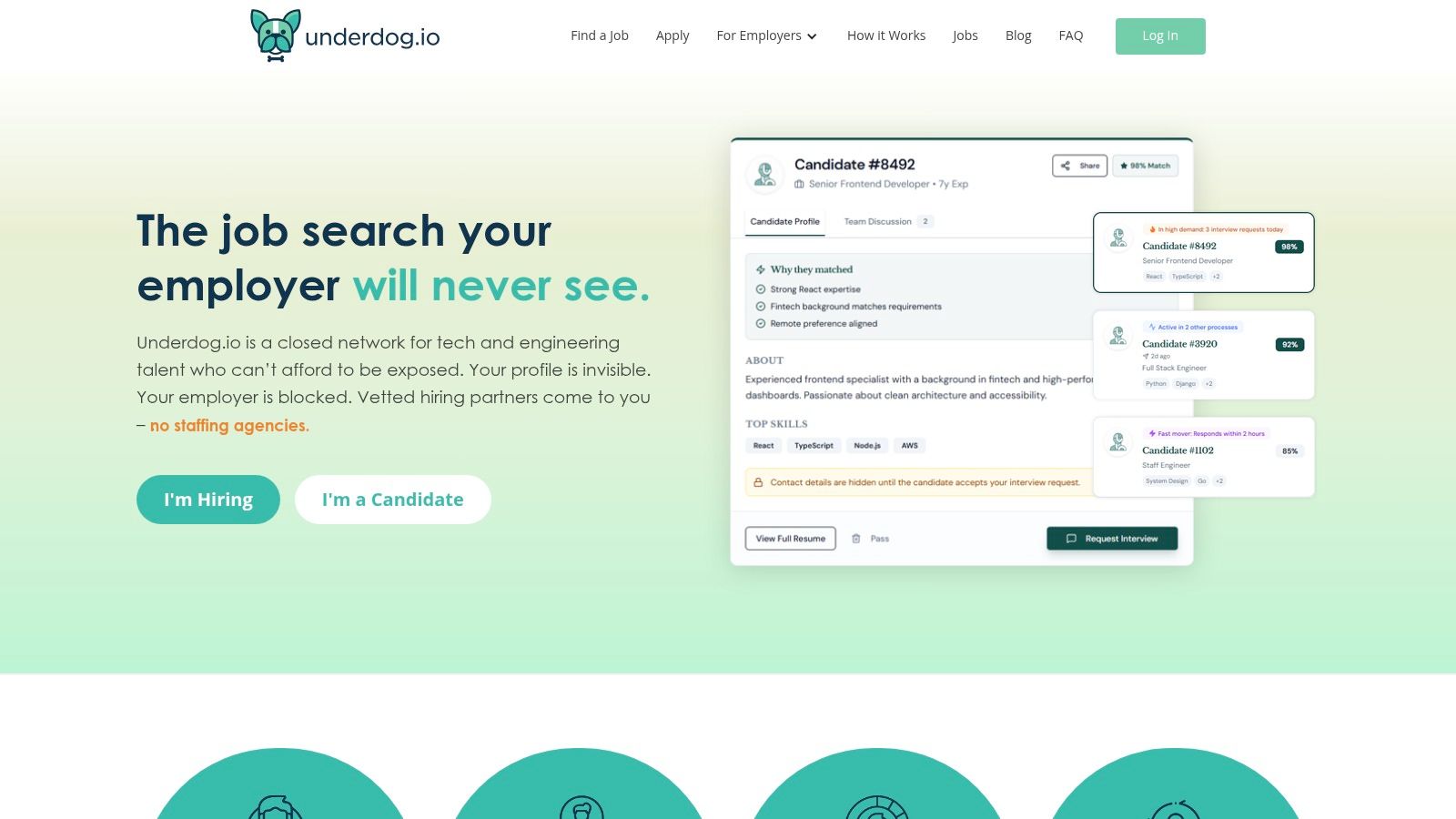
They're useful for market mapping.
You can learn how companies title roles, which teams are hiring repeatedly, and what patterns keep appearing in descriptions. If you're trying to understand how to get a job in NYC as an engineer, this gives you quick signal on demand. The strongest demand is in backend, full-stack, and infrastructure engineering, while AI and machine learning roles are growing fastest. Senior software engineer base salaries in NYC typically range from $140,000 to $190,000 before equity and bonuses, according to Underdog's overview of cool places to work in NYC.
Use job boards to study the market. Don't rely on them to carry your search.
Curated channels narrow competition and improve fit. Instead of fighting for attention in public, you place yourself where hiring teams are already filtering for relevant experience.
A few examples:
Different search methods work better for different candidates.
| Candidate type | Better channel | Why |
|---|---|---|
| Senior engineer with startup experience | Curated marketplace or warm intro | Teams can evaluate fit quickly and often want to move discreetly |
| Product manager with niche domain expertise | Targeted outreach | Your relevance may be obvious to a founder but invisible in keyword screening |
| Designer with strong portfolio but nontraditional background | Community and direct outreach | Visual proof and thoughtful outreach can beat credential filters |
| Passive candidate who can't signal publicly | Curated and confidential channels | Lower exposure, less noise, better conversation quality |
A practical weekly rhythm works better than endless browsing:
That rhythm sounds slower. It usually works faster.
The best networking in NYC tech rarely sounds like networking.
It sounds like someone who understands your product asking a sharp question. It sounds like a thoughtful comment on a founder's post. It sounds like a short note after an event saying, “Your team's approach to onboarding stood out. I'd love to stay close to what you're building.”
That matters because New York has real density. As of July 2026, the city is home to 282 actively hiring Y Combinator-funded startups with roles across engineering, AI, UX, and operations, according to Y Combinator's New York hiring directory. There are a lot of companies worth knowing. There are also a lot of candidates trying to talk to the same people.

Here's the kind of message that gets ignored:
Hi, I'm exploring opportunities in NYC and would love to connect. Please let me know if your company is hiring.
There's no signal in that. It creates work for the reader.
Here's a better version:
I've been following your team's work on developer workflows. The way you simplified setup for new users stood out. I've worked on backend tooling and internal platform problems in similar environments. If you're adding engineers this quarter, I'd be glad to share a few relevant projects.
That works because it shows three things fast. You paid attention. You're relevant. You're easy to evaluate.
If you don't live in the city yet, you can still build useful proximity.
Try this approach for a few weeks before direct outreach:
For a founder:
“Your team seems to be hiring around a real product inflection point. I've worked in environments where the challenge was scaling backend reliability without slowing feature work. If that's a current pressure point for you, I'd be happy to send over a few relevant examples.”
For a PM or engineering manager:
“I'm evaluating a move into NYC startup roles and your team's work caught my eye. I'm not looking for a generic networking chat. I'm trying to understand how your team thinks about shipping speed versus system quality, since that's been a recurring theme in my work.”
Good networking creates recognition before there's a requisition attached to your name.
That's the insider move. Don't ask strangers to solve your job search. Give them enough context to understand why talking to you might be useful.
Startup interviews in NYC tend to feel less scripted than corporate loops. That's not because they're casual. It's because teams are trying to answer a different question.
They're not just asking whether you can do the work. They're asking whether you can do it in an environment where priorities change, teams are small, and the line between strategy and execution is thin.

The titles vary, but most startup interviews include a version of these steps:
Initial screen
This is often less about your technical depth than your trajectory. Why this kind of company, why now, and why this problem space?
Functional evaluation
Engineers may get a coding round, systems conversation, or take-home. Product candidates may get product sense, execution, or case-style prompts. Designers may walk through portfolio work in detail.
Team or cross-functional interviews
During these interviews, communication style and working habits become visible. Can you explain trade-offs? Can you disagree without becoming rigid?
Founder or executive conversation
At smaller companies, conviction gets tested. Founders want to know whether you understand what kind of mess you're signing up for.
They don't memorize perfect answers. They prepare decision stories.
For each major project, be ready to explain:
This works across functions because startup teams hire judgment under pressure.
A few practical examples:
Many candidates overbuild take-homes. That's a mistake.
A good submission shows prioritization. It doesn't try to prove you can do a month of unpaid work. State assumptions. Name what you'd do with more time. Make your reasoning obvious.
If you need help sounding more concise and confident in interviews, this guide on build confidence for work conversations with ChatPal is useful because it focuses on how to speak clearly under pressure rather than how to sound rehearsed.
The best interview answers sound like calm problem-solving, not polished theater.
A lot of candidates lose before the interview starts because they rely on formal applications for companies that don't manage inbound well.
A better route is targeted outreach. Identifying Series A to B startups and contacting founders or hiring managers directly with proof of work yields significantly higher success rates than standard job board applications, which are often described as “dead on arrival” at growing startups in Garrett A. Wolfe's guide to getting a startup job.
That doesn't mean spamming founders. It means sending short, relevant outreach tied to a real need and a credible example of your work.
Compensation at startups is a bundle. Salary matters, but so do equity, level, reporting line, scope, and timing.
When equity comes up, make sure you understand:
Ask direct questions. A serious company won't be offended by that. They'll usually respect it.
If you're deciding between two offers, pick the one where expectations are clearest. Ambiguity in a job description is manageable. Ambiguity in ownership, compensation mechanics, or decision rights becomes painful fast.
Getting the offer is one milestone. Making the move work is the next one.
A lot of people spend weeks optimizing the search, then handle relocation and onboarding like afterthoughts. That's backwards. Early friction in housing, commute planning, or team alignment can drain energy you should be using to build trust and momentum.
If you're relocating, don't lock yourself into the first apartment that looks acceptable on a listing site. Give yourself some room to learn the city around your actual work rhythms.
A practical bridge option is a short-term setup or sublet while you learn where your office, teammates, and social orbit sit. If you're considering that route, this overview of understanding New York City subleases is a useful primer on what to review before signing anything.
A few relocation principles help:
Your first month isn't about proving you're brilliant. It's about reducing uncertainty around you.
Do these early:
By this point, your team should know you can execute. Now they need to know how you think.
Use this phase to:
| Time window | Priority | What it should look like |
|---|---|---|
| First 30 days | Learn and de-risk | Clear notes, useful questions, one small win |
| Days 30 to 60 | Build trust | Better communication, good follow-through, sensible trade-offs |
| Days 60 to 90 | Expand scope | Own a tougher problem, propose improvements, influence planning |
Here, strong startup hires separate themselves.
You should be able to point to one area where you've improved clarity, speed, quality, or decision-making. That might mean cleaning up a process, shipping something with visible impact, or becoming the person who can reliably drive a messy problem forward.
Early success in a startup usually comes from making other people's work easier, not from trying to look impressive.
That mindset helps whether you're moving across the country or just changing teams across town.
The wrong way to approach New York startup hiring is to act like a resume in a giant database and hope the market notices.
The better way is to operate like a selective candidate entering a selective ecosystem. Tighten your profile until it clearly signals ownership and judgment. Use channels that improve conversation quality instead of maximizing application count. Build familiarity with companies before you ask for anything. Show up in interviews like someone who understands startup trade-offs, not someone reciting polished answers.
That approach works because startup teams don't hire the same way large companies do. They hire for proof, clarity, and relevance. They want candidates who understand what early-stage work feels like when priorities move, resources are limited, and every hire changes the team.
If you're serious about learning how to get a job in NYC, spend less time asking, “How many applications should I send?” and more time asking, “How quickly can a good hiring manager understand why I fit this specific company?”
That's the true conversion point.
A practical search in this market looks narrower from the outside. Fewer applications. More research. Better outreach. More intentional conversations. It feels slower at first because you're doing more thinking. Then it starts compounding.
If you need places to focus your target list, reviewing top NYC tech companies is a useful starting point for understanding the industry and deciding where your background is most relevant.
The candidates who do well here usually aren't louder. They're clearer. They know what they offer, who needs it, and how to get in front of the right people without getting buried in job board noise.
If you want a quieter, more curated path into startup hiring, Underdog.io is one option to explore. It lets experienced tech candidates create a single profile and get introduced to vetted startup opportunities, which can be useful if you want to avoid mass applications and keep your search more discreet.