Series B funding is the second major round of venture capital a startup raises. It's for companies that have already found their footing, proven their business model works, and now need a serious injection of cash to hit the accelerator. This is the growth and expansion phase, where a startup shifts from just finding an audience to aggressively capturing a huge slice of the market.
Think of a startup's life cycle like a rocket launch.
The first money in, the Seed round, is like building the rocket in a garage. It's about turning a great idea into a real prototype or a minimum viable product (MVP). Then comes Series A, which is the successful launch. You've gotten the rocket off the ground, proved it can fly, and found a consistent group of users who love what you're doing.
Series B funding is the next, much more powerful engine burn. This is the fuel needed to break out of Earth's orbit and genuinely aim for the moon. It’s no longer about proving the concept; it's all about scaling what already works.

To really get what Series B is all about, you have to see how it stacks up against the stages that come before it. Each funding round has a very different purpose, and the amount of money involved changes based on how mature the company is and how much traction it can show.
The key differences really come down to three things:
At the Series B stage, investors are no longer betting on just a vision. They are investing in a proven business model with clear data showing it can grow efficiently and predictably.
This distinction is everything. A Series A company might get a round of applause for hitting its first $1 million in annual recurring revenue (ARR). A Series B company, on the other hand, is expected to take its funding and multiply that number several times over. The whole game shifts from validation to domination.
To make this crystal clear, here’s a quick look at how the early funding stages compare.
This table breaks down the primary goals and typical investment sizes for the first few critical funding rounds.
As you can see, each stage represents a significant step up in both ambition and capital. By the time a company reaches Series B, it's playing in a completely different league.
As a startup moves from Series A to Series B, the cast of characters on the investor side of the table changes. The early-believer angel investors and smaller seed funds who wrote checks based on a vision and a prayer often take a step back.
In their place come the heavy hitters: established venture capital (VC) firms and sometimes even growth equity funds. These aren't people investing in a dream anymore; they're investing in a proven, repeatable business model. Their process is less about the founder's charisma and more about intense, rigorous due diligence. They want to see the math behind the magic.
While a compelling story still matters, Series B investors demand hard numbers. They need proof that a startup is ready to scale efficiently, and they have a specific set of key performance indicators (KPIs) they use to check the company's health.
For most software-as-a-service (SaaS) companies, it boils down to three critical metrics:
These metrics never live in isolation. The real story emerges when you look at how they relate to each other.
The ultimate test for any Series B hopeful is the relationship between what it costs to get a customer and how much that customer is worth over time. This is all captured in the LTV to CAC ratio.
For most VCs, the magic number is an LTV/CAC ratio of 3:1 or higher. This signals a healthy, sustainable business. It means for every dollar spent to acquire a customer, the company can expect to get at least three dollars back over that customer's lifetime. Anything less might point to problems with pricing, customer retention, or an inefficient sales process.
Let's make this real. Imagine a SaaS startup called "ScaleUp" that sells project management software.
Now, let's say the average ScaleUp customer pays $200 a month and typically stays subscribed for 30 months.
A 6:1 ratio is exactly what gets a Series B investor to sit up and pay attention. It’s hard proof that ScaleUp has built a profitable growth engine. Every dollar they pour into marketing and sales generates six dollars in return. The company isn't just growing; it's growing efficiently. This is the kind of data that convinces a VC to write a $30 million check, giving ScaleUp the fuel to pour right back into its proven acquisition machine and start dominating the market.
To really get what Series B funding means for a startup, you have to look at what’s happening in the market right now. This isn't just another step on the funding ladder; it's become a massive milestone that separates the promising companies from the ones truly poised to dominate an industry. The capital flowing into this stage is serious, validating the winners in a cutthroat tech environment.
For tech professionals, understanding these dynamics is crucial. A company that successfully locks in a Series B round isn’t just getting by—it’s thriving. It has been put under the microscope by sophisticated investors and handed the resources to scale its operations, product, and—most importantly—its team. This is where the hiring blitz often begins.
The sheer size and scope of these deals can be eye-opening. Recent data shows just how much capital is being pumped into companies at this stage. Between January and April 2025, a total of 115 Series B financing rounds were completed, injecting a huge amount of cash into the ecosystem.
The average deal size during this period was a staggering $182.4 million. However, the median was a more grounded $38 million, which tells you that a few monster deals are pulling that average way up. For a closer look at these trends, you can explore recent Series B funding data from Fundraise Insider.
This huge gap between the average and the median reveals an important truth: while many companies are raising solid, healthy rounds in the tens of millions, a handful of perceived superstars are securing "mega-rounds" that skew the numbers.
The capital isn't spread evenly. In March 2025, for instance, the total deployed in Series B rounds shot up to $15.87 billion across just 29 deals, driven largely by massive investments into the AI sector.
This points to a market that’s making highly strategic, concentrated bets on companies it believes can deliver outsized returns. For a job seeker, this means a Series B company, especially one in a hot sector like AI, is likely sitting on a mountain of cash and ready for a major growth spurt.
Investors don't just throw this kind of money around blindly. They pour capital into companies because the data tells a crystal-clear story of scalable, repeatable growth. The chart below gives you a snapshot of the core metrics a Series B company needs to have nailed to attract this level of investment.
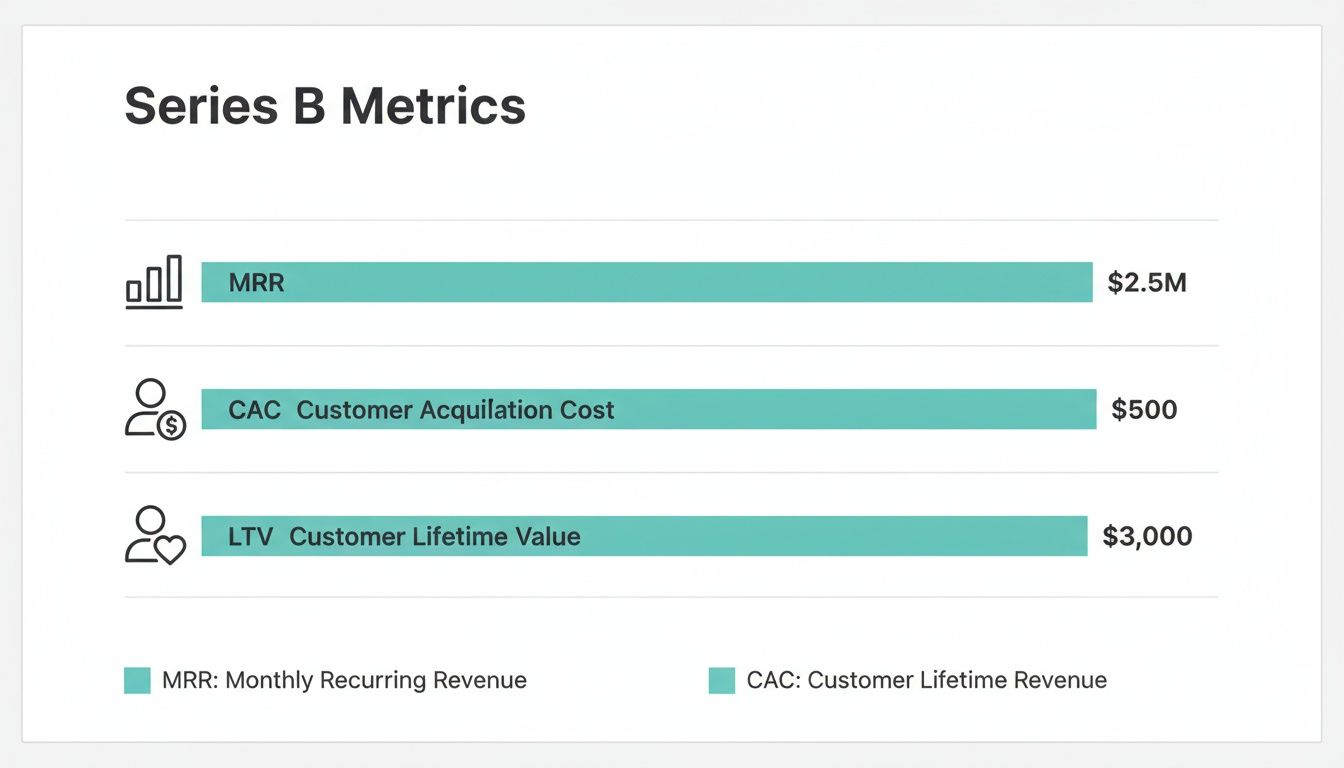
This demonstrates the healthy economic engine investors are looking for: strong, predictable recurring revenue (MRR) paired with a low customer acquisition cost (CAC) and a high lifetime value (LTV). This balance proves the business model isn't just working—it’s efficient and profitable over the long haul, making it a perfect candidate for a major growth investment.
Landing a huge Series B round is one of those moments that completely changes the game for a startup. It's like a shot of adrenaline. The primary goal from investors is no longer just "prove this works" but to hit hyper-growth—a full-throttle, relentless push to scale the business, and fast. This cash infusion flips a switch, taking the company out of survival mode and putting it squarely into expansion territory.
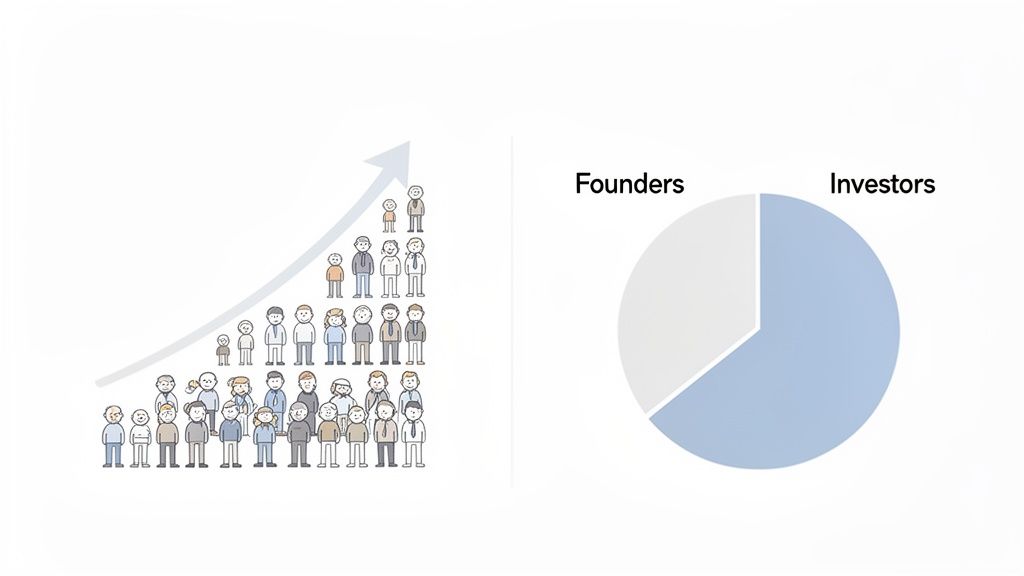
That mandate for growth translates into immediate, aggressive action. The new capital is put to work building out the teams that will actually drive that expansion.
The first order of business is almost always a hiring blitz. The engineering team might double to accelerate the product roadmap, while the sales and marketing departments get massive budget increases to bring in customers faster. It’s not uncommon for a company to morph from a small, tight-knit crew into a multi-department organization in just a few months.
This expansion isn't just about headcount; it’s about geography, too. A startup that was once focused on a single country might use its Series B funds to:
While all this rapid scaling is exciting, it also brings on new pressures and complexities that can challenge the startup's core identity.
With millions in the bank comes immense pressure to perform. Investors expect to see a clear return on their investment, which means hitting ambitious quarterly targets for revenue, user growth, and market penetration. The informal, all-hands-on-deck culture of an early-stage company often starts to shift, making way for more structure, formal departments, and new layers of management.
Another major consequence is equity dilution. Think of the company's ownership as a pie. Before this funding round, the founders and early employees owned all the slices. To get the new investment, the company has to bake a bigger pie by creating new slices for the Series B investors.
While the pie itself gets much larger and more valuable, the original owners' individual slices become proportionally smaller. This is a necessary trade-off to fuel the growth that makes everyone's remaining equity worth far more.
Understanding this dynamic is crucial for everyone involved. For a deeper dive, you can learn more about how equity dilution works for startup employees and what it really means for your financial stake in the company. This shift from a small, scrappy team to a structured, high-growth organization is what truly defines the post-Series B journey.
The venture capital world doesn’t exist in a bubble. To really get a feel for what Series B funding means today, you have to look at where the big money is flowing. Right now, two massive currents are reshaping the entire investment landscape: enormous "mega-rounds" and an almost obsessive focus on Artificial Intelligence.
This flood of cash can make it seem like only a handful of AI giants are getting funded. But if you look closer, you'll see a much more interesting picture, with incredible opportunities for growth and great jobs across many different industries.
Investment has become incredibly concentrated at the very top. A huge chunk of all global venture funding in 2025 went to a surprisingly small number of companies raising rounds of $500 million or more. Of this, AI companies claimed a massive share, pulling in $226 billion in 2025, which was 48% of total venture funding. To get the full story on these trends, you can explore detailed insights from Crunchbase News on 2025 venture funding.
The data paints a pretty stark picture: a ton of capital is chasing a select few, often AI-centric, companies. For anyone looking for a job, this means an AI startup that just closed a Series B round is probably swimming in cash and getting ready to expand aggressively.
This intense focus on AI creates a "halo effect." Companies that can genuinely weave AI into their business models—whether they're in biotech, finance, or logistics—are attracting premium valuations and much larger funding rounds.
But the story doesn't end with AI. While the spotlight is definitely bright, it doesn’t light up the whole stage. Plenty of strong, scalable businesses in other sectors are still securing serious capital and building impressive teams.
Even with all the cash pouring into AI, other vital industries continue to attract serious investment, including at the Series B stage. The numbers show a healthy, diverse funding environment for companies with proven business models, no matter what sector they're in.
Here’s a glimpse at where else the money went in 2025:
For tech professionals, this is a critical takeaway. The AI gold rush is real, but it hasn't closed the door on opportunities elsewhere. A Series B in healthcare from a firm like Index Ventures or a fintech round from a16z is a powerful signal of stability and growth. It’s proof that even outside the AI spotlight, there are fantastic, well-funded companies scaling up fast and hunting for top talent.
Joining a startup that’s just closed its Series B round can feel like catching a perfect wave. It's that sweet spot between the chaotic, scrappy days and the slow-moving stability of a big corporation. You get the thrill of high growth, but with a bit more of a safety net.
But let’s be real: not all Series B companies are created equal. As a job seeker, you can use your understanding of this funding stage to pop the hood and see what’s really going on. This is your chance to make a genuinely smart career move, not just a leap of faith.
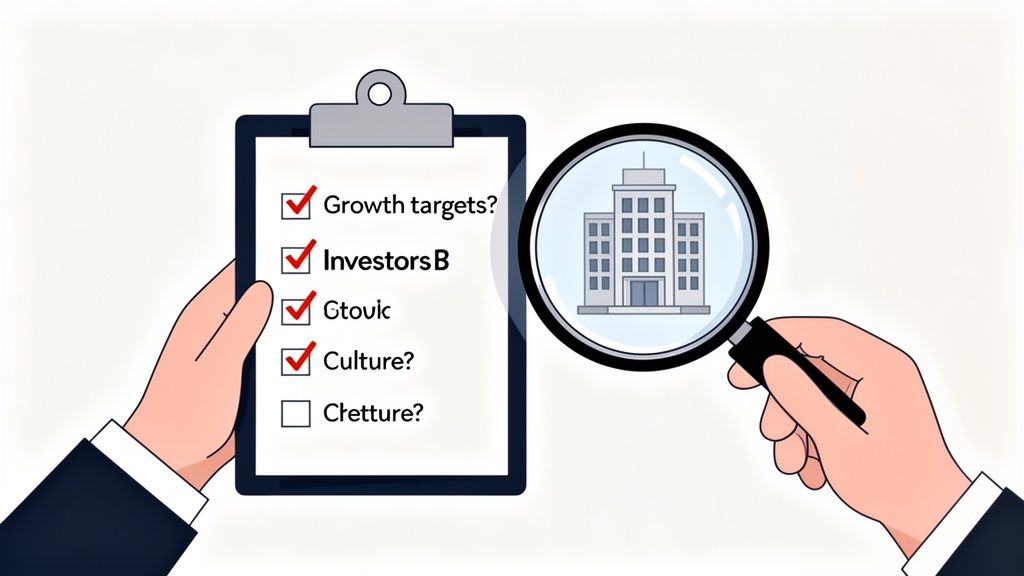
Think of the interview process as your own personal due diligence. It’s absolutely a two-way street. You’re not just there to answer questions; you’re there to ask them, digging in to understand the company’s health, its real vision, and its culture. It’s time to move beyond the generic questions about the role.
Your questions should zero in on the direct implications of that big new investment. This move shows you’ve done your homework and get the pressures—and massive opportunities—that come with a Series B check.
Here are a few sharp, insightful questions to weave into your conversations:
Asking targeted questions about the funding round demonstrates your business acumen and helps you uncover the reality behind the press release. It shifts the conversation from what the company does to where it’s going—and how it plans to get there.
The "who" behind the money is just as important as how much was raised. The reputation of the lead investor in a Series B round is a powerful signal about the startup's long-term potential and stability. Top-tier VC firms like Index Ventures or Dawn Capital have a track record for a reason.
Their involvement suggests two critical things:
A quick search on the lead investor can tell you a lot about their portfolio and investment thesis. Do they specialize in your industry? Do they have a history of guiding companies to successful exits or IPOs? For more tips on this, you can check out our guide on how to evaluate early-stage startup jobs.
By combining insightful questions with solid research on the investors, you can build a truly comprehensive picture of the opportunity. This is how you move beyond the excitement of a funding announcement and make a strategic, clear-eyed decision about your next career chapter.
So, what does all of this mean in the real world? For founders deep in the trenches or for anyone thinking about joining a startup at this stage, the world of funding can bring up a lot of practical questions. Let's break down some of the most common ones.
Brace yourself: raising a Series B is an absolute marathon, not a sprint. The whole ordeal typically takes anywhere from three to six months from the first conversation to money in the bank.
That timeline covers a ton of ground. It starts with intense preparation—pulling together detailed financial models, crafting a killer pitch deck, and getting your story straight. Then comes the outreach and the endless circuit of investor meetings. But the real time-suck is often the due diligence phase, where investors put every single part of your business under a microscope before they'll even think about signing a term sheet.
Failing to lock down a Series B is a make-or-break moment. It's a tough spot to be in, and it forces some very hard decisions. A company that can't get the round closed usually has a few paths forward, none of them easy.
A successful Series B isn't just about the cash. It's a huge stamp of approval from the market. It tells the world that the company has cleared a major hurdle where many, many others have failed.
Almost never. In fact, you'll find that the vast majority of startups raising a Series B are unprofitable—and that’s completely by design.
The money from this round isn't meant to just keep the lights on. It’s rocket fuel. The plan is to pour it aggressively into growth: hiring dozens of new engineers, launching expensive marketing campaigns, and maybe even expanding into new countries. Investors at this stage are betting on a proven, scalable business model, not on immediate profitability. They're backing the idea that spending big today will capture a massive chunk of the market and lead to enormous profits down the road.
This is a critical piece of context for anyone weighing a job offer from a Series B company. You can learn more about how to evaluate a job offer to make sure you're seeing the full picture. It's also smart to understand what a competitive benefits package looks like, especially with new generations entering the workforce and changing the game; these insights on what Gen Z employees are looking for when job hunting can be a real eye-opener.
Series B funding is the stage where a successful startup raises significant capital to scale rapidly. It's for companies that have a proven product and strong user base, and now need investment to expand their team, enter new markets, and outpace competitors. The focus shifts from finding a market fit to dominating it.
The main difference is the company's maturity and goal. Seed funding is for developing an idea and building a prototype. Series A is for optimizing the product and finding a repeatable business model. Series B is for taking that proven model and aggressively scaling it. Investors at this stage expect hard data on revenue, customer acquisition costs, and long-term value, not just a compelling vision.
Investors scrutinize metrics that prove efficient and sustainable growth. The most critical are Monthly Recurring Revenue (MRR) for predictable income, Customer Acquisition Cost (CAC) to see if growth is profitable, and Customer Lifetime Value (LTV) to gauge long-term profitability. The ideal LTV to CAC ratio is 3:1, proving the company's growth engine is healthy.
A company transforms rapidly. It typically shifts from a small, agile team to a more structured organization. This involves a massive hiring spree across sales, marketing, engineering, and international expansion. While exciting, it also brings new pressures to meet ambitious growth targets and often leads to cultural shifts as more management layers are added.
It's a strong signal of stability and growth. A company that has closed a Series B round has been rigorously vetted by top investors and has the capital to execute ambitious plans. For job seekers, this often means a wealth of new, high-impact roles, competitive compensation, and the chance to join a company at a pivotal moment of expansion, especially in hot sectors like AI.
Ready to join a high-growth startup? Underdog.io connects top tech talent with innovative companies that are actively scaling. Get matched with your next big opportunity. Apply in 60 seconds.