Read Time: 7 min read
The difference between a winning startup team and a mediocre one isn't a lucky hire or a slick job post—it's a deliberate, strategic recruitment plan.
When you get intentional about planning for recruitment, you shift from frantically filling empty seats to proactively building the exact team you need to crush your product roadmap and hit your business goals. This is the leap from just hiring to strategically scaling.
When you’re an early-stage company, the pressure to hire right now is immense. A critical project is slipping, a key player just resigned, or a fresh funding round suddenly greenlights a dozen new roles. The knee-jerk reaction? Slap together a job description and pray for the best.
This is what we call "ad-hoc" or reactive hiring. While it might patch a hole for a week or two, it almost always creates bigger, more expensive problems down the line.
Falling into the reactive hiring trap is a massive resource drain. We see it all the time: startups pay a premium for talent out of sheer desperation or, even worse, settle for candidates who aren't a good long-term fit. These mis-hires are poison. A bad hire can easily cost you up to 30% of their first-year salary when you factor in lost productivity, recruitment fees, and team morale.
The damage from a reactive approach goes way beyond the balance sheet. It kicks off a vicious cycle of inefficiency that can completely stall a high-growth company's momentum.
Sound familiar?
Think of a well-defined planning process as your company’s immune system against bad hires. It forces you to anticipate needs, align every role with a business goal, and build a pipeline before you're in crisis mode.
This proactive mindset is a total game-changer. It shifts your focus from just filling a position to making a strategic investment in your company’s future. It makes you answer the tough questions before you even think about writing a job description: What skills will we need in six months? Which role will have the biggest impact on our Q3 OKRs? How do we build a team that can deliver today and scale for tomorrow?
That's exactly what this playbook is designed to help you do. Let’s dig in.
Before we dive into the step-by-step process, it helps to have a high-level map of where we're going. These are the core pillars that every successful startup recruitment plan is built on.
Think of this table as your cheat sheet. Each pillar is a critical component we’ll break down in the following sections, giving you a complete framework to build your team the right way.
A hiring roadmap shouldn't be a simple list of open roles. Think of it as a direct translation of your company’s ambition into a strategic talent plan. It’s what bridges the gap between a high-level goal, like "increase user retention by 15%," and the specific people you need to get there—say, one Senior Data Analyst and one Customer Success Manager.
The whole process kicks off when you look at your business goals for the next two to four quarters.
Your product roadmap, sales targets, and expansion plans are the key ingredients. For instance, if your big Q3 goal is to launch a new mobile app, you can immediately start mapping that back to the hires you'll need. That probably means an iOS Engineer needs to start in Q1 to build the MVP, and a Product Marketing Manager should join in Q2 to prep for the launch.
This kind of forward-thinking prevents the last-minute scramble that leads to reactive, and often desperate, hiring. It turns recruitment into a proactive engine that builds momentum, not just a frantic effort to plug leaks.
Start by listing out your major business initiatives for the next 6-12 months. Then, sit down with your department leads to figure out what each initiative actually requires from a people perspective.
You need to ask pointed questions to get real answers:
Don't forget to account for potential attrition. A solid plan always includes a buffer for unexpected departures, which is typically around 10-15% of your current team size, depending on your company's history. This ensures that losing one key person doesn't completely derail your roadmap. A key part of building this robust roadmap is employing strategic workforce planning to make sure you have the right talent lined up.
Practical Example: Deconstructing a Goal
Business Goal: "Launch our enterprise-tier product by the end of Q4."
Hiring Translation:
Once you have a headcount forecast, it's time to attach some real numbers to it. A classic startup mistake is only budgeting for salary. The true cost of hiring is always higher, and underestimating it can put a serious strain on your cash flow.
A simple way to calculate the Total Cost-Per-Hire includes a few key components:
Let's say you plan to hire a software engineer with a $150,000 salary. A realistic budget for that one hire might look a lot closer to $190,000 once you factor in all the associated costs. Building a comprehensive budget like this prevents nasty financial surprises and makes sure you have the resources to not only hire but also successfully onboard your new team members. If you're building out your first team, our guide on how to build a talent pipeline has more strategies to get you started on the right foot.
The process flow below gives you a bird's-eye view of the journey from high-level forecasting to active sourcing.
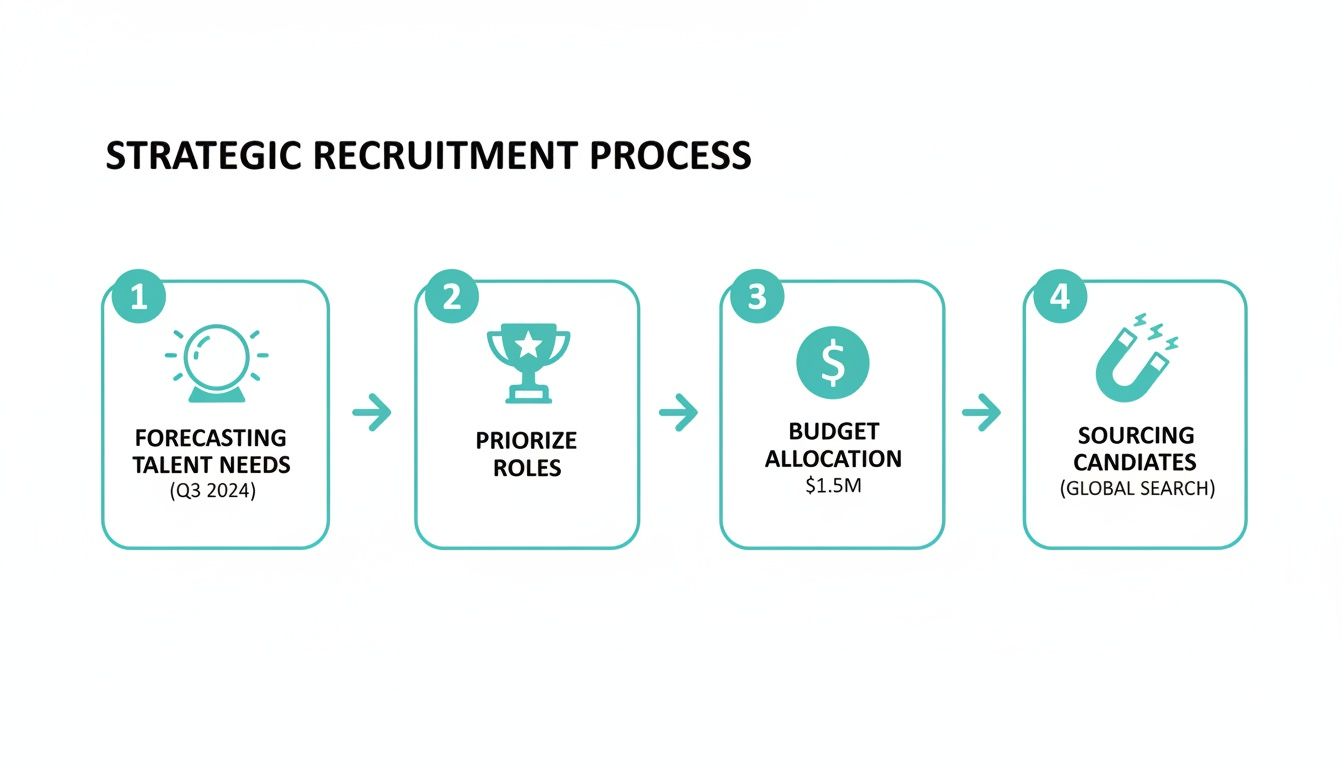
This visual reinforces that great recruitment is a sequenced, strategic effort—not just a series of disconnected tasks.
Today’s tech recruitment landscape absolutely demands this level of planning. Talent shortages persist, with 37% of companies unable to fill open roles last year, often because of a skills mismatch. And while recent layoffs have added over 500,000 tech workers to the market since 2022, bringing the total U.S. tech talent pool to 6.2 million, the competition for top-tier talent hasn't eased.
For hiring managers, this means planning has to be precise. You need to focus on forecasting your needs for high-demand roles like cybersecurity and data analysis while partnering with curated marketplaces to get access to vetted talent.
Okay, you’ve got your hiring roadmap. Now, the game shifts from who you need to hire to how you’re going to get them in the door.
In the cutthroat world of tech, a boring, task-based job description is the fastest way to get ignored. The best people aren't just looking for another job; they're looking for a mission. They want a challenge and a place where they can actually make a difference.
Think of your job description as your most important piece of marketing. It needs to tell a compelling story. Ditch the long laundry list of "responsibilities" and lead with the "why." What problem is this role solving? What exciting projects will this person get to own?
For example, don't just say, "Write clean, efficient code for our backend services." Frame it as an opportunity: "Build and scale the core APIs that power our real-time data processing engine, directly impacting how thousands of users make critical business decisions." One is a task; the other is a mission.
Before you write a single word of that job description, you need to be crystal clear on what success actually looks like for this role. This is where a role scorecard becomes your secret weapon. It’s a simple internal document that forces you to define the role's purpose, key outcomes, and necessary skills before you even think about sourcing.
This simple tool gets your entire hiring team on the same page and prevents that all-too-common problem where every interviewer is assessing candidates against a different set of criteria.
Here’s a practical template to get you started:
A well-defined role scorecard is your North Star. It not only helps you write a better job description but also provides a structured framework for interviews, ensuring you’re evaluating every candidate consistently and fairly.
Once your role is clearly defined, it's time to find the right people. Relying solely on traditional job boards is like fishing in a crowded, overfished pond. Today, the vast majority of top tech professionals are passive talent—they're currently employed and not actively looking for a new job.
This means you have to go where the talent is. It’s time to move beyond the "post and pray" method and embrace a more proactive, multi-channel approach. To make sure your efforts are strategic, it's worth digging into a full guide on How to Recruit Top Talent: A Modern Playbook.
The current tech hiring market adds another layer of complexity. New graduate hiring has plummeted by 50% from pre-pandemic levels, creating a 'lost generation' of entry-level talent. With Big Tech hiring new grads at just 7% of their total intake and startups at under 6%, companies are forced to compete for experienced professionals. Since 85% of candidates are passive, proactive planning is essential to connect with mid-level engineers and product managers who have valuable startup experience.
For any startup, time and resources are everything. Sifting through hundreds of irrelevant applications from a generic job board is a massive time sink. This is exactly why curated talent marketplaces like Underdog.io have become a go-to for high-growth teams.
Unlike job boards that are open to everyone, these platforms vet both the candidates and the companies. This creates a high-signal, low-noise environment where every connection is far more likely to be a great fit.
Just look at the difference in the approach:
Using a curated marketplace fundamentally changes the game. Instead of you chasing candidates, you get introduced to a qualified, interested pool of professionals. This lets your team spend less time on low-value screening and more time having high-value conversations—a critical advantage when you’re trying to build a world-class team. Of course, your ability to attract these folks is also tied to your reputation, so it pays to be intentional about strengthening your employer brand to attract top talent.
A frustrating, disorganized interview process is one of the fastest ways to lose the exact candidates you want to hire. Let's be honest: top tech talent has options. They won't stick around for a process that disrespects their time or fails to get them excited about joining your team.
This is where thoughtful planning comes in. The goal is to map out every single touchpoint, creating an experience that’s structured, fair, and genuinely engaging. When you get this right, your interview loop transforms from a simple evaluation tool into a powerful extension of your employer brand.
Even candidates who don't get an offer should walk away feeling respected and impressed. That’s how you build a great reputation.
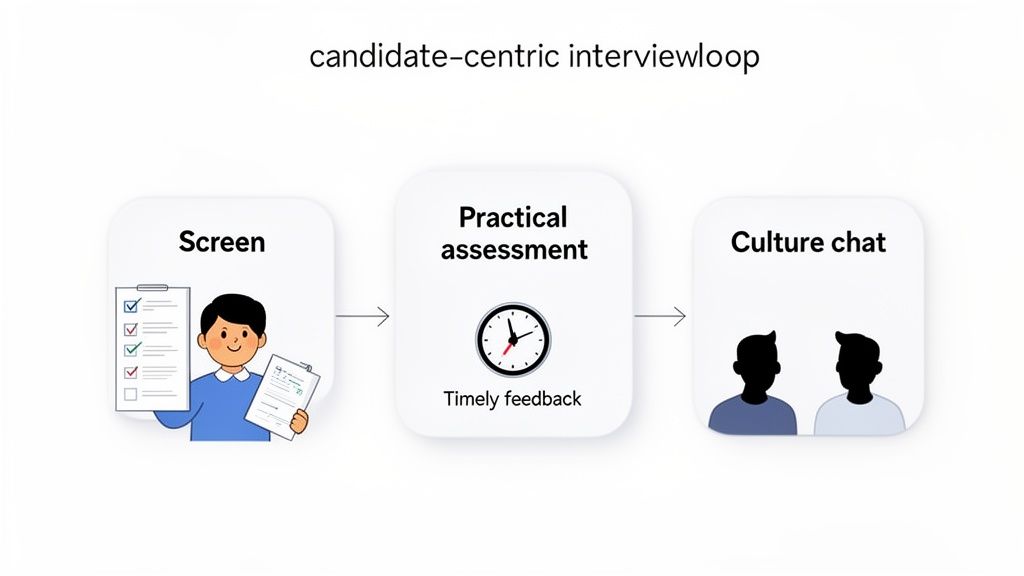
A well-designed process balances rigorous skill assessment with a real effort to get to know the candidate as a person. Critically, it needs to be consistent for every candidate applying for the same role. This is the only way to reduce bias and ensure you're making fair comparisons.
A strong interview loop doesn't have to be overly complicated. A well-structured process is more effective than a marathon of interviews. Below is a sample interview loop that has been proven to work well for startups hiring engineers. It balances rigor with a positive experience.
Ultimately, this structure ensures each stage has a distinct purpose, moving the conversation forward without being repetitive or wasting anyone's time.
A great interview loop feels like a well-choreographed conversation, not an interrogation. Each stage should have a clear purpose, and the candidate should know exactly what to expect at every step.
The secret to a standout process lies in the details. Small, thoughtful actions build up to create a powerful overall impression. This isn't just about being nice; it's about showing candidates you are organized, respectful, and a place where they can do their best work.
Start with clear and consistent communication. Always send an agenda before each interview detailing who they'll meet and what topics you'll cover. This simple step reduces anxiety and helps candidates prepare, allowing their true abilities to shine through.
After the interviews, timely feedback is non-negotiable. Aim to provide an update or a final decision within 48-72 hours. Leaving candidates in the dark for weeks is a surefire way to damage your reputation and lose out on great talent. For a deeper dive, our guide covers more candidate experience best practices that can make a huge difference.
Finally, training your interview team is absolutely critical. Equip them with the tools to conduct structured interviews and reduce unconscious bias. Make sure everyone understands the role scorecard and is assessing candidates against the same objective criteria, not just on "gut feel." This consistency is the backbone of a fair and effective hiring process.
You’ve spent weeks sourcing, screening, and interviewing. Now comes the moment that trips up so many startups: the offer. Getting your top candidate to say 'yes' isn't just a numbers game. It's about selling a compelling vision of their future with your company, and it requires a strategy that blends competitive pay with a clear runway for success.
Remember, the entire process—from the first outreach to the final interview—has been a long conversation. This last step should feel like a natural conclusion to that dialogue, not a cold, transactional ultimatum. A well-crafted offer is your chance to prove you’ve been listening and that you genuinely see this person as a critical part of your future.
Let's be real: trying to outbid Google on salary is a losing battle for most startups. Your real power lies in creating a balanced package where meaningful equity creates an opportunity for a significant long-term win.
To do this right, you need to anchor your offer in solid data. Use industry reports and compensation platforms to benchmark salary bands for similar roles, company stages, and locations. This data-driven approach takes the guesswork out of the equation and immediately positions your offer as fair and well-researched.
When it comes to equity, transparency is non-negotiable. Don't just throw out a number of stock options and hope for the best. You have to explain what it actually means.
The time between a candidate accepting an offer and their actual start date is a critical—and often ignored—part of the hiring plan. A structured onboarding process doesn’t just calm new-hire jitters; it dramatically accelerates their ability to make an impact. In fact, organizations with a strong onboarding process improve new hire retention by 82%.
A great onboarding experience kicks off the second the offer is signed. This is your first opportunity to make your new teammate feel valued and prepared before they even walk through the door (virtual or otherwise).
Think of onboarding as the bridge between recruitment and retention. It's the first and best opportunity to validate a new hire's decision to join your team, transforming their initial excitement into long-term commitment.
A well-executed plan can turn what could be an overwhelming first few weeks into an empowering experience, setting the stage for a successful partnership from the very beginning.
The goal here is to provide structure and clarity, not to drown them with a firehose of information. A thoughtful plan for their first 30 days can make all the difference. Break it down into manageable, week-by-week goals.
Week 1: Welcome and Integration
Weeks 2-4: Learning and Contribution
A great recruitment plan isn't something you write once and file away. It’s a living document, a playbook that should get smarter with every single hire. The only way to make sure your strategy actually improves over time is to move beyond gut feelings and start looking at the data. Measuring what works—and what doesn't—is how you spot bottlenecks, celebrate wins, and sharpen your approach for the next hiring push.
You don't need a fancy, expensive analytics platform to get started. A simple spreadsheet can be your most powerful tool here. It’s all about turning raw data into real insights that make your next round of hiring more effective than the last.
For a startup, focus is everything. Instead of getting bogged down tracking dozens of vanity metrics, zero in on a few key performance indicators (KPIs) that give you a real-time health check on your hiring engine.
Here are the four I always recommend starting with:
The market is also throwing us a new curveball: AI. The competition for specialized talent is heating up fast, with AI-related job postings now making up 20% of all U.S. tech roles—that's double what it was. With 37% of tech firms saying they can't find the skilled people they need, your metrics have to do more than just look backward. They need to track how well you're building talent pipelines for the future. You can dig deeper into this trend to better understand the talent landscape in 2025.
The point of tracking metrics isn't to hit perfect numbers on a dashboard. It's to tell a story about your hiring process—where it's strong, where it's breaking, and how you can make it better.
Data can tell you what's happening, but it rarely tells you why. That's where the hiring retrospective comes in. It’s an absolute game-changer.
Once a role is filled, get everyone who was involved in the process in a room—the hiring manager, the interviewers, the recruiter. It's time for a candid, no-blame conversation.
Ask pointed questions to get to the good stuff:
This kind of qualitative feedback, when you pair it with your hard data, creates an incredibly powerful feedback loop. It stops recruiting from feeling like a series of one-off tasks and turns it into a system of continuous improvement. This is how your team gets better, faster, and smarter at bringing the right people through the door.
For most roles, you should start your headcount planning at least one to two quarters ahead of time. This buffer is crucial—it gives you the breathing room to properly spec out the role, lock in a realistic budget, and build a pipeline of great candidates without scrambling.
When it comes to critical leadership hires, you need to think even further ahead. I always advise founders to start that process 6-9 months before they need someone in the seat. That's the only way to do a thorough, high-quality search for the kind of leader who can change your company's trajectory.
Without a doubt, it's reactive hiring. You wait until a department is on fire, a key person quits, or the workload becomes completely unsustainable, and then you start looking for someone. It’s a recipe for disaster.
This kind of crisis-driven hiring almost always leads to rushed decisions, bad hires who don't fit the culture, and overpaying for talent out of sheer desperation. Proactive planning is the antidote. It lets you be strategic and thoughtful, giving you the time to tap into curated talent pools before you're in a panic. You end up making the right long-term call for the team, not just a short-term fix.
You won’t win on salary alone, so don't even try to play that game. You have to compete on a different field entirely by leaning into what makes your startup a unique and compelling opportunity.
This is where you have to sell the vision and the experience. Your best levers are:
Strategic recruitment planning is the process of aligning your hiring activities with your company's long-term business goals. Instead of reactively filling open positions, it involves forecasting future talent needs, creating a hiring roadmap, and building a pipeline of candidates before you're in crisis mode. It shifts recruitment from an administrative task to a core business function.
Reactive, "fill-this-now" hiring creates expensive problems. It often leads to mismatched skillsets (hiring for an urgent need that isn't the real bottleneck), culture misfires (rushing a candidate who clashes with your values), and budget overruns (forgetting to account for recruiter fees or new software licenses). A bad hire can cost up to 30% of their first-year salary.
Start by listing your major business initiatives for the next 6-12 months. For each initiative, ask: "What skills and roles are required to achieve this?" For example, a goal to "launch an enterprise product by Q4" might translate to hiring a senior backend engineer in Q2 and an enterprise sales director in Q3. This forward-thinking prevents last-minute scrambles.
A role scorecard is an internal document that defines what success looks like for a specific role. It includes the role's mission (a single, powerful sentence), 3-5 measurable key outcomes for the first 6-12 months, and the core competencies required. It ensures your entire hiring team is aligned and evaluating candidates against the same criteria.
The total cost-per-hire includes far more than just base salary. You must account for equity, benefits and taxes (typically another 25-30% on top of salary), recruitment costs (platform fees, commissions), and onboarding costs (equipment, software, training time). A $150,000 engineer might realistically cost $190,000 in your budget.
Stop relying on generic job boards. Most top tech professionals are passive candidates—they're not actively looking. Use proactive, multi-channel sourcing: leverage founder networks for warm introductions, build a simple employee referral program, and engage authentically in niche communities where your ideal candidates already gather. Curated talent marketplaces can also connect you with pre-vetted, interested candidates.
A boring, task-based list of responsibilities is a candidate repellent. Frame the role as a mission. Lead with the "why"—the exciting problem they'll solve and the impact they'll have. For example, instead of "Write clean code," say "Build and scale the core APIs that power our real-time data engine, directly impacting how thousands of users make critical decisions."
Ready to stop sorting through endless applications and start meeting high-signal tech talent? Underdog.io connects you with a curated pool of vetted engineers, product managers, and designers actively looking for roles at startups like yours. Find your next great hire today.