Read Time: 7 min read
Wasting an engineer's time during an interview isn't just rude; it's a direct threat to your startup's growth. A slow, convoluted hiring process actively pushes top candidates toward competitors who move faster and show genuine respect for their time. This isn't just about courtesy—it's about competitive survival.
As a founder, you live and breathe urgency. Every decision, every product shipment, every customer conversation happens at a breakneck pace. Yet, this speed often grinds to a halt when it comes to hiring. The disconnect between a fast-moving startup and its sluggish, multi-stage interview process can be jarring for a candidate.
Let me paint a practical picture: a talented senior engineer, sourced from a curated talent pool, is genuinely excited about your mission. They crush the initial screen and the technical round. But then… silence. A week passes with no update. They get asked the same behavioral questions by three different people. The take-home project is a vague, 8-hour task completely unrelated to the actual job.
By the time you’re finally ready to make an offer, they’ve already accepted a position at a competitor that went from the first call to a signed offer in ten days. You lost because your process was a burden, not a filter.
This isn't just one lost candidate; it's a symptom of a process that bleeds talent, money, and reputation. A poor hiring experience has tangible, painful consequences:
The current tech hiring landscape is unforgiving. Back in 2021, companies hired engineers in about 33 days. That has now ballooned to 41 days on average, with teams conducting a staggering 42% more interviews for each hire. It’s no wonder 61% of candidates report being ghosted—a surefire way to alienate top talent for good.
The takeaway here is that a streamlined process isn't a "nice-to-have"—it's a critical competitive advantage. To really fix these inefficiencies, you need to actively improve your recruitment process. Honing your approach and putting the candidate experience first is how you win the war for talent. We cover this in-depth in our guide on candidate experience best practices.
Let’s be honest: the most meaningful way to respect an engineer's time is to make sure you’re only talking to people who are genuinely qualified and interested in the first place. This work starts long before anyone ever hops on a Zoom call.
If you want to stop wasting your team's valuable interview slots, you need to invest in solid, effective talent sourcing strategies that bring the right folks to your digital doorstep.
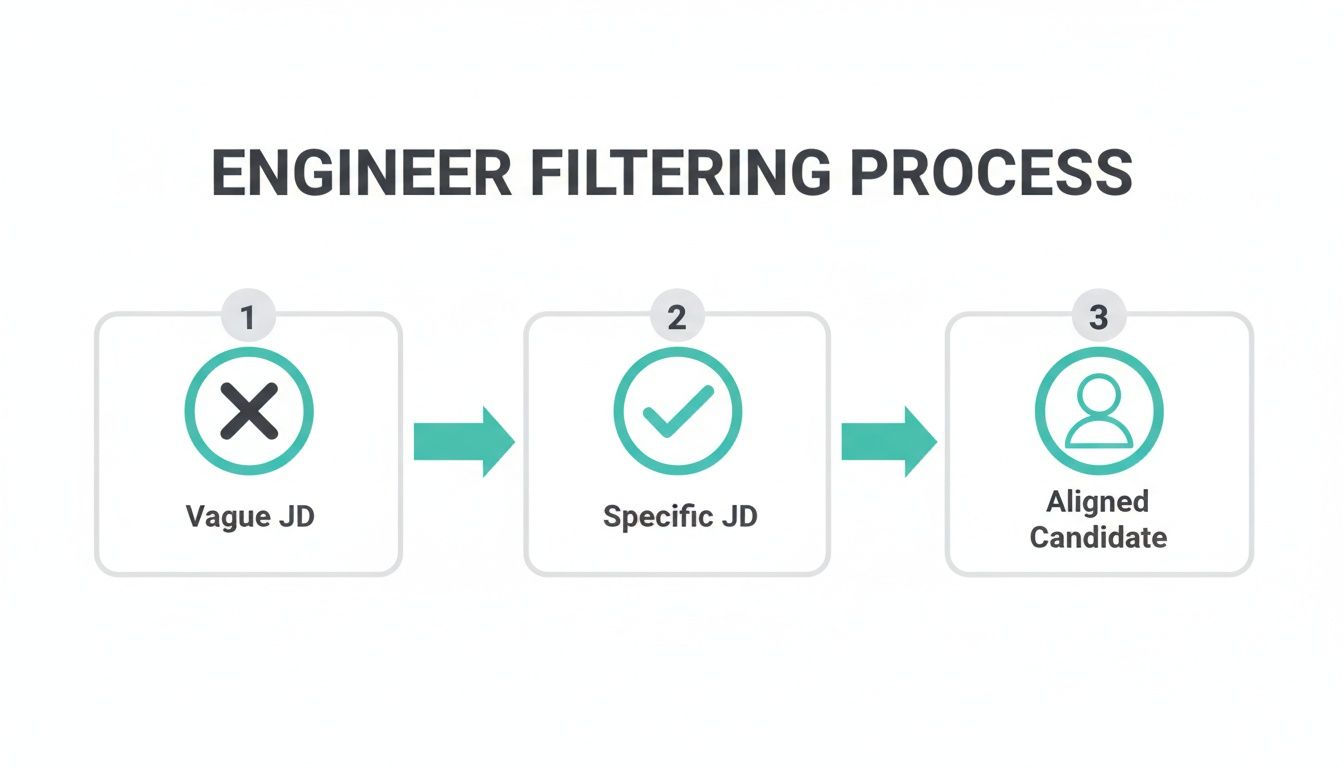
Your job description is the first and most powerful filter you have. A vague posting for a "Senior Engineer" is like putting out a giant net—you'll catch a ton of mismatched applications, forcing your team to sift through noise. It’s a massive time sink for everyone.
Instead, get hyper-specific. That generic title? Transform it into something with real substance, like "Senior Backend Engineer (Fintech Payments)." Just that simple tweak signals the domain and immediately attracts engineers who are actually excited about solving complex payment problems, while gently steering away those who aren’t a fit.
A great job description does two things equally well: it pulls in the right candidates and pushes away the wrong ones. The goal isn't just to get a high volume of applicants; it's to get a high volume of the right applicants. You need to move beyond a simple laundry list of technologies and start talking about the mission.
Clearly spell out the problems the new hire will be tackling in their first 90 days. This simple shift changes the entire conversation. It’s no longer about a list of required skills, but about a tangible, exciting challenge.
Think about the difference.
Here's a Vague, Uninspiring Example:
This describes thousands of jobs and attracts people who are just spraying and praying with their resumes.
Now, Here's a High-Fidelity Example:
This strategic front-loading does more than just describe a role—it builds a narrative. It tells a story about the impact the candidate will have, ensuring every initial conversation is with a well-aligned engineer who is already excited about your specific challenges.
By clearly separating "must-have" skills from "nice-to-haves," you create immediate clarity. A potential candidate can look at the list and self-select, knowing instantly if they meet the critical bar. This one distinction prevents a flood of unqualified applications and saves your engineering team from conducting interviews that were doomed from the start.
It’s time to ditch the Big Tech interview playbook. Founders often make the mistake of copying the complicated, multi-stage processes from giant corporations, completely forgetting that a startup's biggest advantages are speed and relevance. A bloated interview loop is a dead giveaway that you haven’t actually defined what you’re looking for.
The goal is simple: create a process that gives you the insights you need while being incredibly respectful of the candidate’s time. Each stage should be a high-signal filter designed to answer a specific question about their abilities, not just another box to check. This approach shows you value their expertise from the very first interaction.
Let’s be honest, the modern interview gauntlet is getting out of hand. Engineers are spending 40% more hours prepping for flawed system design challenges and LeetCode marathons than they did just a few years ago. With 82% of firms now demanding pixel-perfect solutions under that same pressure, your best candidates will simply ghost you when your process feels like a burden.
To see what I mean, let's compare two common approaches. One wastes everyone's time and filters for the wrong things, while the other is built for speed, accuracy, and a positive candidate experience that even a busy startup can manage.
The difference is night and day. A streamlined process doesn't just save time; it focuses every conversation on what actually matters for the role you're trying to fill.
This all starts before the first interview. The quality of your entire loop depends on the quality of your initial filtering. A specific, well-thought-out job description attracts the right people, which makes every subsequent stage far more efficient and meaningful.
The endless debate between live coding and take-home assignments misses the point. It’s not about which one is universally "better," but which tool will give you the specific signal you need at that stage.
A respectful live coding session should feel like a pair programming exercise, not an interrogation. The interviewer’s job is to be a collaborator—offering hints and guidance to see how the candidate thinks and communicates, not to watch them sweat.
Ultimately, designing a better loop comes down to empathy and clarity. By carefully structuring each stage and training your team on what to look for, you can build a process that top talent actually wants to go through. For more on getting your team ready, check out our guide on effective hiring manager interview training.
A brilliant interview loop design is completely worthless if the execution is clumsy. The little things—scheduling, communication, and prep work—are what separate a frustrating experience from one that makes a top engineer genuinely want to join your team.
Getting this right sends a powerful signal that your startup is organized, respectful, and a place where they can actually get things done.
Poor logistics are a shockingly common reason great candidates drop out. Think about it from their side: endless back-and-forth emails to find a time, a last-minute reschedule from your engineer, and an interviewer who shows up 10 minutes late. It screams chaos and disrespect.
Your first logistical touchpoint sets the tone. Instead of firing off a generic calendar invite, send candidates a clear, detailed agenda. This small act of transparency does wonders for reducing their anxiety and helps them prepare, which ultimately gets you a much better signal on their abilities.
Here's an actionable email template you can adapt:
Subject: Interview Details for [Role Name] at [Your Company]
Body: Hi [Candidate Name], looking forward to our chat on [Date] at [Time]! Here's a quick agenda so you know what to expect:
We'll start with a brief discussion about a challenging project from your resume.
Then, we'll spend about 30 minutes on a collaborative coding exercise in Python using CoderPad. The goal is to see how you approach problems, not to find a perfect solution.
This is a chance for us to learn about your working style and for you to ask questions about our team culture.
Sending a comprehensive agenda isn't just polite; it's a strategic move. It shows you have a structured, intentional process and that you respect the candidate's time enough to help them put their best foot forward.
The single biggest point of failure in any hiring process is an untrained interviewer. When you just throw engineers from your team into interviews without any alignment, you get disaster. They ask redundant questions, let their biases run wild, and fail to assess the skills that actually matter for the role.
It’s a massive waste of everyone’s time.
Actionable Insight: Hold a 30-minute pre-interview sync with your hiring panel for each role. In this meeting, you will:
When your interviewers are prepared and aligned, the entire experience feels professional and insightful. Candidates leave feeling challenged but respected—even if they don't get an offer. That positive experience is built on clear, two-way communication. Speaking of which, it's also why you must stop using no-reply emails for recruiting messages if you want to keep that connection strong.
The final 48 hours after an engineer’s last interview are the most critical you'll face in the entire hiring process. This is the moment of truth. You either win their trust and secure their talent, or you lose them to a competitor who moves faster and communicates better.
Slow decisions and radio silence? Those are guaranteed ways to waste all the time and effort invested—on both sides.
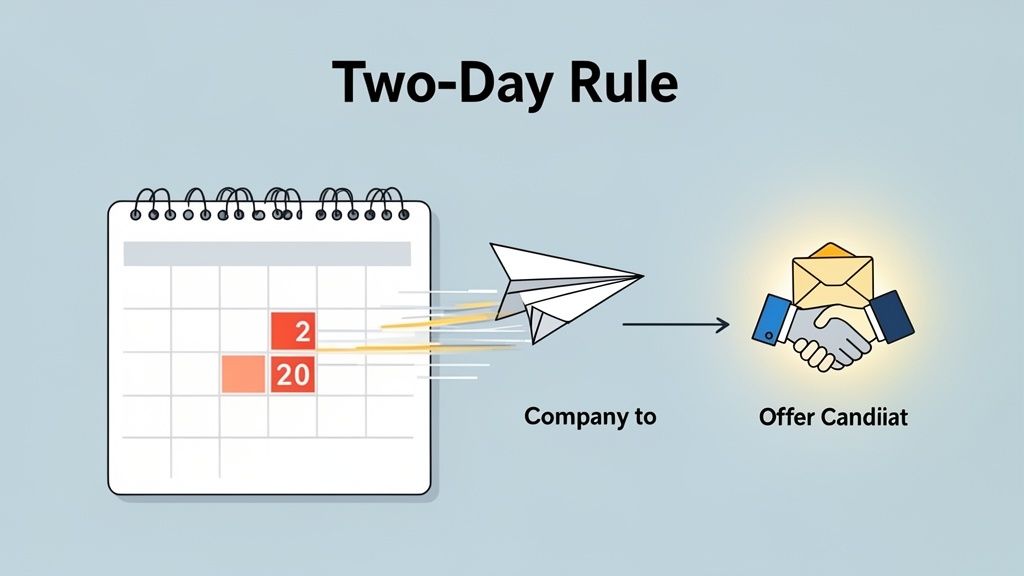
This is why you need to adopt the “Two-Day Rule.” Make it a non-negotiable policy that every single candidate gets a definitive update—either an offer or a rejection—within 48 business hours of their final conversation. Speed is a powerful signal. It tells a candidate you’re decisive, organized, and, most importantly, that you deeply respect their time.
Actionable Insight: Block 30 minutes on your calendar for the day after a final interview, labeled "Hiring Debrief." This forces a decision. Invite all interviewers. The only goal of this meeting is to make a hire/no-hire decision. This simple calendar habit prevents decisions from dragging on for days.
When you've found the right person, please don't just email a generic offer letter and call it a day. The absolute best way to show respect is with a personal phone call from you, the founder. This is your chance to sell the vision one last time and reinforce exactly why they are the perfect fit for the mission.
Here’s an actionable script for that call:
Rejecting a candidate is never easy, but how you do it defines your employer brand. Ghosting is completely unacceptable. A thoughtful rejection can turn a candidate you didn't hire into a potential advocate who speaks highly of your process.
Always send a personalized email, not a cold, automated template. The key is to be honest but kind. If you can, provide one or two pieces of specific, actionable feedback. This is a crucial step in not wasting an engineer's time, as it genuinely helps them in their ongoing search.
Actionable Example: Don't just say "we found a better fit." Try this instead:
"Hi [Candidate Name], thank you again for the time you invested with us. While the team was really impressed with your backend experience, we decided to move forward with a candidate whose fintech-specific background more closely aligned with our immediate roadmap. We’ll definitely keep you in mind for future roles."
This simple act of closing the loop with transparency and respect is the final, and perhaps most important, piece of the puzzle. It ensures that every single engineer who interacts with your company leaves with a positive impression, regardless of the outcome.
Even with the best-laid plans, a few tricky questions always seem to pop up during the hiring process. Let's tackle some of the most common ones founders and hiring managers run into.
Think of this as your go-to guide for those "what do we do when..." moments. Getting these details right is the difference between a process that just looks good on paper and one that actually respects an engineer's time.
For most engineering roles at a startup, the magic number is three to four stages, not necessarily separate "rounds" spread over weeks. If you’re going beyond that, you're hitting the point of diminishing returns. You risk burning out great candidates for very little new information.
An actionable, high-signal loop can be structured like this:
This entire process can be completed in under four hours of the candidate's time, often scheduled within a single week.
This one’s simple: it all comes down to the time commitment. If your take-home is going to take more than three hours of real, focused work, you should absolutely pay them for their time. It's the single best way to show you value their expertise right from the jump.
Actionable Rule of Thumb: If you can't complete the task yourself in under 90 minutes, it's too long for an unpaid assignment. Either shorten it or offer compensation. A flat fee of $150-$250 is a common and respectful rate for a 4-6 hour project.
Talk about it immediately. On the very first call. There is absolutely no reason to wait. Wasting hours of everyone's time only to find out you're miles apart on salary at the finish line is a massive failure of the process.
Actionable Insight: The most transparent and efficient method is to include the salary range directly in the job description. This pre-filters candidates for you. If you don't do that, the first question in your initial screen should be: "Just to make sure we're aligned and respect your time, the budget for this role is between $[X] and $[Y]. Does that range work for you?" This single question saves countless wasted hours.
The biggest time-wasters are a lengthy, disorganized process with too many rounds; poorly defined or irrelevant technical challenges that don't mirror real work; lack of communication and feedback between stages; and interviewers who are unprepared, leading to repetitive or off-topic questions. These issues frustrate candidates and harm your employer brand.
Replace multi-hour, abstract whiteboard coding with focused, practical assessments. Use a concise take-home project relevant to your stack or a 60-90 minute paired programming session on a real problem. Clearly define the scope and expectations upfront. This respects the candidate's time and gives you a better signal of their actual working skills and problem-solving approach.
Aim for a streamlined process of 3-4 key stages. This could include: 1) an initial screening call with a recruiter or hiring manager, 2) a technical skills assessment (e.g., practical coding challenge), 3) a series of focused interviews (e.g., system design, behavioral/cultural fit, maybe with the future team lead), and 4) a final conversation with leadership. Consolidate feedback to avoid bringing a candidate back for redundant conversations.
Critically important. Set and communicate a clear timeline for your process at the outset. After each stage, provide candidates with timely updates on next steps, even if it's just to say the review is in progress. Ghosting or long silences are major red flags for candidates and show a lack of respect for the time they've invested.
Consistency is key to fairness and efficiency. Develop a structured interview plan with core questions that every candidate is asked for a given role. Use a shared scoring rubric or scorecard to evaluate responses objectively. This ensures all interviewers are assessing the right skills, reduces bias, and prevents candidates from having to answer the same question multiple times in different forms.
Invest in interviewer training. Ensure every interviewer understands the role's requirements, the structured question set, and how to use the evaluation rubric. Encourage them to block time before the interview to review the candidate's materials and after to immediately document feedback. A prepared interviewer runs a tighter, more effective session.
Ready to connect with top-tier tech talent without the hassle? Underdog.io provides a curated pipeline of vetted engineers, designers, and product managers ready for their next role at a high-growth startup. Find your next great hire.