The product manager career path is a journey, one that takes you from executing on specific features to eventually shaping company-wide strategy. It’s a highly sought-after track that blends strategy, user empathy, and technical fluency, making it one of the most rewarding and impactful roles in the tech industry.
As you climb the ladder, you’ll typically move from an Associate Product Manager (APM) all the way to a Chief Product Officer (CPO).
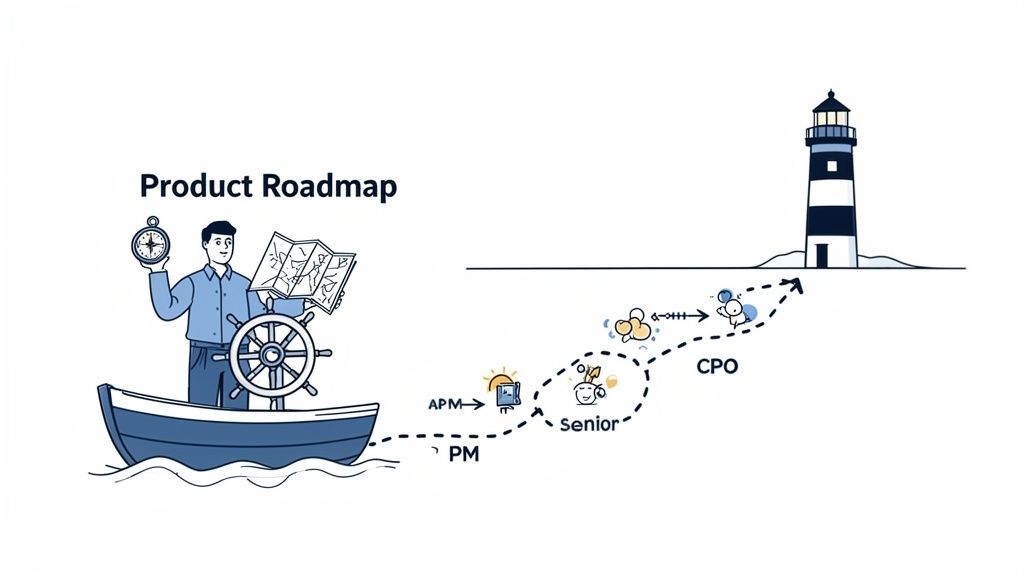
Think of a product manager as a ship's navigator. Early in your career, you’re focused on a single part of the journey—maybe charting a course through a specific channel. As you gain experience, your scope expands until you're overseeing the entire fleet, setting the destination, and managing the resources for every single voyage. That's the essence of the product manager career path.
This role has become a central engine for growth in modern tech companies. Recent data shows just how in-demand PMs are. After a dip in 2023, open PM roles rebounded, jumping by 53.6% in early 2024. This proves the sustained and growing need for skilled product leaders.
The path from an entry-level PM to an executive is all about expanding your scope and influence. You’ll go from managing features to managing entire products, and eventually, to managing the people who manage those products.
This graphic lays out the typical hierarchy, moving from an individual contributor to a key part of the executive leadership team.
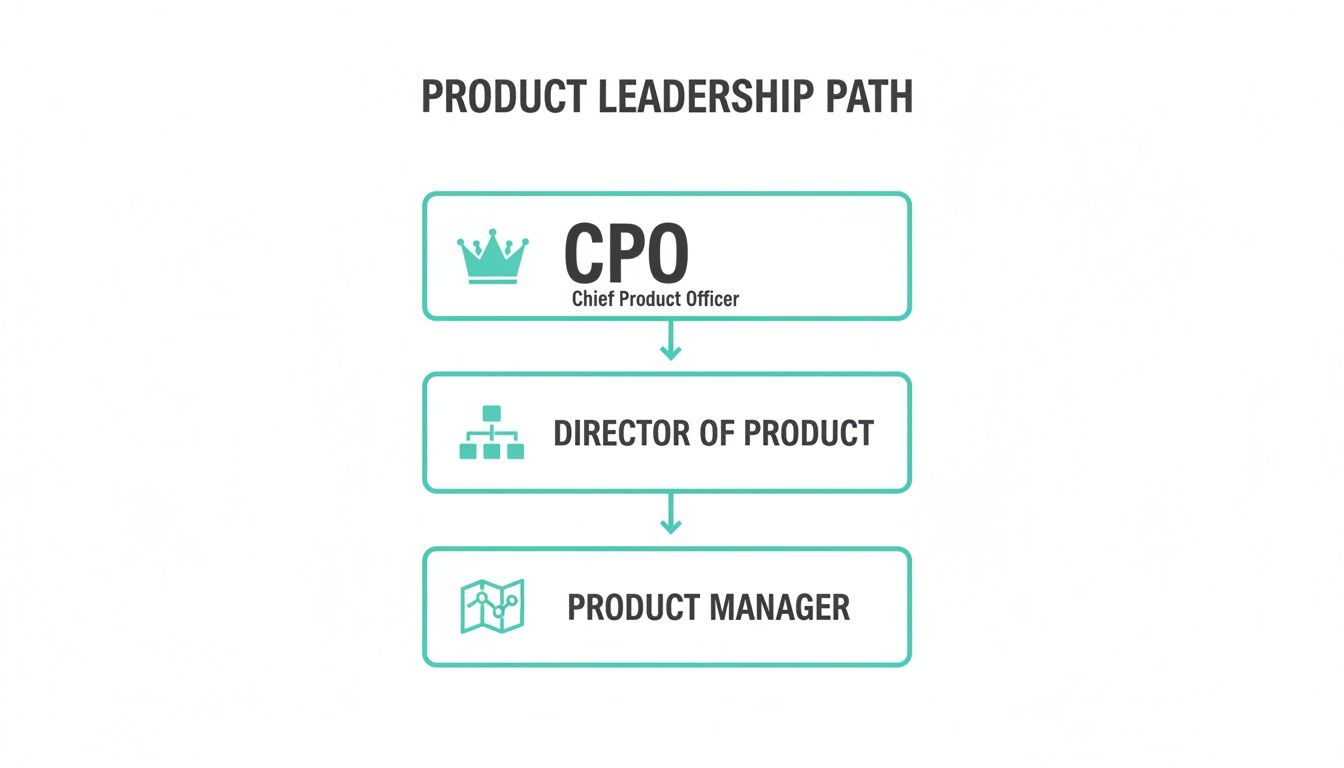
Each step up requires a real shift in mindset. You'll move from pure tactical execution to strategic vision, leading teams, and ultimately, driving business outcomes.
To get a clearer picture of this progression, here's a quick breakdown of what to expect at each stage.
This table provides a high-level overview, but remember that timelines can vary wildly, especially depending on the company environment you're in.
While this career ladder exists in many companies, startups offer a unique environment for accelerated growth. The fast-paced, high-ownership nature of a startup forces product managers to develop a wide range of skills very quickly. You often end up wearing multiple hats.
A startup PM is often part-strategist, part-marketer, part-designer, and part-analyst. This forced versatility is an incredible catalyst for career development, pushing you to master the entire product lifecycle faster than you would in a more structured environment.
This kind of setting is perfect for ambitious people who want to make a tangible impact and climb the ladder efficiently. For this very reason, many find that startups are the best career development bootcamp for aspiring product leaders.
Of course, to truly excel and adapt in the long run, you need to think about the bigger picture. Learning how to future-proof your product management career means building the right skills for whatever comes next.
Every product manager's career starts here, on the ground floor, where you learn the craft and start shipping work that matters. This first stage is broken down into two core roles: the Associate Product Manager (APM) and the Product Manager (PM). Think of the APM as the apprentice and the PM as the skilled craftsperson who owns their corner of the product.
In these early days, it’s less about setting a grand vision and more about getting exceptionally good at the fundamentals of execution. Your main job is to learn how to translate what customers need into clear, actionable work for your engineering and design teams.
The Associate Product Manager role is your foot in the door. It’s a true training ground where you work directly under a more seasoned PM, soaking up the skills you'll need to eventually run your own show. Your world revolves around execution and support, taking on well-defined tasks that feed into a bigger product initiative.
Your day-to-day is intensely tactical. You're the one in the trenches, making sure the small—but critical—details are handled perfectly.
What APMs Actually Do:
The heart of the APM role is learning by doing. No one expects you to have all the answers, but they do expect you to ask great questions, stay organized, and absorb feedback like a sponge. It’s all about building a solid foundation of product habits.
A huge part of building that foundation is understanding how to figure out what to build in the first place. This is where learning what is product discovery comes in, ensuring you're solving problems people actually have.
After you’ve put in your time as an apprentice—usually within one to two years—you’ll be ready to step up to the Product Manager role. This is a massive shift in responsibility. You’re not just supporting anymore; you are now the direct owner of a specific product area or a set of features.
You have the autonomy to make the call, and with that comes accountability for the results. Your focus shifts from simply executing tasks to delivering measurable value.
What PMs Actually Do:
To move up from these foundational roles, you need to hit clear, measurable milestones. Think of this as your personal checklist for proving you're ready for the next level.
By hitting these goals, you build the track record and trust required to take on the bigger, more complex challenges that lie ahead in your product manager career path.
Once you've nailed the art of shipping features and owning a piece of the product, the career ladder starts to look a little different. The next climb is all about expanding your influence, shifting from hands-on execution to true strategic leadership. This is the moment you graduate from owning a feature set to shaping a whole product area. Eventually, you'll be managing other PMs yourself.
This is where you stop being just a "feature owner" and start becoming a "product strategist." Your thinking elevates from the how and what to the why. You're no longer just planning the next sprint; you're mapping out multi-quarter roadmaps and tying your team's work directly to the company's bottom line.
Making it to Senior Product Manager (Sr. PM) is a nod to your mastery. You’ve proven you can consistently ship products that matter. Now, you’re handed the keys to more complex, ambiguous, and high-stakes challenges. You get more autonomy, but you’re also expected to lead initiatives that stretch across multiple teams and last for months, not weeks.
The role isn't just about being a better PM; it’s about being a different kind of PM. You become a force multiplier, making everyone around you better.
How the Senior PM Role Evolves:
A Senior PM's true value lies in their ability to connect the dots between day-to-day execution and long-term business vision. They don't just manage a backlog; they shape the strategic direction that creates the backlog in the first place.
The jump to Group Product Manager (GPM) is one of the biggest pivots you'll make in your entire product career. It’s your first official foray into people management. At most startups, this role is a hybrid—you're both a "player" and a "coach."
You'll likely keep owning a critical, complex part of the product yourself while also managing a small team of one to three other PMs. Your success is no longer measured just by what you ship, but by the combined impact of your entire team. This demands a whole new set of skills centered on delegation, coaching, and making tough calls on where to place your bets.
Key Responsibilities of a Group PM:
Moving from an individual contributor to a manager isn't automatic. You have to prove you have leadership chops. Here’s what it typically takes to make that leap.
This evolution is less about learning new software and more about mastering people, strategy, and communication. It’s about learning to amplify your impact by empowering others—setting the stage for the executive-level challenges that lie ahead on the product manager career path.
Climbing into the executive tiers of product management means you’re no longer just managing products—you’re managing the entire product organization. Your focus shifts from executing strategy to becoming a true visionary, shaping the company's future in the market. Success stops being about feature launches and starts being measured by sustainable business growth, market share, and the health of your teams.
This is the top of the ladder. It’s where you become responsible for building the engine that builds the products. The roles of Director, VP of Product, and Chief Product Officer (CPO) are less about the daily tactical grind and all about strategic oversight, leadership, and setting a vision that gets the whole company fired up.
Stepping into a Director of Product role is your formal entry into senior leadership. You’re now officially a "manager of managers," leading a team of Group PMs and Senior PMs. Your main job is to create an environment where they can all do their best work.
This is where you zoom out from a single roadmap to oversee a whole product portfolio. You’re not in the weeds of daily stand-ups anymore. Instead, you’re focused on hiring the right people, setting high-level goals, and making sure your department runs like a well-oiled machine.
What Directors of Product Actually Do:
A Director of Product builds the machine. They are architects of the product organization, focused on process, people, and portfolio strategy. Their goal is to create a scalable system that consistently produces great products and develops future product leaders.
Making it to Vice President (VP) of Product or Chief Product Officer (CPO) puts you at the very top of the product hierarchy. While the titles can sometimes be used interchangeably, the CPO is typically a C-suite executive who reports directly to the CEO. At this point, you’re not just managing the product department—you are a key driver of the entire business strategy.
Your focus shifts almost completely from internal team operations to external forces like market dynamics, financial performance, and long-term competitive positioning. You’ll find yourself spending less time with engineers and a lot more time with the executive team, investors, and the board of directors.
Key Executive Responsibilities:
Compensation at these executive levels reflects this immense responsibility. Director-level roles often see base pay starting in the $125k–$175k range, while VP and CPO positions move well into the mid-six figures—especially when you factor in equity at a successful startup. You can find more insights on product manager compensation at CPOclub.com. Reaching this stage means you’ve successfully navigated the complete product manager career path.
Some of the best product managers I know didn't start their careers in product. They came from adjacent fields like engineering, design, or marketing, bringing a ton of specialized knowledge that became a massive advantage once they learned how to channel it.
Breaking into product is less about starting from scratch and more about reframing the skills you already have. It’s all about learning to speak the language of product: customer problems, business outcomes, and strategic trade-offs. Your background—whether you’re an engineer, designer, or marketer—gives you a unique lens to see product challenges. The goal is to build a solid bridge from what you do now to what a PM does every day.
Engineers often have a pretty smooth transition into product because they’re already fluent in the language of technology. They get what’s possible, can realistically estimate effort, and earn instant credibility with the development team. The biggest challenge is shifting your mindset from how to build something to why it should be built in the first place.
This means developing deep customer empathy and a user-first perspective. It’s about falling in love with the problem, not the solution.
Actionable Tip for Engineers: Volunteer to help your current PM with user interviews. Your goal is to listen, not to solution. Take detailed notes on customer pain points. Afterward, write a one-page summary connecting those pain points to a potential business opportunity. This demonstrates your ability to think strategically about customer needs.
Designers have a natural edge in user empathy and understanding customer journeys. You’re already masters of the user experience, which is the heart and soul of any great product. To make the jump, you just need to zoom out from user flows and wireframes to business metrics and market analysis.
You have to learn to connect your design decisions directly to business impact. This means thinking about things like revenue, user acquisition, and retention.
Actionable Tip for Designers: Take a feature you recently designed and create a full-blown business case for it. Go beyond the UX and include projected impacts on key business metrics like conversion rates or daily active users. For example, "By simplifying the checkout flow from 5 steps to 3, we project a 10% increase in completed purchases."
Marketers are experts at understanding the market, positioning a product, and telling a compelling story. Your knowledge of go-to-market strategies, competitive landscapes, and customer segmentation is pure gold. The pivot to product involves moving "upstream"—from promoting the finished product to defining what that product should be in the first place.
This requires translating all those market insights into a concrete product strategy and a clear roadmap.
Actionable Tip for Marketers: Dive into customer feedback and market data to pinpoint an unmet need. Develop a detailed product brief for a new feature that fills this gap. Be sure to include target personas, core value propositions, and a high-level roadmap to show you can turn go-to-market knowledge into real product direction.
Building a portfolio with these practical, real-world examples is your ticket in. As you get ready to make the move, it helps to know where to look for that first role. You can check out the top product manager job boards to find curated opportunities at growing startups that value your unique background.
Getting your next product role comes down to one simple thing: can you prove you think like a PM when the pressure is on? The interview, especially at a startup, is built to test your product sense, strategic mind, and your bias for action. It’s less about reciting frameworks and much more about showing a genuine obsession with users.
Your real goal is to connect the dots between a user’s problem and a business outcome. Startups don't just need someone to manage a backlog; they’re looking for a business owner who can drive growth from the ground up.
Most PM interviews circle back to a few core types of questions. Getting good at them isn't about memorizing answers, but about building a reliable mental model to tackle whatever they throw at you. Let's break down two of the big ones.
Knowing how to structure your responses is half the battle. For a much deeper dive with detailed frameworks and examples, check out our guide on common product manager interview questions.
If you're an aspiring PM or switching careers, a portfolio is your golden ticket. It's your chance to make your product thinking tangible and prove you can do the job before you even have it.
Your portfolio should tell a story. It’s not just a collection of projects; it's a demonstration of how you identify problems, analyze opportunities, and conceptualize solutions. Focus on showing your thought process, not just the final result.
Here are a couple of practical portfolio projects that always get a startup hiring manager’s attention:
It typically takes somewhere between three to six years to go from an entry-level PM to a Senior Product Manager. But that timeline isn’t set in stone—far from it.
Working at a high-growth startup is often the fastest way to accelerate that journey. The sheer level of ownership and breakneck pace force you to learn and show your impact much faster than you might in a larger, more structured company. An actionable insight here is to proactively take on complex, ambiguous projects that no one else wants. Solving those tough problems is a shortcut to demonstrating senior-level capabilities.
Nope. A technical degree is definitely not a hard requirement to become a product manager. While a computer science background can be a leg up, especially for deeply technical products, it's not the only way in.
Many of the best PMs I know come from backgrounds like design, marketing, and even the liberal arts. What truly matters are the core PM skills: deep customer empathy, sharp communication, and a strong business acumen. In a startup, your knack for understanding user problems and getting the team aligned is almost always more valuable than your ability to read code.
The best PMs are defined by their curiosity and problem-solving skills, not by their diploma. Domain expertise and the ability to rally a team around a shared vision will always outweigh a specific degree.
The biggest difference really boils down to two things: scope and autonomy.
A startup PM often owns a massive surface area of the product. You’re a generalist, doing a bit of everything from user research and wireframing to writing marketing copy. The autonomy is immense, but you’re also operating with way fewer resources and a lot less structure.
On the other hand, a corporate PM usually has a much narrower focus, maybe owning a single feature within a huge, established product. The role is more specialized, and you're supported by dedicated teams for research, data, and marketing. You’ll have less autonomy, but you get the benefit of established processes and a ton of resources at your disposal.