You got the offer. The team likes your background, the product is interesting, and the compensation finally makes the move feel real. Then the recruiter asks a question that decides whether the whole thing happens: what's your current work authorization, and what visa path would you need?
That's the point where many engineering hires slow down. Not because the company has changed its mind, and not because the candidate suddenly looks weaker, but because immigration strategy becomes part of the hiring decision. A strong offer can still fall apart if the visa path is wrong for the timing, the employer, or your profile.
A useful engineer's guide to US visas has to do more than define acronyms. It has to answer the question hiring managers and candidates both care about: which path is realistic, how long can you wait, and what evidence will move your case from possible to viable?
A startup offer often arrives with speed. The interviews move quickly, the founder wants you to start soon, and everyone talks as if the hard part is over. For international engineers, that's usually when the hard part begins.
The visa question isn't a side issue. It shapes where you apply, how you negotiate, and whether you should optimize for a startup, a multinational, a university lab, or a company with a mature immigration process. If you ignore it until the offer stage, you lose your advantage.

The broader market explains why this matters. In 2021, foreign-born workers made up 19% of the entire US STEM workforce, representing 7,023,900 people, according to Duke Career Hub's guide for engineers considering global destinations. International talent isn't an edge case in US tech. It's part of the operating model.
Engineers usually approach hiring as a skills problem. Can you build the thing, lead the team, ship the roadmap, or scale the system? Immigration adds a second filter. Can this company hire you in a way that works on your timeline and theirs?
That changes practical choices:
Strong candidates lose offers when they treat immigration as paperwork instead of strategy.
There's also a documentation angle that candidates underestimate. Offer letters, contractor agreements, IP assignment language, and advisory arrangements can become part of the paper trail around your work history and responsibilities. If you need a fast way to organize that side of the process, a tool like this AI contract generator can help you draft clean documents before legal review, especially when you're juggling multiple roles or startup relationships.
Most engineers don't need every possible visa explained. They need a decision framework. If you're a new grad, your path won't look like a senior machine learning engineer with published research. If you're joining a multinational, the answer may be different from a seed-stage startup making its first international hire.
That's where the rest of the guide should focus. Not on the alphabet soup, but on what works, what tends to stall, and where your probability is highest.
An engineer can be fully qualified for the job and still have three very different immigration paths depending on one detail: where they studied, who employs them now, and how much evidence they can document. That is why visa strategy starts with profile fit, not with whichever category gets mentioned most in recruiting calls.
For engineers, the options that matter most in practice are F-1/OPT, H-1B, O-1A, L-1, and TN. Each one suits a different hiring situation. If you are actively searching, it helps to target employers already set up for sponsorship and international hiring, especially on job boards that filter for visa sponsorship roles.
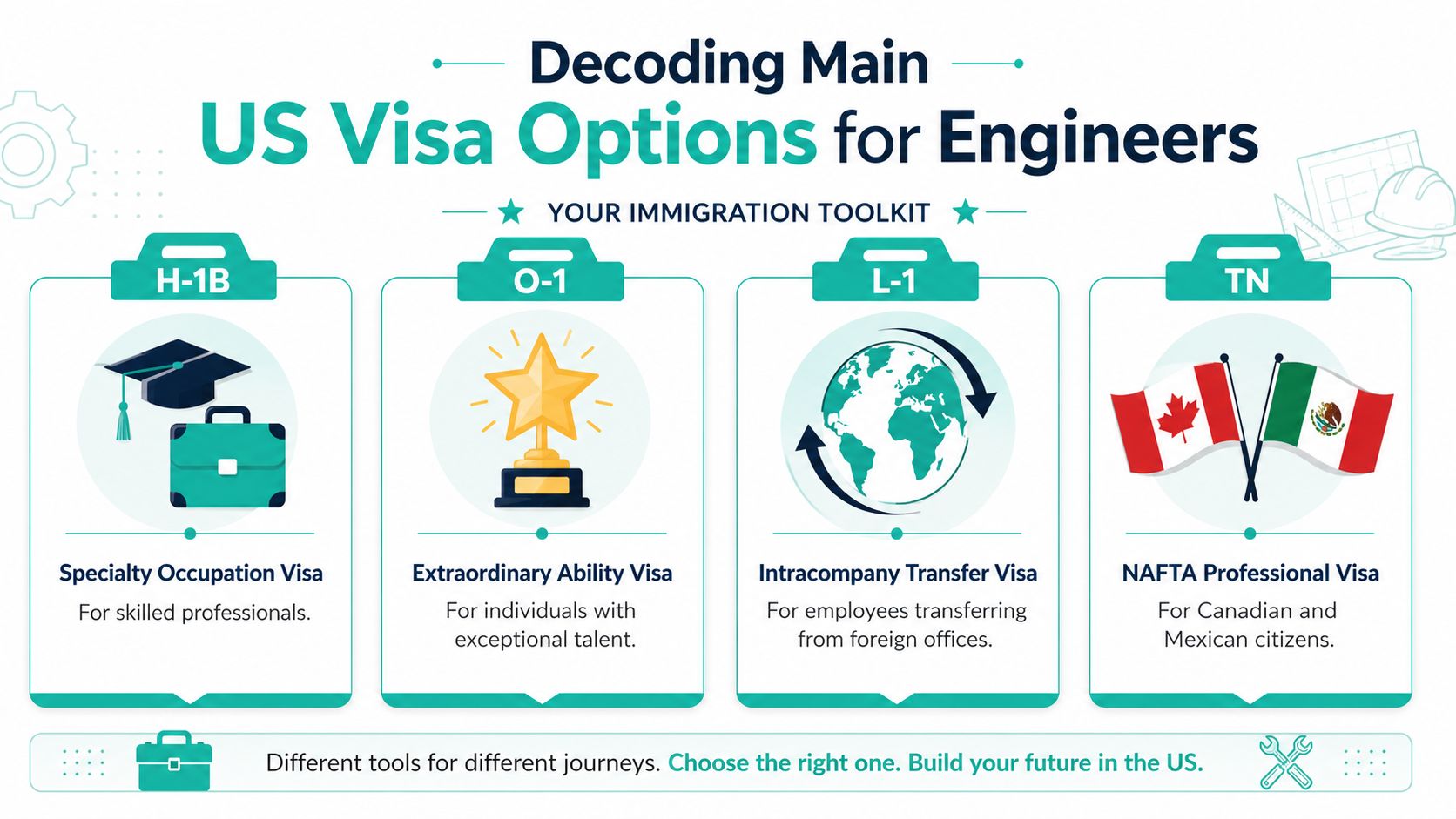
F-1 and OPT are usually the first workable path for US-educated engineers. For a new grad, this is often the cleanest way to start employment quickly while keeping longer-term options open.
H-1B is still the standard employer-sponsored route for many software and infrastructure roles. It works best when the role clearly requires specialized knowledge tied to your degree and the employer can tolerate timing risk. The problem is not usually eligibility on paper. The problem is that many candidates treat H-1B as the plan, when in reality it is only one possible plan and often a probability play.
O-1A fits a narrower profile, but it is more relevant to engineers than many assume. There is no annual cap and no lottery. The trade-off is evidence quality. You need a record that can be documented through awards, publications, judging, major contributions, press, high compensation, or similar proof. For engineers trying to assess whether their background is strong enough, Tukki's O-1A guide for software engineers gives a useful breakdown of how technical candidates are typically evaluated.
L-1 is less about outside prestige and more about company structure. If you work for a multinational and have the right employment history abroad, this can be one of the more practical routes for a mid-career engineer or engineering manager transferring into a US team.
TN is one of the cleanest options available, but only for Canadian and Mexican citizens in qualifying professions. For engineers, that distinction matters. “Software engineer” can fit where “programmer” may not, so role wording and credentials have to match carefully.
| Visa Category | Primary Use Case | Annual Cap/Lottery? | Key Requirement |
|---|---|---|---|
| F-1 / OPT | US student moving from school to work | Not discussed here as a lottery path | Must hold qualifying student status and work within the rules of that status |
| H-1B | Employer-sponsored specialty occupation role | Yes, cap-subject cases face the annual cap and lottery | Relevant degree and employer sponsorship for a specialty occupation |
| O-1A | Engineer with a strong record of distinction | No annual cap, no lottery | Evidence of extraordinary ability, typically meeting at least 3 of 8 criteria |
| L-1 | Transfer from foreign office to US affiliate | No lottery described here | At least one continuous year with a qualifying foreign affiliate in the preceding three years |
| TN | Canadian or Mexican professional in an eligible occupation | No lottery described here | Citizenship plus fit with a listed TN profession and applicable credentials |
The useful question is not which visa sounds strongest. It is which one matches your profile and your timing.
A practical way to map this is by career stage. A US master's student usually starts with F-1/OPT and then evaluates H-1B, cap-exempt roles, or in rare cases O-1A. A mid-career engineer at a multinational should examine L-1 early, before assuming H-1B is the default. A founder or highly visible staff-level engineer may have a better shot with O-1A than with a lottery-based path.
The biggest mistake I see is overrating title and underrating paper trail. “Senior engineer” is not a visa strategy. Neither is “worked at a top company.” Officers and lawyers assess documented facts, not brand aura.
The second mistake is treating all engineer profiles as interchangeable. A new grad with strong internships, a machine learning researcher with publications, and a startup founder with press and patents may all be excellent hires. They should not be pursuing the same immigration path.
Good visa planning is a matching exercise. Choose the route that fits your evidence, your timeline, and the employer type in front of you.
From the company side, sponsorship is a hiring commitment with legal process attached. That doesn't make it bad. It just means employers think about visas through risk, timing, and internal capacity.
A founder may say, “We sponsor.” What you need to know is whether they've done it before, whether counsel is already in place, and whether they understand what happens if the first-choice route doesn't work.

For most engineering roles, sponsorship isn't just filing one form. It means the employer has to support the role definition, the worker's eligibility, and the timeline. If the path is H-1B, the company also has to live with cap risk. If the path is O-1, the company and lawyer need a coherent evidentiary strategy. If the path is green-card based later, the process may continue for years.
Startups feel this differently from larger companies. A mature tech company may have in-house recruiters, outside immigration counsel, and a repeatable process. An early-stage startup may have none of that. It can still hire internationally, but execution quality varies a lot.
For multinational companies, the L-1 is often the cleanest operational tool when H-1B uncertainty is a problem. It requires the engineer to have worked for a foreign affiliate for at least one continuous year and can be a strong internal-transfer route when timing matters, as explained in Underdog's engineer visa guide.
That matters because companies don't only evaluate candidate quality. They evaluate predictability. A multinational with offices in more than one country can sometimes design around uncertainty in ways a startup can't.
If a company can hire you abroad first and transfer you later through a qualifying structure, that may be more realistic than waiting on a cap-subject process.
These questions tell you quickly whether an employer knows what it's doing:
Candidates looking for companies that already discuss sponsorship openly can save time by using places where that filter is explicit, such as this guide on finding jobs with visa sponsorship.
What stalls deals most often isn't hostility. It's vagueness.
A recruiter says the company is “open to sponsorship,” but nobody has checked with finance, legal, or the hiring manager. A founder assumes any lawyer can “just file something.” A candidate waits until final rounds to disclose constraints that should have shaped the process from the start.
Those situations are fixable only if both sides get specific early.
A visa strategy should match your actual profile, not the strongest category on paper.
I've seen engineers lose months pursuing a path that was technically available but poorly matched to their timing, evidence, or employer situation. The better question is simpler. Given where you are now, which route gives you the best mix of approval odds, speed, and future flexibility?
A new graduate usually needs two things at once. Immediate work authorization and a platform to build a stronger record.
If you're finishing a US degree, the practical play is usually to start with the student-to-work route available to you, join an employer that already hires international graduates, and use that first role to build credibility. The first job matters beyond salary or brand. It shapes what evidence you can collect for later filings, who can write informed recommendation letters, and whether you stay employed while a longer process runs.
For this profile, the biggest strategic mistake is forcing an O-1 case too early. Good grades, internships, and strong technical ability are useful, but they rarely carry an O-1 filing by themselves. If your record does not yet include visible recognition, third-party validation, or work with clear significance outside one employer, spend the next couple of years building that record on purpose.
This is the profile I see most often. Strong engineer, solid projects, good references, maybe some leadership, but limited public evidence.
That usually calls for a probability-first approach. If an employer is ready to sponsor and the role clearly requires your degree background, H-1B may be worth pursuing despite the timing risk. If you already work at a multinational, an L-1 transfer can be more predictable because it avoids the annual cap process. O-1 can still be viable, but only when the file shows more than internal praise and a strong performance review.
The primary trade-off here is visibility. Many mid-career engineers have done impressive work that is hard to document in a way immigration officers can evaluate. Building a core service used by millions may help your career enormously, but for an O-1 case you still need evidence that outsiders can verify, such as conference speaking, published technical writing, cited work, judging, media coverage, or letters that explain why the contribution mattered beyond your team.
Strong engineering work and strong immigration evidence overlap less than candidates expect.
This profile starts to shift the strategy. If you have publications, invited talks, peer review, patents with real adoption, media coverage, or a reputation others in your field can independently confirm, merit-based options deserve serious attention earlier.
For these engineers, O-1 and sometimes EB-2 NIW can be worth prioritizing because the case turns on evidence quality rather than an employer's willingness to enter a lottery or manage a long sponsorship process. The burden is still high. The work has to be framed clearly, documented carefully, and supported by people with enough standing to make the record credible.
Engineers in this group should organize evidence around three questions:
If those answers are strong, your visa strategy changes materially.
Startup profiles are uneven, which makes them interesting and difficult.
A founder may have product traction, fundraising, press, accelerators, conference appearances, open-source influence, or a critical technical role in a company people in the market recognize. Any of that can help. None of it carries the case alone. Immigration filings still depend on evidence that can be checked, contextualized, and tied to your specific contribution.
For founder and early startup candidates, O-1 often becomes realistic only after the story is separated from the hype. Officers care less about how exciting the startup sounds and more about what can be proven. Press mentions, third-party awards, speaking invitations, expert letters, and evidence that a product or technical system had broader impact tend to matter more than internal titles.
Timing matters here too. A founder with six months of momentum usually has a weaker case than a founder with two years of visible traction, even if the underlying talent is the same.
Management experience helps in some cases, but title inflation is common and immigration officers know it.
Managers have a better chance when leadership can be tied to outcomes that are concrete and externally understandable. Running a team that shipped a critical platform migration, built infrastructure used across a large product line, or led a function inside a recognized multinational is more useful than generic claims about coaching or delivery. The challenge is that many management achievements live in org charts and internal documents, which are harder to turn into persuasive evidence.
Employer structure often drives the answer for this profile. A manager inside a multinational may have a cleaner transfer route. A manager with a visible public reputation may have an O-1 angle. A manager with sustained influence in an important technical domain may want to start green card planning earlier, because that record can often be developed more deliberately than candidates realize.
A strong visa plan answers two different questions. First, how do you start work legally and on time? Second, how do you avoid getting stuck three years later with limited options, a filing deadline, and too much dependence on one employer?
That second question separates a decent plan from a smart one.
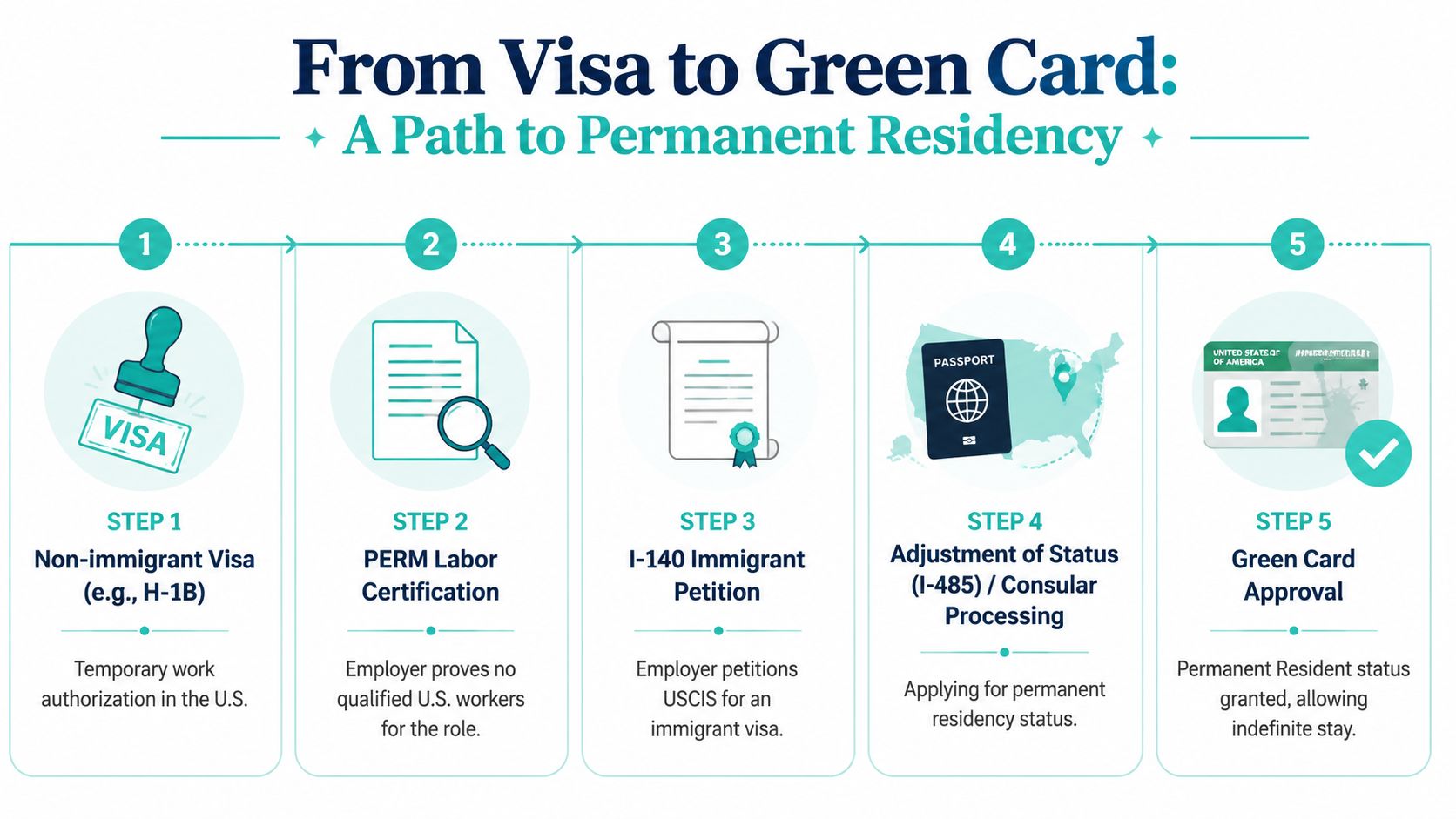
For engineers, long-term planning usually comes down to how much control you want over the process, how portable you need your career to be, and how much evidence you can build outside a single employer's internal records.
The main green card paths for engineers tend to fall into three buckets:
Each path creates different constraints. An employer-sponsored route can work well at a stable company with good immigration counsel and predictable headcount planning. It is less attractive if you expect to switch jobs soon, join an early-stage startup, or work at a company that treats immigration as an exception instead of a hiring capability.
The engineers who have the easiest time later usually start collecting proof long before anyone says "green card." They keep a record of what they built, who used it, why it mattered, and what independent signals show the work had real significance.
This matters a lot for candidates who may eventually qualify for merit-based filings such as EB-2 National Interest Waiver, and in some cases for people whose earlier O-1 work helps create a stronger long-term record.
A new grad usually does not have enough public evidence yet, so the practical move is often to secure work authorization first and build a stronger file over time. A mid-career engineer at a recognizable company may already have enough material to start planning seriously. A founder or technical leader may have a higher ceiling on a merit-based case, but only if the record includes traction that exists outside pitch decks and internal claims.
Engineers often do strong work and leave almost no usable paper trail. By the time they want permanent residence, the evidence is scattered across old laptops, expired company accounts, and half-remembered product launches.
Keep a working file with items like:
A future case is often won or lost on documentation quality, not just raw talent.
The practical mistake is treating the temporary visa as one project and permanent residence as a separate project for later. For many engineers, those decisions should be made together.
A candidate deciding whether to accept a role at a large company or a startup should weigh more than compensation and title. Team stability, prior sponsorship history, access to strong counsel, and the employer's willingness to start green card work early all affect the actual value of the offer. This is one of the less obvious factors to review before you accept a job offer.
The right answer depends on profile and timing risk. If you need immediate work authorization with the highest chance of approval, one path may be best even if it gives you less flexibility later. If you already have a strong evidence record, it can make sense to choose a role that helps you keep building an independent case instead of tying everything to one employer.
Engineers in research, infrastructure, healthcare, energy, semiconductors, telecom, and other fields with clear public significance often have an easier time framing long-term impact. Engineers in less visible product roles can still build strong cases, but they usually need to be more deliberate about documenting outcomes and external recognition.
Visa conversations go badly when they happen too late, too vaguely, or too emotionally. You don't need to sound defensive. You do need to sound prepared.
A recruiter or hiring manager should come away thinking two things: you understand your own situation, and you won't create avoidable chaos.
Have your materials ready before the process gets serious.
You don't need to unload your full immigration history in minute three. But you do need to answer clearly when asked.
Good answers are brief and operational. For example: you're currently working under student status and will need employer sponsorship for the next step, or you're employed abroad by the same group and may be eligible for an internal transfer route.
Bad answers are fuzzy. “I think I can probably find a way” makes employers nervous because it sounds like no one has mapped the path.
Use questions that reveal process maturity, not just intent.
If you're close to an offer, it also helps to read practical advice on how to accept a job offer so you don't separate the immigration conversation from the rest of the negotiation.
Don't assume anything that matters.
The strongest negotiation posture is calm specificity.
A few moves consistently hurt candidates:
A visa process is easier when both sides know the constraints early and treat them as part of hiring, not as an awkward add-on after the offer is signed.
A strong offer can still fall apart if the visa path is weak, too slow, or built on assumptions. Engineers who handle this well treat immigration as part of career strategy early, not as paperwork after they sign.
The practical advantage is not memorizing visa terms. It is knowing which path fits your profile, how much timing risk it carries, and which employers are equipped to follow through. A new grad usually needs to optimize for companies with repeatable sponsorship processes. A mid-career engineer may have more than one workable path, but each comes with different trade-offs in speed, cost, and approval risk. A founder or highly visible specialist should assess whether a merit-based route is realistic instead of assuming the H-1B lottery is the only route worth pursuing.
That is the essence of visa literacy. It helps you make better bets.
Strong candidates also build options over time. They keep clean records of projects, promotions, publications, patents, and scope of impact because those details often matter later. They choose roles with an eye on what the next petition or green card case may require, not just what gets them into the US fastest.
Companies benefit from the same clarity. Startups often want to hire international engineers, but many teams misjudge the cost, timing, or internal coordination involved. This guide on hiring visa candidates as a startup gives founders and hiring managers a more realistic picture of what sponsorship requires.
The best outcome is not perfect certainty. It is a plan with a primary path, a backup path, and a clear view of what could block both. Engineers who approach visas this way keep more control over where they work, when they move, and how they build toward permanent status.
If you're exploring startup roles and want a clearer view of companies that actively hire technical talent, Underdog.io is one way to get introduced to vetted startups and high-growth tech firms through a single application.